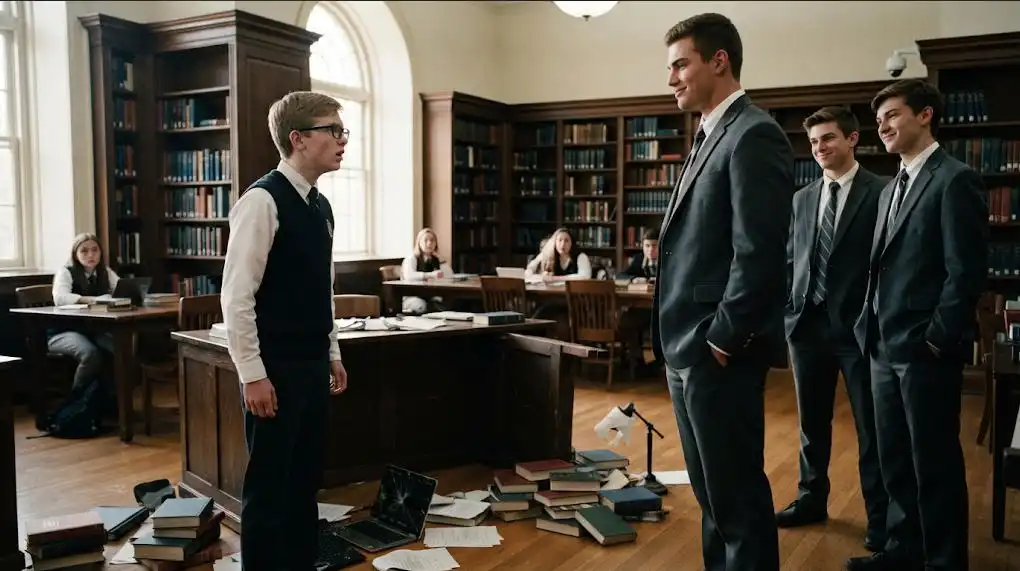
I held his gaze for three agonizing seconds. Then, with deliberate, meticulous handwriting, I wrote his name, the time, and the infraction into the duty log.
I closed the book, turned on my heel, and walked back to my desk. I logged into the library’s administrative portal and formally submitted the incident report. I assumed the administration would bury it, as they always did, but my conscience was clean. I had done my job.
I was profoundly naive to think it would end there.
Twenty minutes later, the ambient hum of the reading room was shattered by the sharp, aggressive sound of hard-soled loafers striking the marble floor.
I was deep in my essay, my fingers flying across the cracked keyboard of my Dell laptop, completely absorbed in a citation regarding due process. I didn’t look up until a shadow fell across my screen.
Grant Whitmore was standing directly in front of my heavy oak desk. Hayes and Barrett flanked him like secret service agents, their faces flushed with adrenaline.
The surrounding tables went dead silent. Fifty students stopped breathing.
“You really think you’re important, don’t you?” Grant said, his voice echoing off the vaulted ceilings.
I took my hands off the keyboard. “I’m working, Grant. Leave me alone.”
He placed his palms flat on the surface of my desk, leaning his weight onto it. He looked at the stacks of library books I had meticulously bookmarked. He looked at my handwritten notes. And then, his eyes locked onto my battered laptop.
“You think you can write me up?” Grant snarled, the mask of the casual, cool billionaire heir completely slipping to reveal the violent, spoiled child beneath. “You think rules apply to me?”
I pushed my chair back, preparing to stand up. “Grant, step away from the desk.”
His face twisted into a mask of pure, unadulterated rage.
He didn’t hit me. He did something infinitely more destructive.
Grant gripped the thick, protruding edge of the two-hundred-pound Victorian oak table with both hands. He planted his feet, engaged his shoulders, and with a violent, explosive surge of athletic strength, he heaved upward.
The entire desk vaulted into the air.
Physics seemed to operate in slow motion. I threw myself backward as the massive piece of furniture flipped vertically. A tidal wave of textbooks, pens, and loose paper launched into the air.
My laptop slid off the polished wood. I reached for it, my fingers brushing the plastic casing, but I was too late.
It struck the marble floor corner-first. The sickening, sharp crack of the motherboard snapping echoed like a gunshot. The screen spider-webbed into a thousand jagged shards of dead pixels. The heavy oak desk slammed down on top of it with a deafening crash, pinning the crushed machine against the stone.
The silence that followed was absolute. It was a suffocating, terrifying vacuum.
I lay on my back on the cold marble, my heart hammering against my ribs like a trapped bird. I looked at the wreckage. My laptop. The machine that held the Langdon Fellowship essay. The machine that held my college applications. The machine I had saved for two summers to afford, completely, irreversibly annihilated.
Grant stood over the wreckage, his chest heaving, his fists clenched. He looked down at me, a sadistic, victorious smile spreading across his face.
“Maybe now,” Grant spat, his voice ringing through the paralyzed library, “you’ll learn to mind your own business.”
He turned and walked out of the reading room. Hayes and Barrett hurried after him, looking slightly terrified by the sheer violence of what had just occurred.
Nobody moved. Nobody breathed.
A sophomore girl at the next table slowly lowered her textbook, her eyes wide with horror. A senior boy stood up and looked nervously toward the grand entrance, as if waiting for an adult to materialize and restore order.
I didn’t scream. I didn’t cry. I felt a white-hot, blinding fury course through my veins, urging me to chase Grant down the hallway and tear him apart with my bare hands. But the cold, rational, legal mind I had been cultivating took absolute control. If I laid a finger on him, I would be expelled for assault before the sun set. The Whitmore family lawyers would see to it.
I took a deep, shuddering breath and pulled myself up from the floor.
I looked at the crushed laptop. And then, slowly, I tilted my head upward.
Mounted high on the plaster molding above the reading room, shrouded in a dark glass dome, was a panoramic security camera.
I didn’t touch the desk. I didn’t touch the computer. I turned to the girl sitting at the adjacent table. She was staring at me, trembling slightly.
“Watch this,” I told her, my voice eerily calm. “Don’t let anyone touch the evidence.”
I walked directly to the head librarian’s office. Ms. Albright was a stern, brilliant woman in her sixties who had always viewed me with quiet approval. When I pushed open her frosted-glass door, she took one look at my pale face and stood up.
“Ethan? What’s wrong?”
“I need you to initiate a formal digital preservation hold on the main reading room’s security camera feed,” I said, my voice clipped and professional. “From 3:15 PM to 3:45 PM. I need the raw file downloaded to a secure server immediately.”
“Ethan, what happened?”
“Grant Whitmore just destroyed my workstation.”
Ms. Albright’s face hardened. She didn’t waste time asking for details. She understood the gravity of the name Whitmore. She immediately sat at her terminal and locked the footage under an administrative firewall, burning a copy to a physical encrypted flash drive.
Then, she followed me out to the reading room.
When she saw the overturned Victorian desk and the shattered remains of my laptop, she let out a sharp gasp. The students in the room began speaking all at once, a chaotic chorus of witnesses.
“He flipped the whole table!” “He was screaming at Ethan!” “It was completely unprovoked!”





