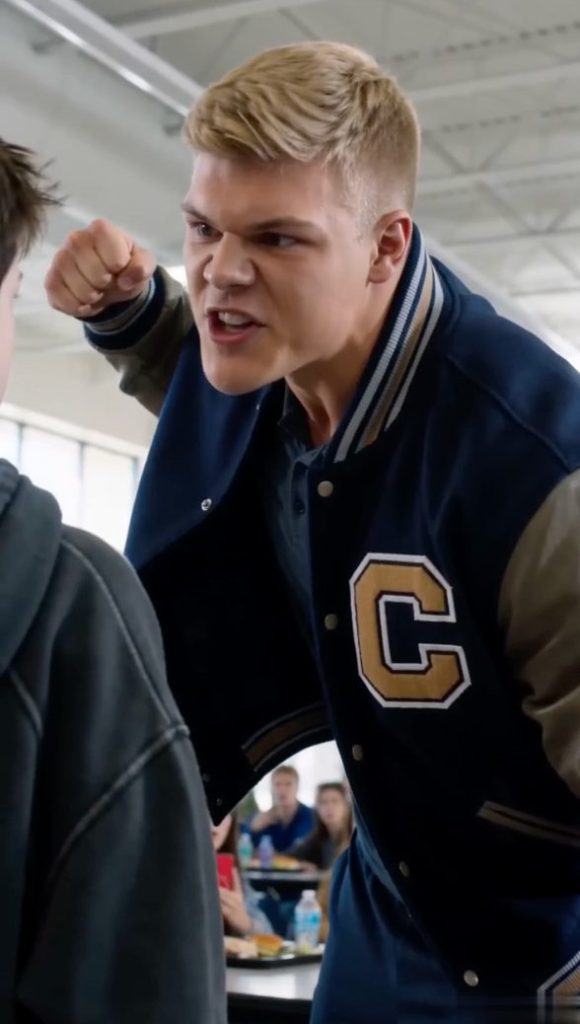
“Hit him again!
The teacher won’t do anything!”
The shout came from somewhere behind the crowd, sharp enough to cut through the noise of the school cafeteria.
Nearly thirty students had their phones raised, recording the tall football player gripping the front of my black hoodie while I stood trapped between him and a row of heavy lunch tables.
A few people laughed, others watched in uncomfortable silence, and the history teacher standing near the vending machines deliberately lowered his eyes to the clipboard in his hands.
Nobody moved to help me.
The boy holding my hoodie was six feet two inches tall, broad-shouldered, and strong enough to make most people think twice before disagreeing with him.
His name was Brody, and everyone at our school knew exactly who he was.
He played linebacker on the football team, came from one of the wealthiest families in town, and carried himself with the confidence of someone who had never seriously considered that rules might apply to him.
He was smiling now, his fingers twisted into the worn fabric around my collar.
He wanted me frightened.
More than that, he wanted everyone watching to see that I was frightened.
The students gathering around us weren’t simply witnesses to another ugly cafeteria confrontation.
To Brody, they were an audience, and I was supposed to play the part of a helpless kid who finally broke under the weight of three months of humiliation.
But my left hand remained open.
I kept my fingers relaxed, my palm loose, and my breathing controlled despite the pressure against my throat.
There was a reason for that.
It was something I had learned long before I met Brody, long before I entered that school, and long before anyone started calling me the quiet kid from the trailer park.
To understand why I refused to make a fist that afternoon, you would have to understand what those three months had been like.
You would also have to understand the promise I had made when I was six years old.
I lived near the railroad tracks, in a trailer park separated from the better neighborhoods by several miles of worn pavement and a difference in money that seemed even greater than the physical distance.
The homes there were small, the gravel roads were uneven, and the sound of passing freight trains was so familiar that most nights I barely noticed it.
My place wasn’t the kind of home anyone at school would have considered impressive.
There were no polished stone countertops, no spacious driveway, and certainly no garage filled with expensive cars.
When rain struck the roof, it made a hollow rattling sound, and when the wind blew hard enough, I could feel the thin walls shiver.
But it was home.
I had learned early to take care of the things I owned because replacing them wasn’t always possible.
Shoes lasted until their soles became too thin.
School supplies were used until there was almost nothing left to use.
Clothes were washed carefully, folded neatly, and worn again because there was no good reason to throw something away simply because it was old.

That was how my black hoodie became the one thing almost everyone at school associated with me.
It had faded around the shoulders, the sleeves were beginning to fray, and one pocket had a small repaired tear near the seam.
The fabric wasn’t particularly warm anymore, but it fit comfortably, and I liked having somewhere to put my hands when I walked through crowded hallways.
I wore it nearly every day.
Before Brody noticed me, I never imagined that an ordinary piece of clothing could become something people used to measure another person’s worth.
At school, expensive clothes were practically a language.
Students recognized the brands on one another’s shoes, compared phones, discussed which families were buying new cars, and seemed to know exactly how much someone’s jacket had cost without ever asking.
I didn’t speak that language.
Most mornings, I arrived with my backpack hanging from one shoulder and walked straight toward my first class.
I was never particularly interested in being popular, and I didn’t spend much time worrying about what other students thought of me.
I wanted to finish school, get through the day without unnecessary trouble, and return home with enough peace of mind to focus on the things that mattered.
For a while, that seemed possible.
Then Brody decided I was worth noticing.
The first time he said anything about my hoodie, we were standing near a bank of lockers between classes.
The hallway was crowded, and students were moving around us in both directions.
I had stopped to adjust a loose strap on my backpack when I heard someone laugh behind me.
“Hey, does that thing ever get washed?”
I turned my head.
Brody was standing with two of his friends, looking directly at my sweatshirt.
He had one hand hooked through the strap of an expensive athletic bag and wore the easy grin of someone who already expected the people around him to laugh.
One of his friends made a show of stepping backward.
“Careful,” he said.
“That thing might be older than the school.”
They laughed.
I looked down at the hoodie for a moment, then finished adjusting my backpack.
“It gets washed,” I answered.
I said it quietly, without anger or embarrassment, because it was true.
For some reason, that seemed to irritate Brody more than any angry response would have.
He tilted his head and studied me.
“That’s all you’ve got?”
I didn’t understand what else he expected me to say.
He had made a joke.
His friends had laughed.
I had answered his question.
There didn’t seem to be anything more worth discussing.
So I walked away.
As I moved through the hallway, I heard one of his friends say something about trailer parks, followed by another burst of laughter.





