Someone paying attention to the whole situation could see who had blocked the exits, who had grabbed another student’s clothing, and who had tried to avoid a fight.
I didn’t know why that thought kept returning to me.
At the time, it seemed like another lesson in observation.
Later, in the cafeteria, I would realize how important it was.
By the beginning of the third month, Brody had almost stopped pretending that his behavior was harmless.
His comments were more direct.
His friends were bolder.
And whenever he approached me, I could see him looking for some new way to produce a reaction.
He had already made fun of my clothes.
He had already mocked where I lived.
He had already turned photographs of me into jokes for the school group chat.
He had already cornered me behind the gym.
But none of it had given him the moment he wanted most.
He had never seen me completely lose control.
That seemed to bother him more than anything.
On the morning of the cafeteria incident, I woke to the familiar sound of a freight train moving beyond the trailer park.
The sky outside was pale, and the air carried the ordinary coolness of an early school morning.
I pulled on my jeans, found my black hoodie where I had left it, and checked the sleeves before putting it on.
The repaired tear near the pocket was still holding.
I smoothed the fabric with my palm.
There was nothing remarkable about the morning.
Nothing about the sound of the train, the worn floor, or the familiar walk toward school suggested that the day would end differently from any other.
I remember that because afterward, I found myself thinking about how ordinary everything had seemed.
Sometimes the moments that change the way you understand yourself begin without any warning.
At school, the first few classes passed quietly.
I listened, took notes, and tried to concentrate on what the teachers were saying.
During one lesson, a group of students behind me whispered about something on a phone, but I kept my eyes on my notebook.
I didn’t know whether they were talking about me.
I didn’t want to know.
For once, I was determined not to spend the entire day anticipating Brody.
Between classes, I passed a group of his teammates near the lockers.
One of them looked at my hoodie and grinned, but nobody stopped me.
I continued toward the next room.
For a moment, I allowed myself to believe that perhaps the day would be uneventful.
By lunchtime, that hope had begun to feel reasonable.
The cafeteria was crowded, as usual.
Students moved between tables carrying trays, chairs scraped against the floor, and several conversations competed with the noise of dishes and the steady hum of the vending machines.
Sunlight entered through the large windows, making bright patches across the floor.
I paused just inside the entrance and looked toward the tables.
Brody was sitting with his friends near the center of the room.
I noticed him immediately.
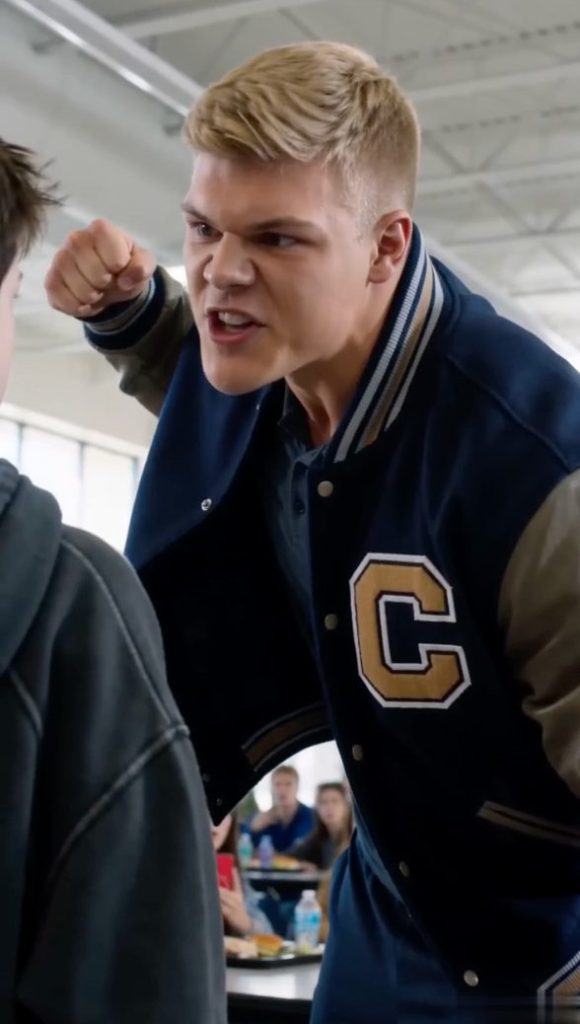
He was wearing an expensive jacket over his shirt, and his athletic build made him easy to recognize even among the other football players.
Several students were gathered around his table, laughing at something one of his friends had said.
I looked away.
There was no reason to assume he would bother me that afternoon.
I collected my lunch and chose a route that would take me toward an open seat away from the center tables.
For a while, nothing happened.
I sat down, placed my tray in front of me, and began eating.
The relief was small but real.
I could hear the usual cafeteria noise, but nobody was speaking to me.
Nobody had asked about my hoodie or made a joke about my neighborhood.
I let my shoulders relax.
Then I heard laughter from Brody’s table.
I didn’t look up.
The laughter continued.
A moment later, one of his friends spoke loudly enough for several nearby tables to hear.
“Hey, look who’s hiding over there.”
My fork stopped moving.
I recognized the tone before I recognized the words.
Another voice answered.
“Think he knows we can see him?”
I stared at my tray.
There was still a chance they would lose interest.
Brody said something I couldn’t hear, and the others laughed again.
I lifted my fork.
Then his voice carried across the room.
“Hey, hoodie!”
I closed my eyes for a fraction of a second.
I could have pretended not to hear him.
I could have finished my lunch and left.
But I already knew how that usually worked.
If he wanted my attention badly enough, he would keep calling until other students began looking.
I turned my head.
Brody was standing.
His friends were watching me with expectant smiles.
He motioned toward himself with two fingers.
“Come here.”
I remained seated.
“What do you want?”
The question was calm.
That appeared to disappoint him.
He looked around at his friends.
“Listen to this guy.
Like he’s too busy to talk.”
One of them laughed.
I glanced toward the cafeteria doors.
There were still students moving in and out, but the space between my table and the exits was beginning to fill.
Brody took a few steps toward me.
“Come on.
I just want to ask you something.”
I didn’t believe him.
But I also didn’t want to create a scene by standing up and rushing away.
“What is it?”
He stopped near the end of my table.
His eyes moved toward my hoodie.
Then he smiled.
“Seriously, man.
How many days in a row have you worn that thing?”
A few students nearby laughed.
I looked at him.
“I don’t count.”
He spread his hands.
“That’s obvious.”
More laughter.
I took a slow breath.
I had heard variations of the same insult so many times that the words themselves no longer surprised me.
What bothered me was the determination behind them.
Brody wasn’t asking about my clothes.





