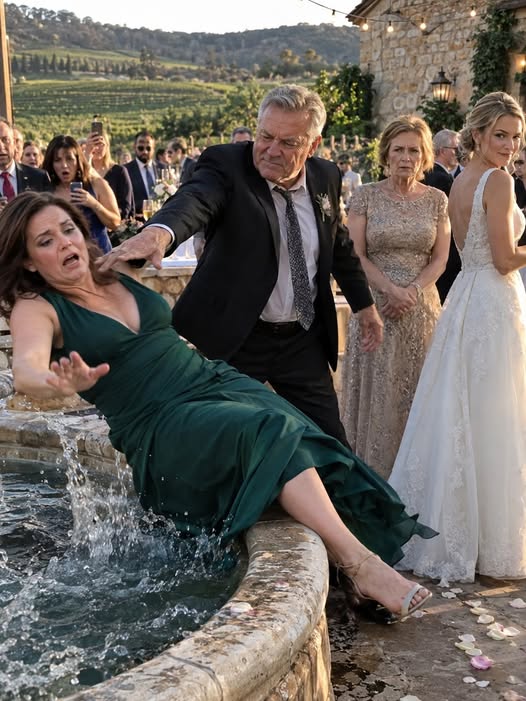
The tires of the black Cadillac Escalade crunched over the river-washed gravel, the sound cutting through the vineyard courtyard like a dry branch snapping underfoot.
Silence did not fall all at once; it rippled outward in waves. First the cousins standing by the brass beverage bins lowered their glasses. Then Aunt Melissa stopped laughing at whatever uncle she had cornered beside the arbor. Finally, the string quartet, which had been gamely sawing through pop covers from the terrace above, tapered off into an awkward, discordant squeak as their bows hovered in the humid late-summer air.
I stood beside the boxwood hedges, my green silk slip dress drenched and heavy, sticking to my ribs like an icy second skin. Water still dripped from the ends of my chestnut hair, tracing cold trails down the nape of my neck and pooling between my shoulder blades. The rose petals from the fountain floor were glued to my shins and forearms, bruised pink against pale skin.
Behind me, my father, Gerald, gave a short, grating bark of laughter. He took a long swallow from his highball glass, his knuckles red, his shirt collar unfastened to reveal a throat mottled with scotch and self-satisfaction.
“Look at that,” Gerald said, his voice loud enough to carry across fifty feet of manicured lawn. He gestured toward the idling SUV with his glass, ice cubes clinking like little brass bells. “The princess’s Uber has arrived. Go on, Waverly. Don’t keep the meter running. Wouldn’t want you wasting whatever’s left of your alimony on waiting fees.”
My mother, Eleanor, reached out and touched Gerald’s sleeve—not to restrain him, but in that familiar, placating rhythm she had perfected over forty years. It was the gesture of someone trying to adjust the volume on a radio rather than turn it off.
“Gerald, hush,” she whispered, her eyes darting frantically toward Trevor’s parents, the Caldwells, who were standing by the wine press looking as though someone had just dragged a dead raccoon onto their linen tablecloths. “Let her go quietly. The photographers are bringing Brianna out for the lantern lighting.”
Across the lawn, Brianna stood under the cedar pergola. Her cathedral veil was pinned securely to her updo, her hand gripped tightly around Trevor’s forearm. She wouldn’t meet my eyes. She was staring fixedly at the hem of her four-thousand-dollar gown, checking for splashed water, calculating the exact degree to which my humiliation had detracted from her aesthetic. Trevor, to his credit, looked thoroughly sickened, his jaw set in a rigid line as he glared at my father. But Trevor was twenty-eight, new to our family’s peculiar brand of bloodsport, and still believed that silence was the most polite way to navigate madness.
The passenger door of the Escalade did not open.
Instead, the rear door swung outward on oiled hinges, clicking softly into the evening quiet.
A man stepped down onto the gravel.
He was tall—easily six foot three—with the broad, disciplined shoulders of someone who had spent his twenties rowing for Dartmouth and his thirties running international infrastructure funds. His suit was bespoke charcoal wool, sharp enough to cut paper, paired with a white shirt unbuttoned at the throat and no tie. Silver flecked his dark hair at the temples, cut short and neat.
He didn’t look at the fairy lights. He didn’t look at the ninety-odd guests gaping at him from beneath the floral chandeliers. He didn’t look at the five-tier buttercream cake or the antique wine barrels.
His slate-grey eyes locked directly onto me.
The air in Julian Vance’s chest seemed to leave him all at once. I saw the slight flinch in his jaw—the microscopic betrayals of composure that only someone who had spent four years working eighteen-hour days across a mahogany conference table from him would ever recognize.
His eyes traveled down my soaked dress, down to the trembling of my knees, down to my bare feet where I had kicked off my ruined heels in the grass.
He didn’t hurry. Julian Vance never hurried. But the distance between the driveway and the hedges evaporated under his long, deliberate strides.
Gerald chuckled, turning to Arthur Caldwell, Trevor’s father. Arthur was the chairman of Caldwell Commercial, the regional development giant that owned half the retail frontage in the tri-county area.
“Must be the firm’s junior associate,” Gerald muttered, loudly enough for the surrounding tables to hear. He puffed his chest out, tugging down the vest of his rented tuxedo. “Waverly always surrounds herself with boys she thinks she can boss around. Probably called him to come play knight in shining armor after she made a fool of herself in the pool.”
Arthur Caldwell didn’t answer.
Arthur’s champagne flute had frozen halfway to his mouth. The older man’s face had drained of color so completely that his heavy jowls looked like uncooked dough.
“Gerald,” Arthur croaked, his voice cracking like dry parchment. “Who… who did you say that was?”
“Nobody,” Gerald scoffed, waving a hand dismissively as he took another step toward me, eager to get the last word in before I vanished into the dark. “Some project manager from her office. She runs that boutique architectural consultancy in the city—thinks she’s a big shot because they remodel hotel lobbies. Hey! Pal! You’re trespassing on a private reception!”
Julian did not even turn his head toward Gerald’s voice.
He reached me. The scent of him arrived first—cedarwood, rain, and the faint, bitter edge of black espresso. Without a word, without asking for permission, Julian slipped his charcoal jacket off his shoulders. The silk lining was warm from his body as he draped it over my trembling frame.
It was massive on me. The hem fell past my hips; the sleeves swallowed my hands. The heat trapped inside the wool hit my frozen skin like a hearth fire, and against my will, a jagged shudder ran through my diaphragm.





