The winding mountain road leading toward the high country felt like a decompression chamber, stripping away the manicured artifice of the valley below. Through the tinted glass of the Escalade, the dense pine forests loomed like dark sentinels against a twilight sky bleeding into bruise-colored indigo. The air outside was sharp and alpine-cold, but within the leather-lined sanctuary of the vehicle, the dual-zone climate control and the steady hum of the seat heater kept the chill at bay.
I stared down at my phone where my mother’s name continued to pulse in silent, frantic desperation against the glass.
MOM.
For twenty-eight years, that word had been a command. It was a frequency I had been conditioned to answer on the first ring, a Pavlovian trigger designed to pull me back into line whenever I dared to forge an identity separate from the family’s carefully curated social ledger. Every career choice, every milestone, every apartment lease, and every relationship had been weighed, measured, and found wanting against Brianna’s effortless, golden-child perfection. Even my architecture firm—a business I had built from the ground up through sixty-hour workweeks and sheer architectural grit—had been treated by my parents as a quirky little hobby, something to keep me occupied until a suitable merger could be arranged.
Without a word, I turned the phone face down against my thigh.
Julian noticed the movement. He didn’t ask if I was okay; Julian knew better than to offer platitudes when a wound was still bleeding. Instead, he reached into the small compartment between the seats, retrieved a sterile package of antiseptic wipes and a clean microfiber cloth, and handed them to me.
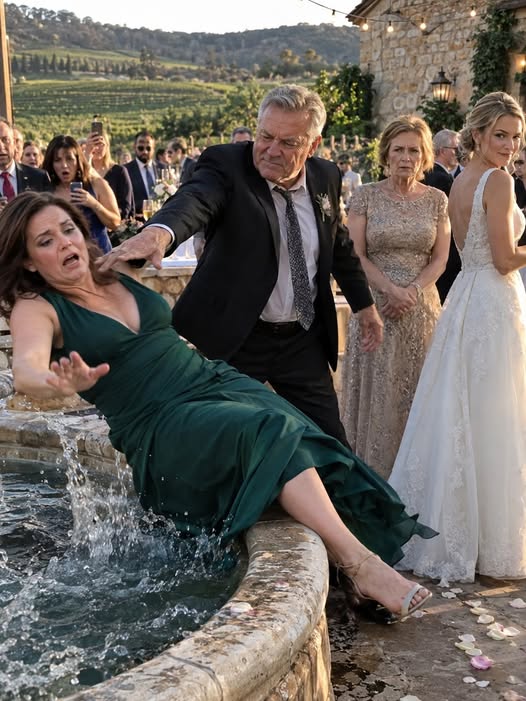
“Your hands,” he said quietly. “You scraped your knuckle on the fountain stone when you fell.”
I looked down. A small, ragged crescent of skin on my right knuckle was oozing a thin line of blood, mixed with a smear of green slime from the boxwood hedge. The adrenaline crash was setting in, leaving my hands trembling with a sudden, uncontrollable fine-motor twitch.
“I didn’t fall,” I corrected, my voice barely audible over the purr of the engine. “My father didn’t just shove me. He wanted me out of the photographs. Brianna had spent three hours making sure the courtyard layout matched her Pinterest board. My wet dress ruined her symmetry.”
Julian’s jaw tightened. He didn’t look at me, but I saw the muscles in his forearm flex beneath the fine wool of his shirtsleeve as he curled his hand into a fist.
“They are done,” Julian said. It wasn’t an empty promise or a comforting lie. It was a strategic assessment, delivered with the absolute finality of an executive liquidating a toxic subsidiary. “By nine o’clock tomorrow morning, Caldwell Commercial will be facing a catastrophic liquidity crisis. Arthur’s primary lenders have already been quietly flagged by our risk management division for overleveraged commercial retail exposure in the valley. When we pull the mezzanine financing for the Eastport project, the remaining equity partners will trigger the default clauses within forty-eight hours.”
I looked at him, the weight of his words settling over me like lead. “You’ve been planning this.”
“Not this specifically,” Julian admitted, his slate-grey eyes shifting to meet mine. “I didn’t know your father was a violent drunk who would physically assault you at a public reception. But I knew Caldwell Commercial was overextended. I knew Arthur Caldwell had been using his son’s wedding as a backchannel to lobby regional investors while hiding a thirty-percent vacancy rate in his primary strip mall portfolio. I had the dossier on my desk in Chicago yesterday morning. I was simply waiting for the right moment to execute.”
“And buying fifty-one percent of the Vance-Caldwell Joint Venture?” I asked, a faint, humorless smile touching my lips. “Was that in the dossier too?”
“That,” Julian said, a ghost of a smile warming his lips for a fraction of a second, “was an impulsive acquisition. Expensive, but entirely worth the markup.”
Marcus, the former Marine driving the Escalade, took a sharp curve in the mountain pass without losing a single mile per hour of momentum. The vehicle handled the switchbacks with effortless authority, a rolling fortress of steel and glass ascending into the mist.
The lake house was not a sprawling, ostentatious monument to wealth like the Caldwell vineyard. Tucked away on a granite shelf overlooking Lake Tahoe’s glassy, pine-fringed waters, the structure was a masterpiece of mid-century modern architecture—slate, glass, and dark cedar beams cantilevered dramatically over the rocky shoreline. It was a place designed for isolation, for deep thinking, and for rebuilding fractured things out of raw materials.
When Marcus cut the engine, the sudden silence of the mountain was absolute, broken only by the gentle lapping of dark water against the wooden docks far below.
Julian stepped out first, circling the vehicle to open my door. He offered his hand—large, warm, and steady. I took it, sliding out from beneath the cashmere blanket and stepping onto the cool, damp flagstone of the driveway. The mountain air rushed into my lungs, crisp and smelling of pine resin and old earth. I was still wearing the ruined green silk slip dress, now stained with mud, fountain water, and dried blood, but wrapped in Julian’s massive charcoal coat, I felt less like a victim of a public spectacle and more like an exile returning to a fortress.
“Marcus,” Julian instructed without turning around. “Have the dry-cleaning service in Reno dispatch a courier for the clothes in the back. And secure the perimeter. I don’t want any local reporters or uninvited family members tracking us up this high.”
“Already on it, Mr. Vance,” Marcus replied, his voice flat and efficient as he returned to the driver’s seat. The SUV reversed smoothly down the private drive, its taillights bleeding into the redwoods until the mountain swallowed them whole.
Julian guided me up the low slate steps and unlocked the heavy front door.





