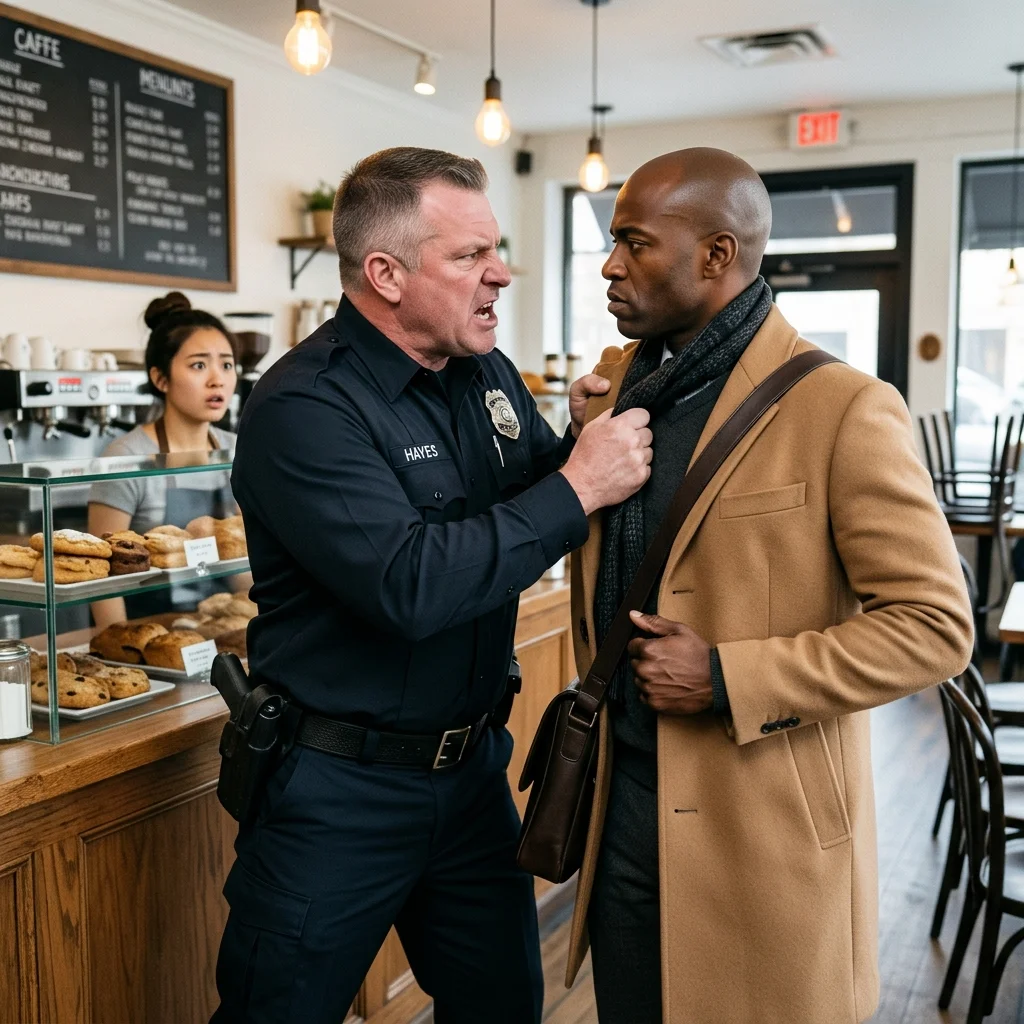
The frost on the front window of the Linden Street Coffee House looked like shattered glass, catching the pale gray glare of a November morning before the sun had cleared the tenement roofs. Inside, the air smelled of dark roast, browned butter, and the faint, metallic tang of the old radiator clanking near the door. Warm amber light from the hanging diner bulbs pooled over the small checkered floor tiles, fighting back the cold blue daylight pressing in from the avenue.
Marcus Vance sat on a chrome-rimmed stool near the end of the counter, his posture upright and unhurried. At thirty-eight, he carried himself with the quiet, athletic discipline of a man who still ran five miles along the riverfront before dawn and read municipal statutes the way other men read box scores. His clean-shaven head caught the soft glow of the overhead fixtures, and his dark, focused eyes moved slowly across the open ledger resting beside his ceramic mug. He had not taken off his tailored camel wool overcoat; its wide lapels framed a dark charcoal crew-neck knit sweater and a dark patterned silk scarf tucked neatly at his throat. Slung across his torso, resting against his hip, was a rich dark-brown leather messenger bag fastened with dull brass buckles.
He had been sworn into the City Council exactly eleven days ago. His official portrait had not yet been framed for the precinct hallways, and his transition office at City Hall still smelled of wet paint and cardboard boxes. That anonymity was deliberate. On Friday, as the newly appointed Chair of the District Public Safety Committee, Marcus was scheduled to cast the deciding vote on a forty-two-million-dollar supplemental appropriation for the Fifth Precinct. Before he signed off on a single dime of taxpayer money, he wanted to sit in the Fifth District at seven in the morning and see how the neighborhood breathed when nobody thought City Hall was watching.
Behind the curved glass pastry display, a young woman in her early twenties was arranging rows of blueberry muffins and flaky croissants with silver tongs. Her black hair was pulled back into a neat bun, and her brown crew-neck café T-shirt looked a size too large on her narrow shoulders. Every few seconds, her gaze flicked past the commercial chrome espresso machine and the row of glass syrup bottles toward the frosted street outside.
Marcus watched the slight tremor in her wrist as she set a croissant onto the waxed paper. Beside the brass cash register sat a rubber-banded stack of pale pink slips—municipal code citations, the kind issued for blocked fire lanes, improper signage, or loitering violations. Three of them were dated within the past ten days.
“Quiet Tuesday,” Marcus said softly, his voice a calm, resonant baritone that barely rose above the low hum of the pastry refrigerator.
The barista startled slightly, the tongs clicking against the glass shelf. She offered a polite, guarded smile that didn’t reach her eyes. “People are mostly grabbing and going this week. Too cold to sit.”
“You’ve got a stack of chairs over there that says it’s been quiet longer than a week,” Marcus observed gently, nodding toward a neat column of red leather diner chairs stacked against the back wall beneath a chalkboard menu written in pastel chalk. House Roast, Cinnamon Roll, Egg & Cheese on Brioche.
Her fingers lingered on the handle of the tongs. “My father says it’s just the season. Things slow down before Thanksgiving.”
“Your father in the back?”
“Prepping the grill,” she said. She glanced toward the swinging kitchen door, then back at Marcus. Something in his stillness—the way he listened without leaning in, the quiet authority in the set of his shoulders—seemed to disarm her for half a second. “Can I top off your coffee, sir?”
“Please. Thank you.” Marcus slid his mug forward. As she poured from the glass carafe, he looked down at the pink slips beside the register. “The city’s been busy on this block. Fire lane?”
The carafe tilted a fraction too far, and dark coffee sloshed over the rim of the mug, pooling on the saucer. “Oh—I’m sorry,” she whispered, grabbing a stack of paper napkins. “I’ll get you a clean one.”
“Leave it. It’s fine.” Marcus reached out, resting two fingers lightly near the saucer to steady her. “Maya, right? Your name was on the business permit by the door.”
She froze, her eyes widening slightly. “Yes. Maya Chen.”
“You don’t have to answer if you’d rather not,” Marcus said, keeping his tone even and unhurried. “I noticed three businesses on this stretch got hit with nuisance citations in the last fortnight. All of them between six and eight in the morning. All of them signed by the same patrol unit.”
Maya swallowed. She looked past him toward the front window, then toward the corner booth near the stacked red chairs, where a teenage boy in a faded gray hoodie sat hunched over a textbook and a paper cup, earbuds tucked into his ears. The boy didn’t look up; his thumb scrolled lazily across the screen of his phone.
“My brother, Leo,” Maya murmured, wiping the counter in tight, nervous circles. “He’s supposed to be studying for a chemistry midterm before first period. He only comes in early because—” She stopped herself, biting the inside of her cheek.
“Because your father shouldn’t be alone when the morning patrol stops by,” Marcus finished quietly.





