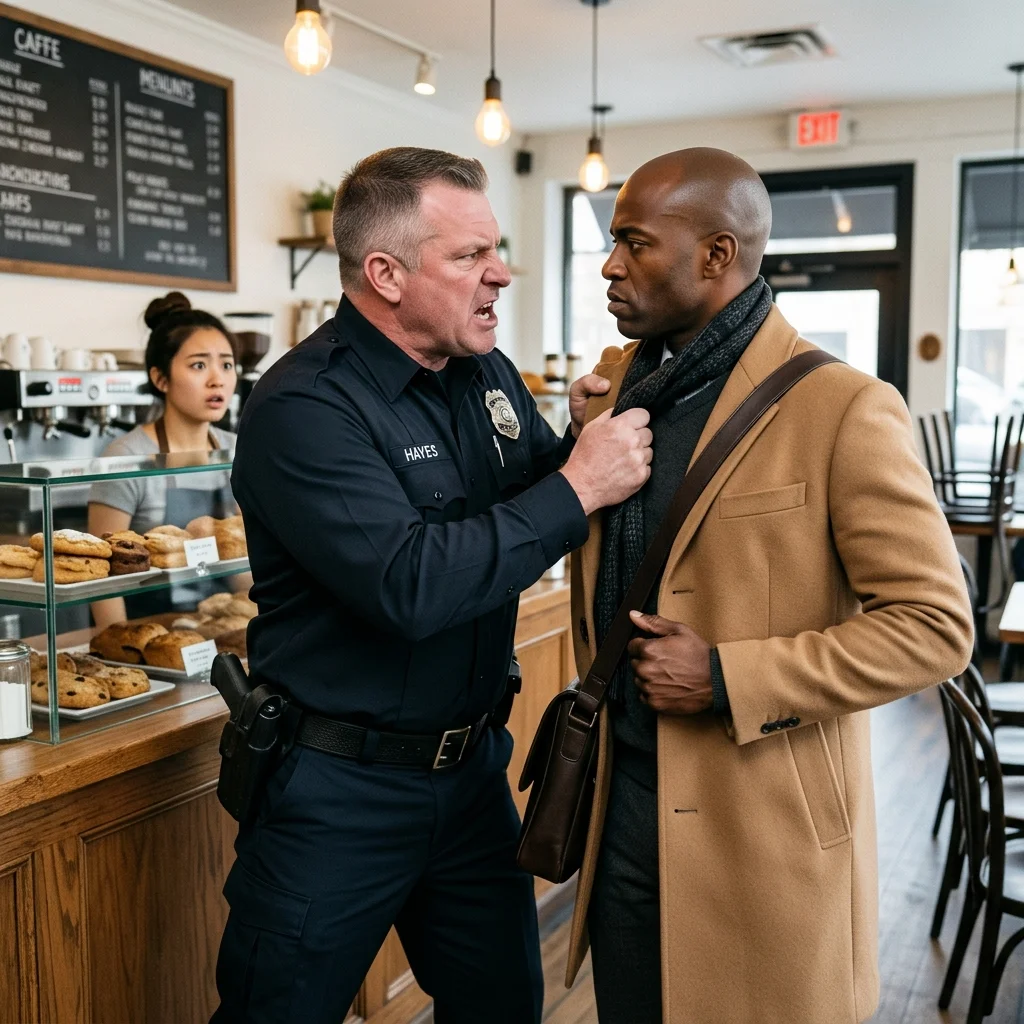
Doyle turned back to Marcus, his expression shifting into practiced, grave concern. “Councilman, if one of my men lost his temper, I’m the first person who wants to get to the bottom of it. Truly. The Fifth District is a high-stress corridor. We’ve had three armed robberies on Linden in the last month. Hayes is a decorated twenty-year officer—a little rough around the edges, maybe, a little quick on the trigger when he thinks a local merchant is in trouble—but he bleeds for this neighborhood.”
“He wasn’t protecting this merchant, Captain,” Marcus said quietly. “He walked in asking for an envelope.”
A microscopic flicker crossed Doyle’s eyes—gone so fast anyone else would have missed it. He glanced casually past Marcus’s shoulder toward Sergeant Briggs and gave the faintest tilt of his chin toward the narrow hallway behind the pastry counter that led to the tiny office and restrooms.
“Briggs,” Doyle said lightly, “make sure we secure the premises and preserve any surveillance equipment from the back office as potential evidence. Standard chain-of-custody protocol.”
“Wait—” Arthur Chen stepped forward, his face flushing. “That’s my office! You don’t have a warrant—”
“Arthur, relax,” Doyle said, his voice dropping into a silky, patronizing purr that carried an unmistakable edge of iron. “If a city councilman is accusing one of my officers of a felony assault in your establishment, that footage is evidence in an active criminal investigation. You wouldn’t want to be charged with obstructing an inquiry, would you? Not with three open municipal code violations sitting right there by your register.”
Arthur stopped dead, his hands clenching into fists against his apron. Beside him, Maya’s eyes filled with tears of pure outrage, but she caught her father’s elbow, holding him back.
Sergeant Briggs didn’t wait for permission. He pushed through the low swinging gate beside the espresso machine and disappeared down the narrow back hallway.
Doyle stepped closer to Marcus, lowering his voice to a confidential murmur, angling his body so his back was to the street. “Let’s be adults here, Councilman. You’re eleven days into your first term. You’ve got a big budget vote on Friday. Right now, I’ve got a body-camera recording of a twenty-year veteran ordering an agitated male to step back after an alleged physical altercation. You’ve got a red mark on your cheek that could have come from anywhere.”
“You’re suggesting I forget your officer hit me,” Marcus said, his voice deceptively mild.
“I’m suggesting we handle a regrettable misunderstanding like professionals,” Doyle replied smoothly. “I’ll pull Hayes off Linden Street for thirty days. Desk duty. Written reprimand in his jacket. In exchange, we don’t turn a bad Tuesday morning into a circus for the evening news. Because if you take this to the press, the Patrolmen’s Benevolent Association is going to release Hayes’s body-cam clip by noon. They’ll frame it as an arrogant rookie politician flexing his title and shoving a beat cop. Your budget audit dies in committee, and your first month in office is spent explaining why you hate the police.”
From the back hallway came the sharp metallic snap of cables being yanked out of sockets. Seconds later, Sergeant Briggs emerged carrying a dusty black rectangular DVR box under his arm, loose coaxial wires dangling from the back like severed nerves.
Briggs set the box on the edge of the counter with a dull thud and looked at Doyle, the faintest smirk tugging at the corner of his mouth. “Funny thing, Captain. Power cord was loose. Hard drive’s cold. Looks like the system wasn’t even recording today.”
Doyle sighed, a masterpiece of theatrical disappointment, and spread his hands. “Shame. Really is. Just your word against a decorated officer, Councilman. And I doubt Arthur here wants to spend the next six months fighting the Health Department in housing court just to play referee between City Hall and the Fifth Precinct.”
The silence in the diner felt heavy enough to crush glass. Outside, through the frosted pane, Hayes stood beside his cruiser, arms crossed over his thick chest, watching through the glass as his Captain worked his magic. Slowly, the color was returning to Hayes’s face.
Marcus looked at the stolen DVR box sitting on the counter. Then he looked at Sergeant Briggs. Then he looked back at Captain Doyle, and for the first time that morning, the faintest, coldest hint of a smile touched the corners of Marcus’s mouth.
“You know what the problem is with running a protection racket for ten years, Captain?” Marcus said softly. “You get sloppy. You stop looking at the people you think don’t matter.”
Doyle’s smile thinned. “Careful, Vance. You’re throwing around words that can get you sued.”
Marcus unfastened the two dull brass buckles on his dark-brown leather messenger bag. He didn’t hurry. He reached inside and drew out a slim, bound packet of spreadsheets, laying them neatly on the wooden counter right beside the dead DVR box.
“Forty-two million dollars,” Marcus said, his voice carrying effortlessly through the quiet room. “That’s what you’re asking my committee to rubber-stamp on Friday. Twelve million of it is earmarked for ‘targeted commercial corridor overtime’ on Linden Street. Only when my office cross-referenced your precinct’s overtime logs with the GPS transponders on your patrol cruisers, we found something fascinating. Half those overtime shifts were billed while the cruisers were parked behind a closed bowling alley on Fourth Avenue. And the other half were spent writing fraudulent code violations to small business owners who refused to hire Apex Shield Security—a shell LLC incorporated in Delaware eighteen months ago by your brother-in-law, Thomas Gallagher.”
Every trace of political warmth vanished from Frank Doyle’s face. The smooth mask cracked, revealing the hard, cornered shark underneath. “Where the hell did you get precinct GPS logs? Those are internal department records—”





