Two one-hundred-dollar bills and a fifty. Two hundred and fifty dollars.
“That covers the linen and the paint, plus a hundred for your time,” Brooke said smoothly. “My dad’s driver can swing around back after sixth period with a moving blanket. You’ll sign the bottom right corner as a private commission to the Lawson Collection, and I’ll have my mom’s assistant email you a release form for the rights.”
Ava stared at the folded bills. The pigment tubes alone—the professional-grade Old Holland oils she had saved for three months of newspaper shifts to buy—had cost nearly one hundred and eighty dollars.
“The rights?” Ava asked, her throat tight.
“For prints. If my mom hosts the regional booster gala this spring, she wants to use the image on the invitations and the charity silent auction program. It’ll say Curated by Brooke Lawson.” Brooke looked at her expectantly, extending a pen with a crystal cap. “You can just initial the transfer here on my planner.”
Ava felt a slow, icy prickle rise along her hairline. It wasn’t just the absurdity of the money. It was the absolute, seamless entitlement—the casual presumption that two hundred and fifty dollars and a smile could purchase three months of grief, late-night prayers, and her mother’s fading breath translated into pigment.
“No,” Ava said.
Brooke’s hand remained extended. The smile on her face froze, calcifying around the edges. “Excuse me?”
“I said no.” Ava gently pushed the bills back toward the edge of the table. “The painting is entered in the Savannah exhibition. It’s the centerpiece of my portfolio for RISD. Even if it weren’t, the copyright isn’t for sale. You can’t buy my work to use as your wallpaper.”
Behind Brooke, Mackenzie stopped scrolling. Chloe shifted uncomfortably, sensing the sudden drop in atmospheric pressure.
“Do you have any idea how ridiculous you sound?” Brooke asked, her voice dropping into a lower, tighter register. “You draw comic strips for a free school paper that people leave in the recycling bins. I’m offering you real money and a line on your resume. You should be thanking me for paying attention to you.”
“I don’t need your charity, Brooke,” Ava said, standing up. She was several inches shorter than the cheer captain, and she felt absurdly small in her oversized, paint-splattered denim smock, but she didn’t look down. “And I don’t need to sell my work. Please take your money.”
Brooke stared at the three bills resting near the palette. For two seconds, her composure slipped, revealing a raw, ugly flash of humiliation. For someone whose social status was reinforced daily by acquiescence, a direct refusal from a girl who wore five-dollar thrifted sneakers was not an inconvenience; it was an insult that demanded correction.
“You’re making a massive mistake, Ava,” Brooke whispered.
She swept the cash off the table with a sharp flick of her wrist, turned on her heel, and walked out. Her friends followed, the heavy door slamming behind them with a shudder that vibrated through the floorboards.
By three-thirty the following afternoon, the art wing had emptied.
The winter gloom had rolled across the high windows early, turning the Atlanta sky into a flat expanse of wet slate. A light drizzle tapped against the exterior glass. Ava spent an hour carefully securing protective cardboard corner-guards onto Where the Light Lands, slipping it into her heavy canvas portfolio case, and zipping the reinforced nylon shut. The strap cut into her right collarbone, but the weight of the canvas against her hip felt solid, real, and undeniable.
She turned off the lights in Room 214 and stepped out into the hallway.
The auxiliary art corridor was one of the oldest sections of the building, flanked on both sides by tall, forest-green metal lockers that dated back to the school’s opening forty years earlier. Because it led only to the kiln room, the photo lab, and an emergency exit facing the rear faculty parking lot, it was dead silent after hours. The yellowed linoleum tiles smelled of floor polish and stale locker sweat.
Ava took three steps toward the central breezeway when she heard the heavy metallic clack of the double doors closing behind her.
She paused, her hand tightening on the nylon strap.
“Walking fast, aren’t you?”
Ava turned.
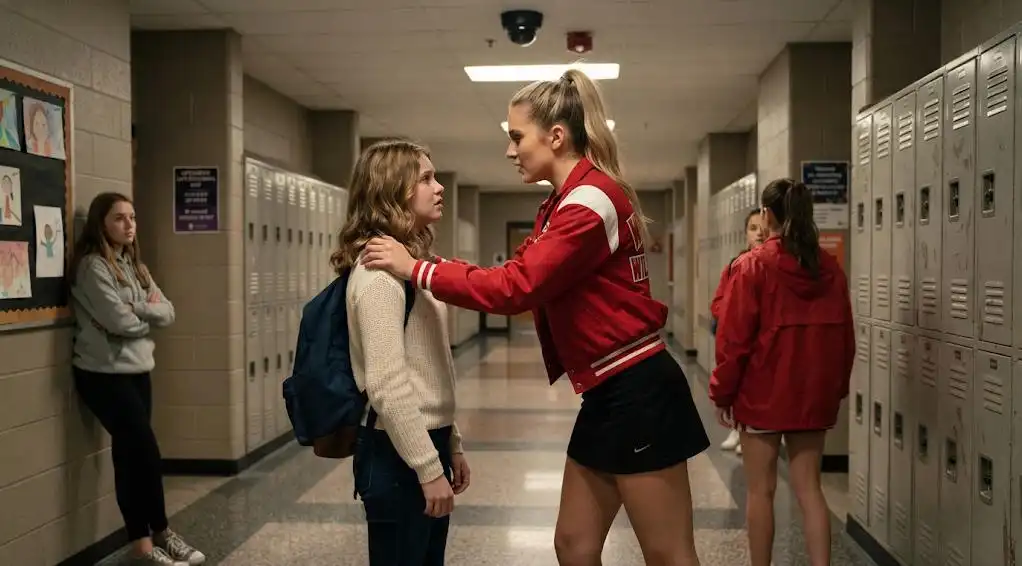
Brooke Lawson stood twenty feet away, flanked by Chloe and Mackenzie. None of them carried backpacks. They had come down the hall with purpose, their sneakers silent against the waxed floor. Brooke’s face was devoid of the bright, socialite cheer she projected in the cafeteria; her jaw was set, her lips pressed into a hard, unforgiving line.
“I have to catch the four o’clock MARTA bus,” Ava said, taking a deliberate step backward. “Let me through.”
“We didn’t finish our conversation from yesterday,” Brooke said, closing the distance between them with slow, measured strides. “My mom asked about the canvas this morning. I told her I’d handle it. I don’t like lying to my parents, Ava.”
“That’s not my problem.”
“It is your problem,” Brooke said, stopping three feet from her. Chloe drifted to the right, leaning casually against a bank of lockers, while Mackenzie stepped to the left, boxing Ava against the wall. “You embarrassed me in front of my friends yesterday. You acted like you were better than me because you know how to smear some oil on cloth.”
“Brooke, I’m leaving,” Ava said. Her heart was beating violently against her ribs, a frantic, bird-like flutter in her throat. She tried to push past Brooke’s right shoulder, aiming for the corridor that led to the main office.
Chloe stepped into her path, crossing her arms.
Ava wheeled around to retreat toward the art room, but Brooke lunged forward. Her manicured fingers clamped down like iron onto the nylon shoulder strap of Ava’s portfolio.
“Give it to me,” Brooke hissed.
“Let go!” Ava yanked backward with all her strength, her sneakers skidding on the linoleum. “Stop it!”





