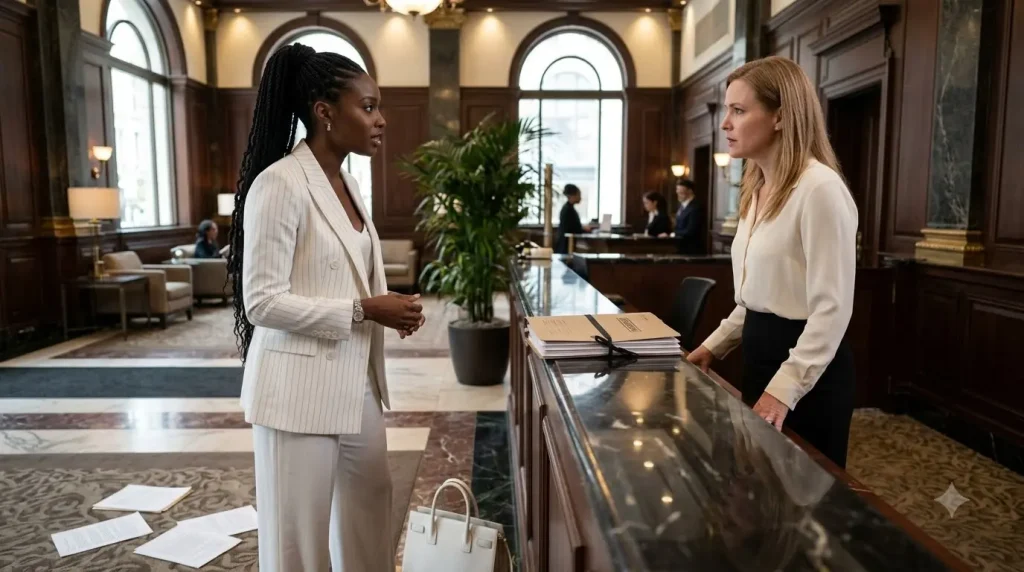
“You can answer.”
The teller swallowed.
“International trust sweeps.”
Imani felt her heartbeat change.
“How large today?”
“I don’t know.”
“Who would?”
The teller looked toward Rebecca.
Rebecca’s face had gone completely white.
Imani stepped closer to the counter.
“Ms. Sloan.”
No answer.
“How large?”
Rebecca whispered:
“I want a lawyer.”
Imani nodded.
“You should have one.”
Then turned toward Margaret.
“Who can see outgoing queued transfers without using a frozen credential?”
Margaret answered:
“Treasury operations.”
“Call them.”
Graham stepped forward.
“Before we cause unnecessary panic—”
Imani turned.
“Panic?”
He stopped.
“You have a court order freezing nineteen accounts and a senior banker saying we’re too late while watching the settlement clock.”
She gestured toward the silent lobby.
“Panic arrived before I did.”
Graham’s face hardened.
“I’m trying to protect this institution.”
Imani looked at him.
“Then help protect the money.”
Margaret called treasury.
Everyone waited.
No one sat.
Thirty-seven seconds.
Then Margaret said:
“Yes.”
Her face changed.
“How much?”
She listened.
Graham closed his eyes.
Margaret whispered:
“Thirty-eight point four.”
Imani stepped closer.
“Million?”
Margaret nodded.
“Destination?”
Another pause.
“Northbridge Legacy Services.”
Imani’s stomach dropped.
There it was.
The name she had been chasing for six months.
“Status?”
Margaret listened.
“Released at 9:59.”
Rebecca shut her eyes.
Imani looked toward Daniel.
“Can it be recalled?”
Margaret asked.
Listened.
“Yes.”
“Window?”
“Seven minutes.”
Imani checked the clock.
10:03.
“Tell them to recall.”
Graham said:
“No.”
Everybody turned.
His voice had been too loud.
Too immediate.
He recovered.
“That transfer may represent legitimate client activity.”
Imani stared.
“How do you know?”
Graham froze.
There.
A tiny mistake.
She stepped toward him.
“I didn’t tell you what kind of transfer it was.”
He said nothing.
“You heard destination.”
“Yes.”
“But not source.”
“No.”
“And you’re already calling it legitimate client activity.”
He straightened.
“I know Northbridge.”
Imani smiled without warmth.
“I know.”
Margaret remained on the phone.
“Do I recall it?”
Graham looked at her.
Imani said:
“The order identifies Northbridge as a restricted destination.”
Daniel opened Schedule B.
He read.
“Confirmed.”
Margaret spoke into the phone.
“Recall immediately.”
Graham’s face tightened.
Nobody missed it.
At 10:05, Sterling Crown attempted to recall $38.4 million.
At 10:06, Northbridge Legacy Services acknowledged the request.
At 10:08, it rejected the recall.
At 10:09, Daniel Cross called the court.
At 10:13, the judge extended the restraint order to Northbridge’s receiving account.
At 10:16, the receiving institution placed the funds on hold.
Thirty-eight million four hundred thousand dollars stopped moving because four people refused to let the clock finish what someone had started.
Imani did not celebrate.
She had learned early in forensic accounting that money stopped in one account usually meant someone had already moved it through three others.
The visible transfer was rarely the beginning.
Sometimes it was not even the middle.
By noon, Sterling Crown’s twenty-ninth floor had become a controlled evidence site.
Outside forensic technicians imaged laptops.
Server logs were preserved.
Personal devices belonging to identified employees were placed under legal hold.
Security disabled Rebecca Sloan’s system access.
Her office door remained open while counsel cataloged files.
No one arrested her.
That seemed to bother her more than handcuffs would have.
She sat inside a small conference room with a bank-provided attorney and stared through the glass at people dismantling the professional life she had built.
Imani passed once.
Rebecca stood.
“Ms. Brooks.”
Imani stopped.
Her attorney immediately said:
“Rebecca.”
“I just want to ask something.”
Imani looked toward counsel.
“If she wants to speak to me, she should do it through you.”
Rebecca’s face tightened.
“I’m asking whether you think I stole thirty-eight million dollars.”
Imani answered:
“No.”
Rebecca blinked.
“You don’t?”
“I don’t think you had thirty-eight million dollars available to steal.”
Rebecca’s attorney closed his eyes.
Imani continued:
“I think somebody used you.”
Rebecca looked furious.
“That is insulting.”
“No.”
“Insulting was what happened downstairs.”
“This is analysis.”
She walked away.
The case had begun with a seventy-nine-year-old retired teacher named Ruth Caldwell.
Ruth did not look like someone whose complaint should have threatened a private bank.
That was part of the problem.
Her husband, Leonard, had spent thirty-four years building a regional medical-supply company.
Not glamorous.
Hospital gloves.
Syringes.
Storage equipment.
Sterile packaging.
He sold it at sixty-five and placed most of their wealth inside a carefully structured family trust.
They were not billionaires.
They were comfortable beyond anything Ruth had imagined growing up in a two-bedroom house with six siblings.
Leonard died eleven years later.
Ruth remained a Sterling Crown client.
For seven years nothing appeared wrong.
Then her granddaughter began graduate school.
Ruth wanted to make a tuition gift.
Her adviser told her liquidity was temporarily restricted because the trust had entered a “legacy optimization cycle.”
Ruth had no idea what that meant.
Neither did her granddaughter.
They asked for documents.
The bank sent eighty-three pages.
Beautiful charts.
Fee disclosures.
Tax language.
Nothing that answered the question.
Ruth called again.
Another adviser told her the trust had entered a pooled strategy approved by Leonard before his death.
Ruth knew Leonard.
He read dishwasher manuals.
He did not approve things without telling her.
She asked for his signature.
The bank produced one.
It looked correct.
Ruth almost stopped asking.
Almost.
Then she noticed the date.
Leonard had supposedly signed the amendment on March 14.
That was the day he had undergone heart surgery in Cleveland.
Ruth had spent fourteen hours beside his bed.
He had been under sedation.
He had signed nothing.
She called Sterling Crown.
They apologized for a “document migration error.”
A corrected copy appeared with a different date.
That frightened her more.
Ruth’s granddaughter knew a lawyer.
The lawyer knew Imani.
Imani first met Ruth at a kitchen table covered in plastic to protect old oak.
Ruth placed two versions of the trust amendment beside each other.
“What do you see?”
Imani asked.
Ruth said:
“Someone thinks old means stupid.”
That was the beginning.
Imani examined seven years of statements.
Fees.
Distributions.
Capital calls.





