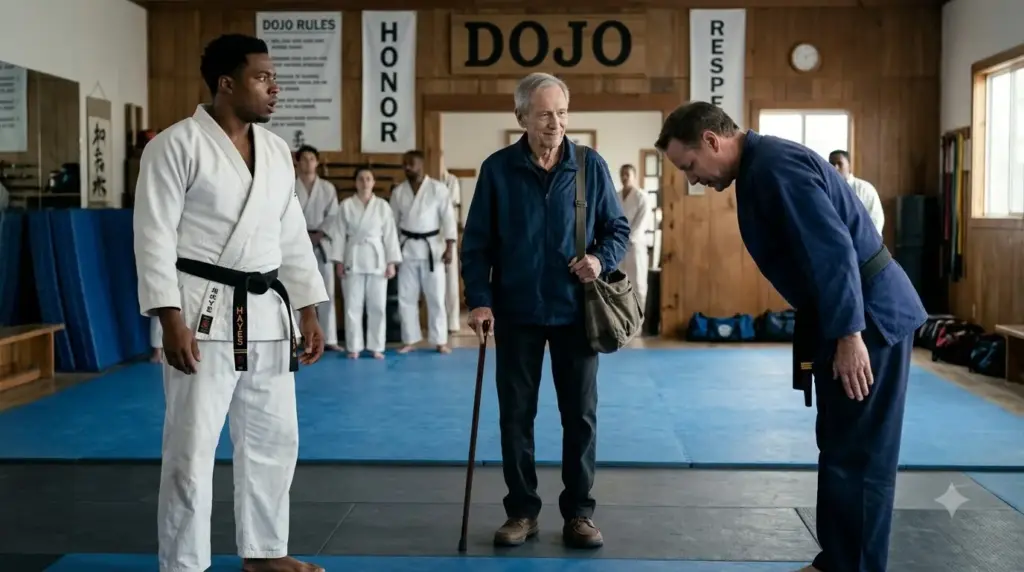
“Why didn’t you?”
“Wrong purpose.”
Daniel smiled slightly.
Sato nodded.
“Good.”
Then he said:
“In competition, use weakness.”
“In training, understand it.”
“Different contract.”
Brandon looked at him.
That phrase stayed too.
Different contract.
Sato continued:
“If we agree competition, you attack hip.”
“If we agree learning, maybe you test, but you do not punish.”
“Your skill is not only what you can do.”
“It is what you choose to do.”
Nobody laughed.
Brandon bowed.
Not because Sato had beaten him.
He had not.
Not because age had been magically defeated.
It had not.
Because the round had made something clear.
Control was not pretending difference did not exist.
It was knowing what the difference meant for the purpose of the round.
Later, Marcus said:
“You technically outscored him.”
Brandon looked at him.
“You counting?”
“Always.”
“Why?”
“Personality defect.”
Brandon laughed.
Marcus continued.
“You look disappointed.”
“I’m not.”
“Then what?”
Brandon thought.
“I wanted the story to be simple.”
Marcus nodded.
“Old master secretly destroys young black belt?”
“Maybe.”
“That would’ve been fun.”
“Yes.”
Marcus looked toward Sato.
“Instead he got tired.”
“Yes.”
“And you got tagged.”
“Yes.”
“And you tagged him more.”
“Yes.”
Marcus smiled.
“Sounds like training.”
Exactly.
During water break, Marcus sat beside him.
“You’re quiet.”
“I’m drinking.”
“You’re thinking.”
“Unfortunately.”
Marcus smiled.
“You called him chair yoga.”
“I remember.”
“You want me to forget?”
“Yes.”
“Expensive.”
Brandon laughed.
Across the room, Sato spoke with Daniel.
The old instructor’s cane rested beside him again.
He looked seventy-two once more.
Brandon could not reconcile the two versions.
That was the problem.
He had assumed only one could be true.
Old and capable.
Slow and skilled.
Using a cane and understanding distance better than most athletes in the room.
People like simple categories.
Bodies do not.
After class, Brandon approached Sato.
“Sensei?”
Sato looked up.
“Yes?”
“I owe you an apology.”
“For?”
Brandon smiled awkwardly.
“You heard me.”
“Yes.”
“About the chair yoga.”
“Yes.”
“I was disrespectful.”
Sato nodded.
“Yes.”
Brandon waited.
No rescue.
Good.
“I’m sorry.”
Sato looked at him for a moment.
Then said:
“Thank you.”
That was all.
Brandon almost preferred a lecture.
Sato picked up his bag.
Brandon asked:
“Can I ask something?”
“Yes.”
“Why the cane?”
Sato looked down.
“Because walking hurts.”
Brandon blinked.
Sato continued.
“Arthritis.”
“Left hip.”
“Some nerve trouble.”
“Does karate not hurt?”
“Sometimes.”
“Then how did you move like that?”
Sato smiled.
“Different problem.”
Brandon frowned.
Sato pointed toward the parking lot.
“Walking is repeated load.”
“Timing drill is short.”
“Controlled.”
“I choose when.”
He tapped the cane.
“This is not defeat.”
“It is equipment.”
That sentence stayed.
Brandon nodded.
“Fair.”
Sato looked at him.
“You thought cane meant helpless.”
Brandon winced.
“Yes.”
“Many do.”
Then Sato smiled.
“I thought twenty-six meant foolish.”
Brandon laughed.
“Also fair.”
Daniel joined them.
“Sensei, dinner?”
Sato nodded.
Then looked at Brandon.
“You come.”
Brandon stared.
“Me?”
“Yes.”
“Why?”
“You need food.”
Daniel laughed.
“Same teaching style.”
They went to a small Japanese restaurant ten minutes away.
Daniel.
Sato.
Brandon.
Marcus came too after inviting himself.
Dinner began awkwardly.
Then Sato started telling stories about Daniel.
That fixed everything.
“Daniel cried first tournament.”
Daniel looked horrified.
“I was nine.”
“He cried before match.”
“Because you made me fight a twelve-year-old.”
“You were same weight.”
“That is not the point.”
Brandon laughed so hard he nearly choked.
Sato continued.
“Daniel also forgot kata in front of entire gym.”
Daniel pointed.
“Enough.”
Marcus said:
“No, please continue.”
Sato smiled.
“Many stories.”
Over dinner, Brandon learned who Sato actually was.
Born in California.
Parents had been children when their families were incarcerated during World War II.
Sato started judo at eight.
Karate at thirteen.
Competed through his twenties.
Never became famous.
Never cared.
Worked forty years as a physical education teacher.
Ran a small dojo at night.
Taught hundreds of students.
Daniel had been one.
Sato closed the dojo at sixty-four after his wife developed Parkinson’s disease.
He cared for her until she died three years later.
After that, he barely trained.
Then slowly returned.
Brandon listened.
Another returning athlete.
Different story.
Sato did not romanticize the years he had spent away from regular training.
That surprised Brandon too.
He had expected him to say caring for his wife had deepened his martial arts.
Maybe it had.
Sato did not say that.
He said:
“I became tired.”
Daniel looked at him.
Sato continued.
“Caregiving is many small jobs.”
“Medicine.”
“Appointments.”
“Bathing.”
“Food.”
“Helping someone stand.”
“Then helping them sit.”
“Then doing it again.”
He looked at his hands.
“My wife hated needing help.”
“So I learned not to make help feel like ceremony.”
Brandon thought about the way Sato had accepted his arm earlier only after first refusing.
That made sense now.
Sato continued:
“When she died, people told me return to dojo.”
“I did not want.”
“Why?”
“Because dojo remembered who I was before.”
Nobody interrupted.
“I did not want to be that man.”
“Could not.”
“So I stayed home.”
“For almost two years.”
Daniel knew this.
Brandon did not.
“What changed?”
Sato smiled.
“A student annoyed me.”
Daniel laughed.
“Which one?”
“Not you.”
“Good.”
“A woman I taught when she was child.”
“She found me.”
“She said her son wanted to learn.”
“I said find another teacher.”
“She said no.”
Brandon smiled.
“Persistent.”
“Very rude.”
“What happened?”
“I showed him stance.”
“Then one punch.”
“Then another.”
“Next week, four children.”
“Then eight.”
“So you opened a dojo again?”
“No.”
Sato shook his head.
“Community room.”
“Two nights.”
“No sign.”
“No business.”
“Just class.”
He looked at Brandon.
“That was enough.”
Brandon asked:
“Did it feel like coming back?”
Sato thought.
“No.”
“Different.”
“Better?”
“Different.”
The answer stayed consistent.
Sato did not force every change into improvement.
Some losses remained losses.
Some returns became something new rather than restoration.
Brandon was beginning to understand why Daniel respected him so deeply.
Not because Sato had answers for everything.
Because he refused to pretend he did.
He asked:





