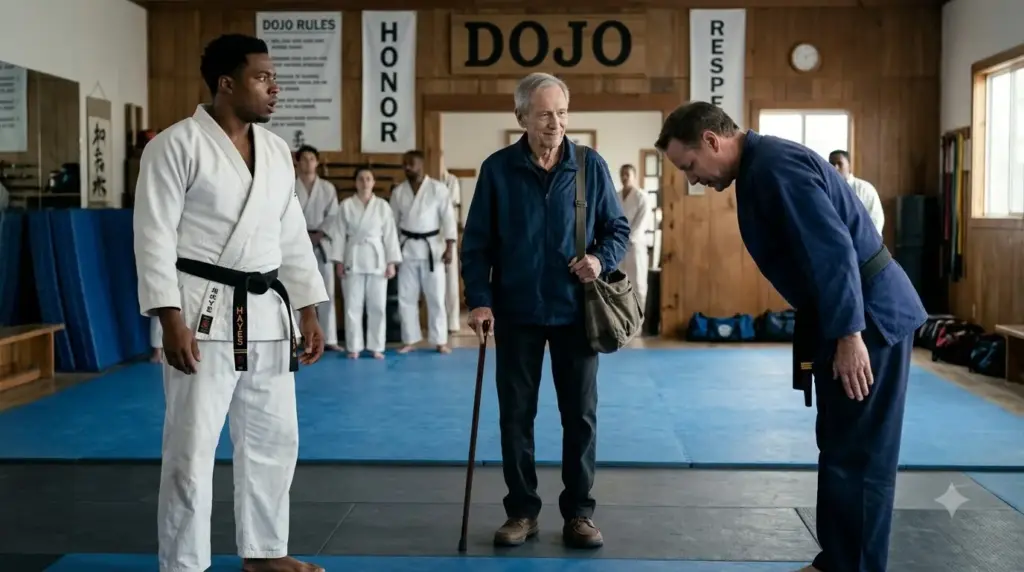
“Do you still teach?”
“Sometimes.”
“Where?”
“Community center.”
“Kids?”
“Mostly older people.”
Brandon smiled.
“Chair yoga?”
Sato looked at him.
Marcus froze.
Then Sato laughed.
“Sometimes chair karate.”
Brandon laughed too.
Good.
The joke changed because permission changed.
That mattered.
Sato visited North Ridge for one week.
Daniel rearranged classes around him.
Not because Sato demanded it.
Because Daniel wanted students to experience a different kind of instruction.
Sato taught no flashy techniques.
Mostly basics.
Stance.
Breathing.
Distance.
Turning.
How to stop before hitting.
That last one frustrated everyone.
He had students punch pads, then stop one inch short.
Brandon hated it.
“Why?”
“Control.”
“I can hit the pad.”
“Yes.”
“I know.”
“Then why not hit?”
Sato looked at him.
“Because you already know how.”
Brandon frowned.
“That’s backwards.”
“No.”
“You train what is missing.”
Brandon stopped.
Another sentence.
Annoying.
Useful.
They worked.
One drill involved moving toward a partner without making them step backward.
Almost impossible for aggressive fighters.
The goal was to close distance without broadcasting pressure.
Brandon failed repeatedly.
Sato watched.
“You enter like police raid.”
The class laughed.
Brandon said:
“I’m trying to get close.”
“Yes.”
“Everybody knows.”
More laughter.
Sato showed him.
Small step.
Relaxed shoulders.
No forward lean.
Partner stayed.
Another step.
Still calm.
Then contact.
Brandon tried.
Better.
Not good.
Sato nodded.
“Again.”
That became the week.
Again.
Again.
Again.
No praise inflation.
No mystical speeches.
Just correction.
On Thursday, a younger black belt named Tyler asked Sato:
“Sensei, what’s the most important technique?”
Sato answered:
“Leave early.”
Tyler frowned.
“What?”
“If trouble starts outside gym, leave.”
People laughed.
Sato did not.
“I am serious.”
Tyler nodded.
Sato continued:
“Martial arts sometimes teaches people confidence.”
“Confidence sometimes makes them stay where intelligence says go.”
Daniel smiled.
He had heard this before.
Sato added:
“Best defense I used most in life was door.”
That line became gym legend.
Brandon wrote it on the whiteboard.
Sato erased it.
“Why?”
“Too dramatic.”
Of course.
During the week, Brandon also noticed what Sato could not do.
Important.
He could not kick high.
Not even close.
His left hip limited rotation.
He could not stay in low stance long.
After fifteen minutes standing, he needed the cane.
His hands shook slightly when tired.
One afternoon he misstepped coming off the mat and caught the wall.
Brandon moved to help.
Sato waved him off.
“Actually.”
He took Brandon’s arm.
“Thank you.”
That changed something too.
Brandon had unconsciously begun replacing one stereotype with another.
At first:
Old means helpless.
Then:
Sensei means secretly invincible.
Both wrong.
Sato was skilled.
And old.
Capable.
And limited.
He needed help sometimes.
None of those facts canceled the others.
The next evening, Brandon asked:
“Does it bother you?”
“What?”
“Not being able to do what you used to.”
Sato looked toward the mat.
“Yes.”
Honest.
Brandon had expected wisdom.
Acceptance.
Something elegant.
Instead:
“Yes.”
Sato continued.
“I miss kicking.”
“I miss running.”
“I miss not planning stairs.”
He tapped his hip.
“Body changes.”
Brandon waited.
Sato said:
“You can be angry and still adapt.”
There.
Not acceptance instead of frustration.
Both.
Brandon understood more than he expected.
He had been dealing with a knee injury for six months.
Minor.
Nothing compared with Sato’s hip.
Still enough to scare him.
He had hidden it.
Not from Daniel.
From himself.
Tournament season was coming.
He kept telling people it was fine.
It was not.
Sato noticed him rubbing the knee after class.
“How long?”
Brandon looked up.
“What?”
“Knee.”
“Six months.”
“Doctor?”
“Physical therapist.”
“What say?”
“Reduce impact for a while.”
Sato waited.
Brandon sighed.
“I didn’t.”
“Why?”
“Competition.”
Sato nodded.
“Important?”
“Yes.”
“More important than knee?”
Brandon laughed.
“When you say it like that…”
“How else say?”
Fair.
Sato did not tell him to quit.
Did not make the decision.
He asked:
“What are you protecting?”
Brandon frowned.
“My knee?”
“No.”
Brandon thought.
Ranking.
Identity.
Momentum.
Fear that stopping would make people forget him.
He said none of that.
Sato seemed to understand anyway.
The next day Brandon told Daniel he wanted to withdraw from the next regional tournament.
Daniel looked surprised.
Then relieved.
“Good.”
Brandon frowned.
“You wanted me to?”
“I wanted you to choose.”
“That’s annoying.”
“Sensei taught me.”
Of course.
Brandon spent eight weeks rehabbing.
No point fighting.
No hard sparring.
He coached.
Held pads.
Worked hands.
Studied distance.
Hated it.
Then started enjoying parts.
He noticed beginners differently.
Before, he corrected technique immediately.
Now he watched longer.
Why was the stance wrong?
Fear?
Mobility?
Confusion?
Injury?
He began asking before fixing.
Sato had left by then.
But the questions stayed.
Three months later, Sato returned for a weekend seminar.
Brandon met him at the door.
No chair-yoga joke.
Not yet.
Sato looked at his knee.
“How?”
“Better.”
“Compete?”
“Not yet.”
“Good.”
Brandon smiled.
“You approve?”
“No.”
“What?”
“Your knee approves.”
Sato walked past him.
Same cane.





