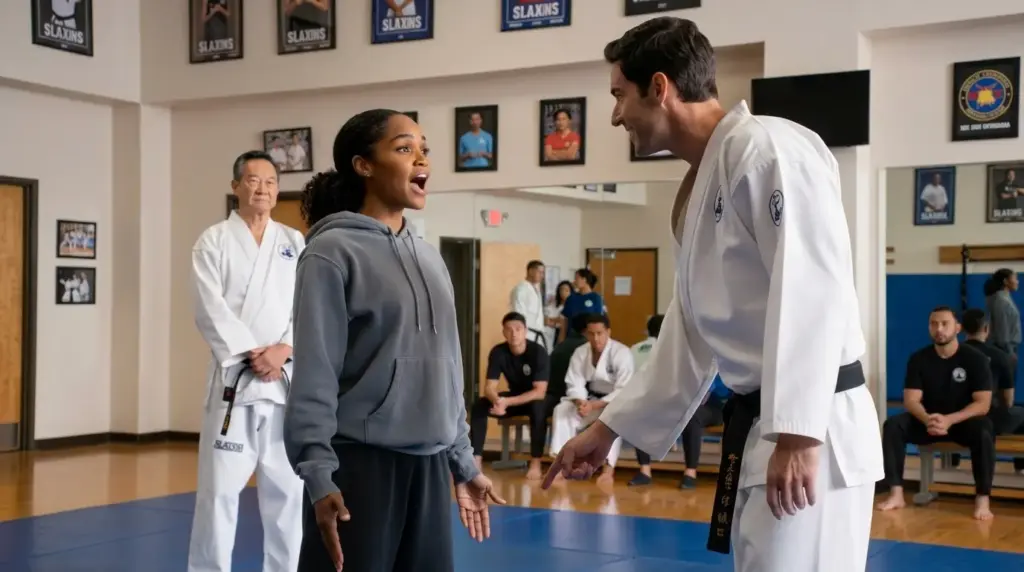
Her left foot slid back three inches. Her hand rose, not to block, but to invite his force past her. Logan overcommitted by half a breath. That was all she needed.
His wrist folded.
His elbow turned.
His knees buckled.
He landed face-first this time, one arm pinned behind him, cheek pressed against the mat, Nora kneeling beside him with no visible strain.
She could have broken the arm.
Everyone in the room understood that, even if they could not explain why.
Instead, she released him before pain became injury.
Logan scrambled away.
Now the silence had a different shape.
Before, it had been shock.
Now it was fear.
Not fear of violence.
Fear of realizing the person everyone had dismissed was not what they thought.
Nora stood and brushed one hand over her sleeve.
“I came to speak with Master Watanabe,” she said. “Not embarrass anyone.”
Logan’s pride was bleeding worse than his lip.
“You think that embarrassed me?”
Nora looked at him gently.
“No. I think you’re doing that yourself.”
A few students looked at the floor.
Master Watanabe stepped forward.
“That is enough.”
But Logan heard laughter where there was none.
He saw judgment in every face.
He saw his own image cracking in the mirror wall behind Nora — the undefeated instructor, the regional champion, the man whose students copied his swagger, now thrown twice by a quiet woman in a hoodie.
He pointed at her.
“Who are you?”
Nora did not answer.
Watanabe did.
“Her name is Nora Vale.”
The old master’s voice trembled slightly.
“And if you had studied the history you pretend to honor, you would have bowed when she stepped onto the mat.”
The room shifted.
Nora’s expression tightened.
“Kenji.”
He looked at her with apology in his eyes.
“You came here quietly. I know. But they need to understand.”
Logan wiped blood from the corner of his mouth.
“Understand what?”
Watanabe turned to the framed photographs on the wall.
Tournaments.
Grand openings.
Seminars.
Children holding belts.
In the back corner, half-hidden behind a newer championship poster, was an old black-and-white photo.
A young woman in a white gi.
Hair cut short.
Eyes steady.
Standing beside a younger Kenji Watanabe and an older man with a cane.
Watanabe walked to the wall and removed the newer poster.
The class leaned forward.
Nora looked away.
“This,” Watanabe said, touching the old photograph, “was taken twenty-one years ago. Before most of you were born. Before Iron Willow had new mats, mirrors, trophies, or business cards. Back when we trained in a rented church basement with leaking pipes and no heat.”
He looked at Nora.
“This woman was my senior student. The best I ever had.”
A whisper moved through the dojo.
Logan stared at the photograph.
“That’s her?”
Watanabe nodded.
“Nora Vale. National champion. Three-time full-contact gold medalist. Invited to train with the Olympic development team. One of the few people I ever trusted to teach in my place.”
Nora’s face did not change, but her hands closed slowly at her sides.
Watanabe continued.
“She left before her career became what everyone expected it to be.”
Logan’s voice came out defensive.
“Then why haven’t I heard of her?”
Nora answered this time.
“Because I left.”
“Why?”
The question came from a small girl near the front, not Logan.
Nora looked at her.
The child was maybe eleven, white belt, hair in two braids, eyes wide with the innocent confusion of someone who still believed talented people simply kept going.
Nora softened.
“My daughter got sick.”
The room went still again, but differently.
Nora reached into her hoodie pocket and pulled out the envelope.
It was cream-colored, old from being handled too many times.
“My daughter’s name was Lily. She was six when the doctors found the tumor. I stopped competing. Stopped teaching. Sold what I had. Moved three states away for treatment. I thought I’d come back when she got better.”
Her voice did not break.
That made it harder to hear.
“She did not get better.”
Watanabe lowered his head.
Nora looked around the dojo, at the students, the parents, the trophies.
“For years after that, I could not step on a mat. This place had too many memories of who I used to be before I knew what a hospital room could take from a person.”
She held up the envelope.
“Three weeks ago, I found this in a box of Lily’s things.”
Watanabe’s eyes filled before she even opened it.
Inside was a drawing made in crayon.
A little girl with no hair, smiling, holding hands with a woman in a white uniform.
Above them, written in uneven child letters:
Mommy, go back to the place where you fly.
Nora’s thumb rested against the paper.
“I came today because she asked me to.”
Nobody spoke.
Even Logan looked shaken.
But shame is a strange thing.
In a good heart, it becomes humility.
In a proud heart, it sometimes becomes anger.
Logan chose anger because it was easier than admitting he had mocked someone’s grief.
He laughed once.
Too loudly.
“So we’re supposed to clap because you used to be somebody?”
Watanabe turned sharply.
“Logan.”
But Logan was already unraveling.
“No, Sensei. Everyone’s acting like I attacked her. She walked in here, refused instruction, made me look stupid, and now we’re hearing some sad story like that changes what happened.”
Nora folded the drawing carefully and slid it back into the envelope.
“I did not make you look stupid.”
Logan stepped closer.
“You keep saying that.”
“Because it’s true.”
He pointed to the center of the mat.
“Then prove it wasn’t luck. Full sparring. No surprise throws. No soft little wrist tricks. You and me.”
The room inhaled.
Watanabe’s voice hardened.
“Absolutely not.”
Logan ignored him.
“What’s wrong, Nora? Afraid your old reputation won’t survive real contact?”
Nora stared at him for a long moment.
She had spent years avoiding fights.
Not because she could not win.





