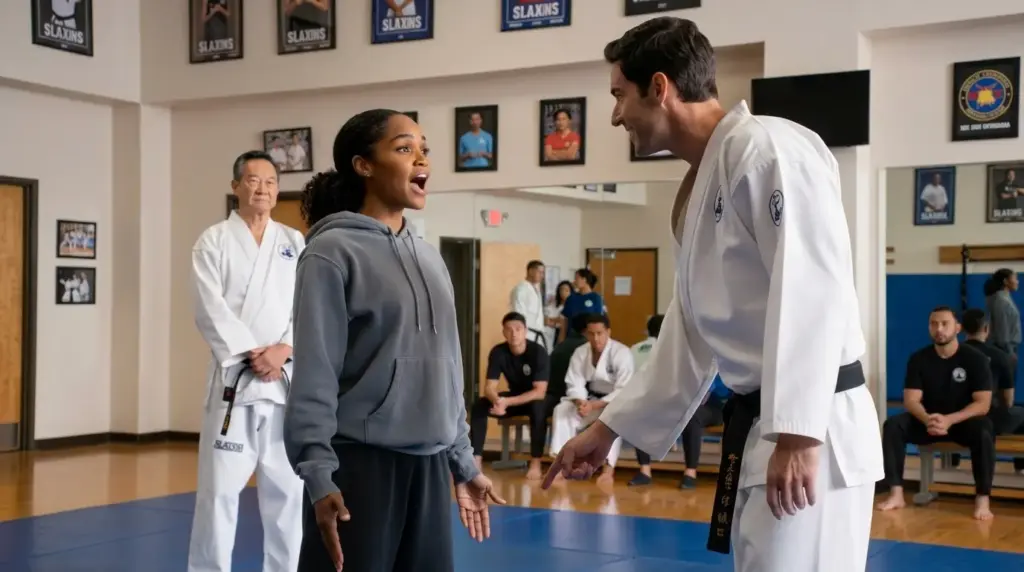
“You mocked beginners. You frightened children. You treated students like props for your ego. I corrected you gently because you were talented. That was another mistake.”
Nora stood near the old photograph, listening.
Watanabe’s voice softened.
“You are suspended from teaching effective immediately.”
Logan’s face went pale.
“What?”
“You may return as a student if you choose humility. You will not instruct anyone until I trust your character more than your kicks.”
Logan looked toward Nora.
For a moment, blame flickered in his eyes.
Then it faded.
There was nothing left to blame that did not lead back to himself.
“I’m sorry,” he said.
It came out rough.
Small.
Embarrassed.
Nora walked over.
He looked at the mat.
“I’m sorry for what I said. About your stance. About your daughter. About all of it.”
Nora studied him.
“I believe you are sorry right now.”
He flinched.
“That’s not forgiveness?”
“That’s honesty. Forgiveness is easy to say when you’re ashamed. Change is what proves it later.”
Logan nodded slowly.
“What do I do?”
Nora glanced at Watanabe.
“Start where you thought I should.”
Logan frowned.
“The stance?”
“Yes.”
She stepped onto the center of the mat and placed her feet the way she had before.
Soft.
Balanced.
Unimpressive to untrained eyes.
“This stance works because it listens,” she said. “Most fighters want to speak first. Hit first. Dominate first. But if you listen with your feet, the floor tells you where force is going. If you listen with your eyes, the body tells you what pride is about to do. If you listen with your ego, you hear nothing.”
Logan stood slowly.
His ribs hurt.
His back hurt.
His pride hurt most.
But he stepped beside her.
For once, he did not bounce.
Did not perform.
Did not smirk.
Nora adjusted his front foot.
“Too stiff.”
He relaxed.
“Too much.”
He corrected.
“Better.”
Watanabe watched from the wall with tears in his eyes.
Not because Logan had lost.
Because, for the first time, Logan was actually learning.
Nora came back the next week.
Not to prove anything.
Not to reclaim old glory.
To speak with Watanabe, as she had intended.
They sat in his office beneath shelves of old belts, cracked trophies, and photographs yellowed at the edges.
He poured tea.
She held the cup in both hands but did not drink.
“I should have come when Lily was sick,” he said.
“You called.”
“I should have come.”
“You were running the dojo.”
“You were family.”
Nora looked at him then.
For twenty years, grief had made the past feel like a locked room. She had avoided anyone who remembered the version of her that existed before hospitals, before test results, before small hands growing too weak to hold crayons.
“I wasn’t angry at you,” she said.
“I was angry at the mats. At the trophies. At every person still moving like the world hadn’t ended.”
Watanabe nodded.
“Grief makes enemies out of ordinary things.”
Nora finally drank the tea.
“I found Lily’s drawing. I think she knew I was leaving more than the dojo. I think she knew I was leaving myself.”
Watanabe looked toward the window that overlooked the mats.
“Then come back.”
“I’m not who I was.”
“No one worth teaching is.”
That sentence stayed with her.
For weeks, Nora returned quietly.
At first, she only helped with beginner classes.
She corrected foot placement.
Taught breakfalls.
Showed children how to breathe when they were scared.
She never raised her voice.
Students learned quickly that when Nora spoke softly, the room became still.
The young girls loved her first.
Then the smaller boys.
Then the adults who had injuries, fear, or shame.
She did not teach them to become fighters.
She taught them to become steady.
Logan returned after two weeks.
Not in a black belt.
He wore a plain white belt over a plain white gi.
The room noticed immediately.
Some students whispered.
He ignored it.
He bowed at the door, then to Watanabe, then to Nora.
“May I train?”
Watanabe looked at him for a long moment.
“Yes.”
Logan joined the beginner line.
A twelve-year-old corrected his hand position.
He thanked her.
That was the beginning.
It was not magical.
He still got frustrated.
Still wanted to explain himself.
Still felt humiliation rise whenever someone mentioned the video.
Because of course there was a video.
One parent had recorded the whole exchange.
It spread through the local martial arts community first.
Then wider.
Black Belt Mocks Quiet Woman’s Stance — First Move Silences Entire Dojo.
People watched the throw.
The second throw.
The sparring round.
The moment Nora said, “The point of knowing how to hurt someone is learning when not to.”
Comments poured in.
Some praised her.
Some mocked Logan.
Some debated the technique.
Some argued whether it was staged.
Nora ignored almost all of it.
But the video did something important.
Women began showing up at Iron Willow.
Mothers who had always wanted to train but felt too old.
Teenage girls tired of being told to smile.
Widows.
Nurses.
Teachers.
A sixty-eight-year-old woman recovering from hip surgery who said, “I don’t need to fight anyone. I just want to stop feeling fragile.”
Nora started a Saturday morning class.
She called it Quiet Strength.
No shouting.
No humiliation.
No belt worship.
The first lesson was always the same.
How to stand.
Not for fighting.
For life.
Feet under you.
Knees soft.
Breath steady.
Eyes open.
Know where the exits are, but do not live like you are already running.
One morning, three months after that first night, Nora entered the dojo and found Logan mopping the mats.
Not because he had been ordered to.
Because the beginner class had spilled water near the wall.
He was barefoot, white belt loose, moving the mop carefully around the edges.
When he saw Nora, embarrassment crossed his face.
“I know,” he said. “Looks funny.”
Nora set down her bag.
“No. It looks useful.”
He smiled slightly.





