“What?”
“You said you’re terrible.”
“At what?”
“Everything.”
Jonah shook his head.
“That’s too large.”
“Your shot timing was terrible today.”
“Your conditioning looked fine.”
“Your hand fighting was decent.”
“You panicked from bottom.”
“Those are things we can work with.”
The boy stared.
Jonah smiled.
“Don’t turn one afternoon into your identity.”
He realized after saying it that the sentence sounded like his father.
That annoyed him.
Which meant he was becoming old.
Marcus Reed aged too.
At seventy-four, his knee finally needed replacement.
At seventy-seven, he stopped demonstrating throws.
At eighty, he still attended Jonah’s youth practices and offered almost no unsolicited advice.
That had taken decades to learn.
One afternoon, a student asked:
“Were you really Coach Jonah’s first coach?”
Marcus nodded.
“Unfortunately.”
Jonah called from across the room:
“I can hear you.”
The student grinned.
“Were you good?”
Marcus answered:
“Some.”
Jonah laughed.
Of course.
Marcus died at eighty-six.
At his memorial, Jonah spoke.
He told stories about ordinary things first.
His father burning pancakes.
Repairing everything with the wrong tool.
Pretending not to like dogs and then giving them food from the table.
Then Jonah told the Harbor Point story.
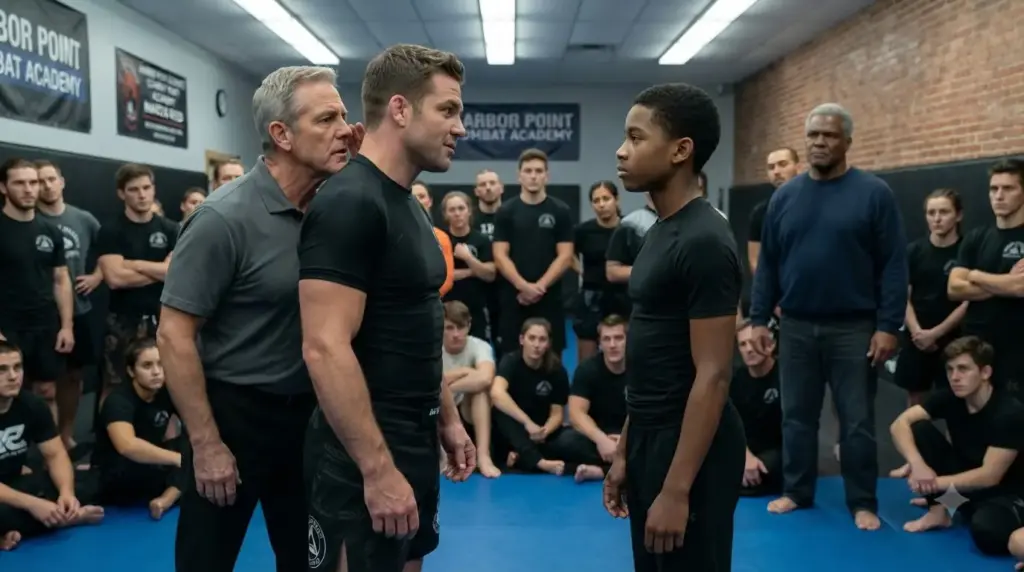
“When I was seventeen, a black belt offered me a thousand dollars to survive sixty seconds.”
People smiled.
“I said no.”
“He kept asking.”
“I kept saying no.”
“Eventually he made walking away feel embarrassing enough that I agreed.”
Jonah looked toward Tyler, sitting several rows back, gray-haired now.
“Tyler knows this story.”
Tyler smiled.
“Unfortunately.”
Soft laughter.
Jonah continued:
“The internet version would be easy.”
“Cocky black belt challenges quiet teen.”
“Teen is secretly a champion.”
“Coach knows the truth and whispers, ‘Don’t fight him.’”
“Black belt learns lesson.”
Jonah shook his head.
“That is not exactly what happened.”
Silence.
“Coach Samuel didn’t stop the round because I was secretly too dangerous.”
“He stopped it because Tyler had stopped making safe decisions.”
“The hidden résumé came later.”
Jonah paused.
“My father always hated the phrase ‘wrong kid.’”
“He would ask:
‘Who was the right kid?’”
“The beginner?”
“The smaller teenager?”
“The kid with no wrestling titles?”
“The kid whose father didn’t know Coach Samuel?”
“No.”
Jonah looked toward Marcus’s photograph.
“My record explained why the round surprised people.”
“It did not make my first no more complete.”
“And my father also refused to make me perfect.”
“I accepted because of pride.”
“That belonged to me.”
“Tyler pressured me.”
“That belonged to him.”
“Samuel let the situation build too long.”
“That belonged to him.”
“Different responsibilities.”
A purple belt nearby looked disappointed.
“That’s it?”
Tyler stared.
“What else?”
“I thought you’d convince him.”
Tyler laughed.
“I retired from that a long time ago.”
The teenager stayed.
Watched class.
Came back the following week.
Eventually joined.
He was not a secret wrestling champion.
No famous coach.
No hidden black belt.
He struggled for months.
Lost almost every round.
Then gradually improved.
Nothing dramatic.
That was enough.
Jonah lived into his nineties.
At eighty-two, he stopped rolling.
At eighty-five, he still coached teenagers from a chair.
One afternoon, a talented fifteen-year-old complained about a new student.
“He has no heart.”
Jonah looked at him.
“How do you know?”
“He quit halfway through the drill.”
“Why?”
“He said he was tired.”
Jonah nodded.
“And?”
“That’s weak.”
Jonah smiled.
“You sound like someone I knew once.”
The boy frowned.
Jonah continued:
“Maybe he lacks discipline.”
“Maybe he slept four hours.”
“Maybe his parents are getting divorced.”
“Maybe he hates wrestling.”
“Maybe he is exactly as weak as you think.”
The boy waited.
Jonah asked:
“Which of those gives you permission to humiliate him?”
Silence.
The teenager looked down.
Jonah nodded.
“Now we can coach.”
Jonah Reed died at ninety-three.
His daughter Elena spoke at his memorial.
She had never been a fighter.
Never wrestled.
Never cared about belts.
Jonah loved that about her.
She stood beside an old photograph taken at Harbor Point.
Jonah at seventeen.
Marcus behind him.
Samuel in the background.
Tyler on the mat.
Elena said:
“My father once had a black belt bet one thousand dollars he could drop him in sixty seconds.”
Soft laughter.
“I heard the story approximately eight thousand times.”
More laughter.
“The dramatic part was that Grandpa Marcus and Coach Samuel knew Dad had years of training.”
“The funny part was that Tyler didn’t.”
She smiled.
“But Dad always said the important part happened before anyone knew his record.”
“He said no.”
“More than once.”
“And people treated his answer like it needed credentials.”
Elena paused.
“Dad eventually became a black belt.”
“A respected coach.”
“A physical therapist.”
“All true.”
“But if he had walked away from martial arts at seventeen?”
“His answer would still have mattered.”
“If Tyler had taken him down in five seconds?”
“Still mattered.”
“If Grandpa Marcus had been an accountant who knew nothing about fighting?”
“Still mattered.”
She looked toward Jonah’s photograph.
“Skill changes what happens in a contest.”
“It should not determine who deserves respect before one begins.”
Years later, Harbor Point remained open.
The wall rules were still there.
A young black belt named Caleb finished a hard competition round.
Near the entrance stood a quiet teenager waiting for his sister.
Caleb asked:
“You train?”
The boy shook his head.
“No.”
“You ever want to?”
“Maybe.”
“Want to try something now?”
“No, thanks.”
Caleb smiled.
“No problem.”
He walked away.
The boy kept waiting.
No secret résumé.
No shocked coach.
No thousand-dollar bet.
No sixty-second challenge.
Nothing happened.
That was the better ending.
Because decades earlier, everyone remembered Coach Samuel leaning toward Tyler Grant and saying:
“Don’t fight him.”
People assumed the warning meant:
You picked the wrong teenager.
He’s secretly dangerous.
He’ll embarrass you.
But Samuel meant something else.
He saw Tyler’s pride taking over.
Saw technique becoming anger.
Saw a training round turning into a personal argument.
So he stopped it.
Jonah’s skill explained why the challenge had not gone as Tyler expected.