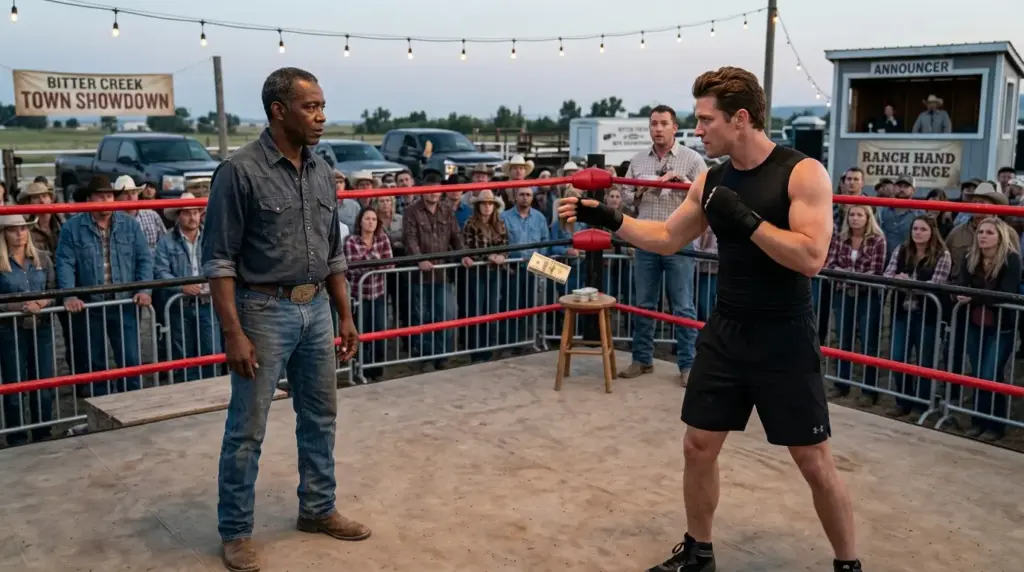
The man in the thousand-dollar sparring gear thought he was picking on a broken-down cowboy.
He saw dirt-stained boots, graying hair, a faded shirt, and silence.
He saw a man who lived alone on three hundred acres of dry Montana earth, drove a rusted Ford pickup, and fixed his own fences under a sun that could split stone.
What he did not see was the memory buried under that silence.
He did not see Fallujah.
He did not see the years when Arthur Hayes had learned that some violence was not loud, not emotional, not theatrical.
Some violence was quiet.
Precise.
Locked away in a cage because the man carrying it knew exactly what happened when the door opened.
The barbed wire snapped tight with the sound of a plucked guitar string.
Arthur held the tension with a heavy leather glove and felt the vibration travel up his forearm. Sweat ran through the dust on his neck. It was ninety-two degrees in Bitter Creek, Montana, and the sun pressed down on his shoulders like a physical weight.
He twisted the wire tie, clamped it with his pliers, and let out a slow breath.
Arthur was fifty-one years old.
His back ached on rainy days.
His left knee carried a titanium pin that set off airport metal detectors, though he had not flown anywhere in years.
He owned three hundred acres of hard, dry land on the edge of town. It was not rich land. It was not easy land. In summer, the grass yellowed early. In winter, the wind came down from the ridges and clawed at every loose board on the place.
But it was quiet.
That quiet had a price.
And lately, the price had been going up.
A cloud of white dust billowed on the horizon, moving fast down the county road.
Arthur did not look up right away.
He kept his eyes on the fence line, checking the spacing of the cedar posts. Whoever was coming was driving too fast for a dirt road chewed up by winter runoff.
The engine had a high-pitched, expensive whine.
German engineering.
Out of place in a landscape built on diesel, rust, and patience.
A matte black G-Wagon skidded to a stop near Arthur’s faded red Ford F-250, throwing dust over the truck until the old paint looked almost white.
Arthur placed his pliers in his leather tool pouch.
He did not brush off his shirt.
He just waited.
The driver’s door opened, and Weston Carmichael stepped out.
Weston was thirty-two, built like a fitness magazine cover, and carried the restless aggression of a man who had gone through life mistaking money for authority.
He had made his fortune in tech, cashed out early, and decided he wanted to play cowboy.
So he bought the two thousand acres bordering Arthur’s land, built a mansion of glass and steel on the highest ridge, and converted an old barn into a state-of-the-art mixed martial arts facility.
Weston was a black belt in Brazilian jiu-jitsu.
He made sure every person in Bitter Creek knew that within forty-eight hours of moving to town.
“Hayes!” Weston called, slamming the SUV door.
He marched across the gravel in spotless custom ostrich-skin boots, wearing compression shorts, a tight black rash guard, and designer sunglasses.
Arthur rested his forearms on the top wire of the fence.
“Carmichael.”
“You ignored my lawyer’s letter,” Weston said.
No hello.
No nod.
No attempt at neighborly respect.
He closed the distance and stood a little too close, leaning into Arthur’s space like he was stepping onto a mat.
It was a fighter’s habit.
Dominate the center.
“I didn’t ignore it,” Arthur said, his voice low and even. “I threw it away.”
Weston smiled, but the corners of his mouth were tight.
“Look, old man. That access road cuts through the southeast corner of my property. I’m paving it. I’m putting up a gate. You need to use the county highway from now on.”
“Deed says I have an easement,” Arthur replied. “Has for sixty years.”
“I don’t care what a piece of paper from 1960 says.” Weston pulled his sunglasses down slightly and glared over the rims. “I’m developing that quadrant. I’ve got sparring partners flying in from Vegas next week. I can’t have your noisy, leaky piece-of-garbage truck rattling past my facility every morning at five.”
“Truck doesn’t leak.”
Weston scoffed.
He looked Arthur up and down, taking in the faded Wrangler shirt, the sweat-stained Stetson, the worn hands.
He saw a relic.
He saw weakness.
“I offered you ten grand for the easement rights,” Weston said. “That’s generous. More than generous. Take the check, Hayes, because the gate goes up Friday. If you try to drive through, I’ll have you trespassed.”
Arthur stared at him.
Not at his eyes.
At his chest.
His shoulders.
His feet.
It was not conscious calculation. It was a diagnostic scan running in the background of a hard drive that had never been fully wiped.
Weston’s weight was shifted forward, heavy on the lead leg.
His chin was up.
Arrogant.
Exposed.
“A fence makes a good neighbor,” Arthur said finally, turning back to his tool pouch. “A gate just makes a prisoner.”
Weston’s face flushed.
Arthur picked up his posthole digger.
“I’ll be using the road Friday, Weston. Same as always.”
Weston’s jaw tightened.
He was used to lawyers.
He was used to boardrooms where he could shout people down.
He was used to mats where he could choke them into submission.
He was not used to a man turning his back on him.
“You’re making a mistake, Hayes,” Weston said, his voice dropping into a menace he had not earned. “I’m not one of these local hicks you can stubborn your way around. You don’t know who you’re dealing with.”
Arthur did not look back.
“Have a good afternoon, Weston.”
For five long seconds, Weston stood there in the sun, the silence stretching until it made him look foolish.





