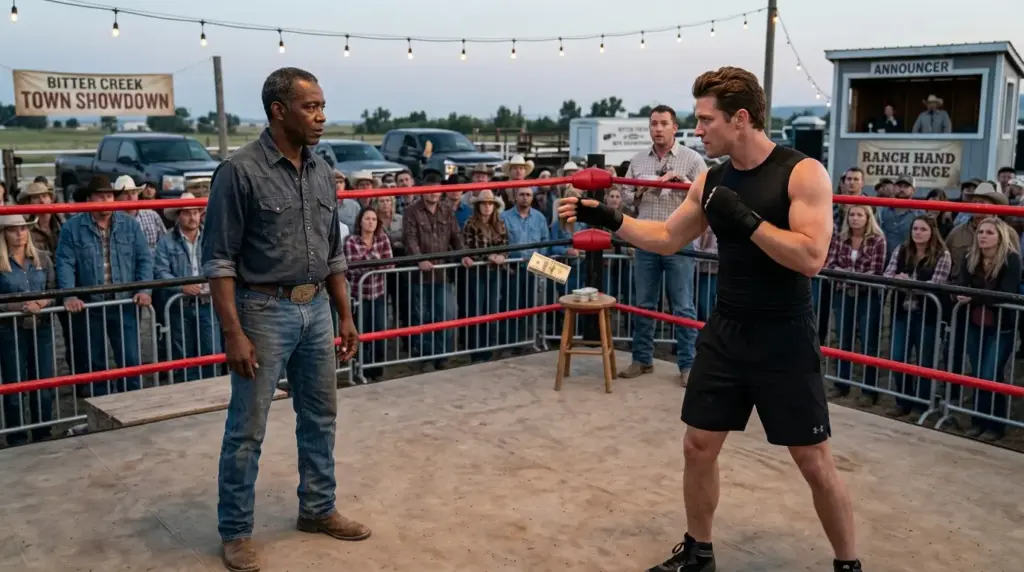
He wore the same faded Wrangler jeans he used for fence work and a plain gray cotton T-shirt. He carried a roll of standard white athletic tape in his left hand.
No gym bag.
No entourage.
No music.
The crowd parted differently for him.
They did not cheer.
They fell silent.
The locals had known Arthur for twenty years, but none of them really knew him. He bought feed, paid taxes, fixed fences, and minded his own business.
Seeing him walk toward the lights with his face set in stone made people uncomfortable.
It felt like watching a man walk to the gallows.
Sheriff Miller, a heavyset man with a gray mustache, met Arthur at the edge of the platform.
“Arthur,” Miller said quietly, “you don’t have to do this. I can shut it down. Call it a hazard. I know what he threatened about your property. We can fight that in court.”
Arthur stopped at the wooden stairs and looked up at the ring.
Weston paced like a caged tiger, glaring down at him, pounding his four-ounce gloves together.
“Court takes years, Sheriff,” Arthur said. “This takes three rounds.”
He walked up the steps and ducked between the ropes.
The canvas was soft beneath his boots.
He had not taken them off.
Weston laughed and pointed.
“You’re fighting in those boots? Are you insane, old man? I’m going to break your legs.”
Arthur said nothing.
He walked to his corner.
There was no stool.
He simply stood facing the center of the ring and began wrapping his hands.
It was a slow, methodical process.
Figure-eight around the knuckles.
Lock the thumb.
Anchor the wrist.
The movements were so deep in muscle memory that his eyes never left Weston.
Arthur’s gaze was empty.
The lights, the crowd, the noise — none of it registered.
He was descending into a dark, quiet room inside himself.
He was unlocking a door he had welded shut in a desert two decades ago.
Sheriff Miller called them to the center.
Weston marched forward, chest puffed, refusing to touch gloves.
He searched Arthur’s face for fear.
He found nothing.
“Standard amateur rules,” Miller yelled. “No strikes to the back of the head, no eye gouges, no groin strikes. Protect yourselves at all times. Obey my commands. Understood?”
“Understood,” Weston barked.
Arthur gave one slow nod.
Miller stepped back.
The crowd went silent.
Only the diesel generator hummed.
Only moths snapped against the halogen bulbs.
“Fight!”
Weston moved first.
He was fast.
Terrifyingly fast.
A man who spent three hours a day conditioning his body for peak performance, all explosive muscle and practiced confidence.
The canvas squeaked under his bare feet as he closed distance with a shifting slide step.
He feinted a sharp jab toward Arthur’s nose while dipping his hips to hide the real attack.
Then he fired a vicious leg kick at Arthur’s lead thigh.
It was a flawless Muay Thai roundhouse meant to deaden the nerve and chop the base out from under him.
Arthur did not back away.
He did not check the kick.
He did something that violated every instinct of a sport fighter.
He stepped inside the arc.
By driving his weight forward, Arthur jammed the trajectory before it could build power. Weston’s shin slapped harmlessly against Arthur’s hip.
But Arthur was not stepping in only to defend.
His right arm fired forward like a steel piston.
Not a closed fist.
An open palm strike, heavy and calloused, driven straight into the center of Weston’s chest.
The impact cracked across the fairgrounds like a rifle shot.
The breath left Weston’s lungs in a ragged wheeze.
His forward momentum hit a wall and reversed. He stumbled backward, his mouthpiece dropping to the canvas, jaw slack, eyes widening with sudden panic.
He could not breathe.
Arthur did not bounce.
He did not reset.
He flowed forward with the economical glide of a shadow.
Desperate and gasping, Weston threw a wild overhand right.
A panic response.
Wide.
Sloppy.
Arthur was not there when the fist arrived.
He slipped beneath it by lowering his center of gravity only a few inches, stepped deep behind Weston’s lead leg, hooked an arm under the armpit, and pivoted his hips with brutal torque.
It was not pretty.
It was not sport.
It was efficient, ugly, military violence.
Weston’s feet left the canvas.
For a fraction of a second, he hung suspended in the harsh, moth-swarmed light.
Then gravity and Arthur’s driving weight slammed him onto the thinly padded plywood.
The ring shuddered.
Chalk dust lifted into the air.
Three hundred people gasped at once.
Weston hit flat on his back.
Before the shock finished rattling through his spine, Arthur had already settled on top of him.
He ignored the sport mechanics of grappling and went straight to heavy side control, dropping his weight onto one localized point.
His right knee drove into Weston’s lower ribs.
Weston screamed.
It was a high, thin sound of pure agony that carried past the bleachers and out toward the dark highway.
“Hey, ref, break it!” one of Weston’s friends shouted.
Weston thrashed like a shark in a net.
He tried to bridge.
Tried to frame his forearms against Arthur’s neck.
Tried to shrimp away and lock his legs around him.
None of it worked.
Moving against Arthur felt like trying to shove a lead vault door.
The old man’s balance was absolute.
Detached from the struggle.
Every time Weston shifted, Arthur adjusted, grinding his knee a fraction deeper into the ribs.
It was not a submission match.
It was calculated suffocation.
Weston finally stopped thrashing and looked up into Arthur’s face.
He expected anger.
Triumph.
Gloating.
Instead, he saw nothing.
Arthur’s breathing was slow and through his nose. His face was slack, almost empty. He looked at Weston’s throat not as part of a human being, but as a mechanical valve that could be closed.
Real fear pierced Weston’s ego.





