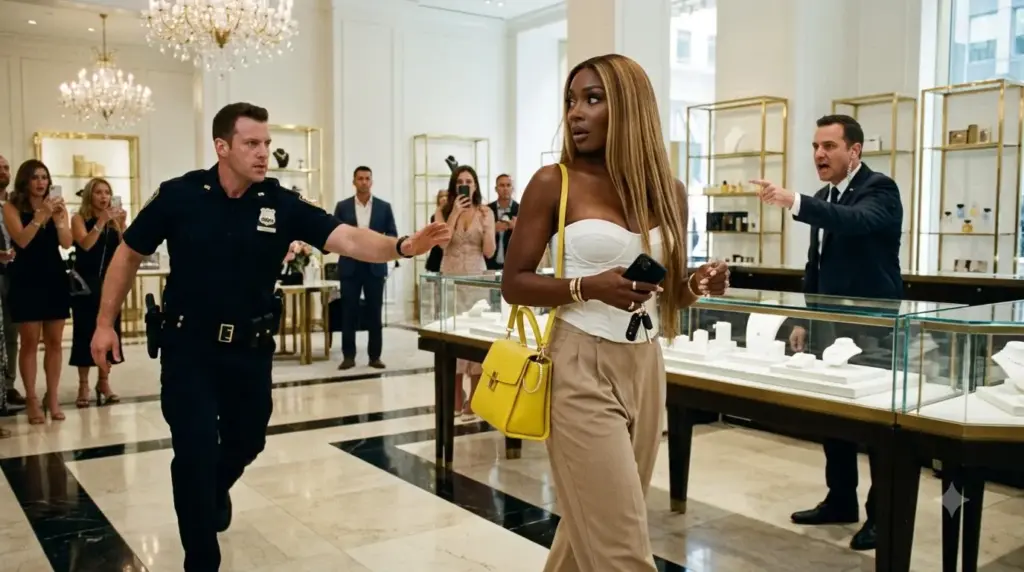
The yellow leather bag slid across marble.
Hit the base of another display.
Tipped.
The zipper opened wider.
Keys fell out.
Lipstick.
Wallet.
Black case.
And the diamond bracelet.
The security manager pointed immediately.
“There.”
The investigator looked at him.
His eyes contained relief.
That was the moment she knew.
Until then, perhaps there remained some possibility she had misread what she saw in the mirror.
Perhaps the item inserted had been something else.
Perhaps another employee made an error.
But relief was difficult to fake.
The bracelet was where he expected it to be.
The officer saw guilt.
The investigator saw confirmation.
Then came the black case.
And the elevator.
And the corporate attorney.
The store went almost completely silent.
The corporate attorney walked toward the officer.
“I need your supervisor here immediately.”
He regained enough composure to become defensive.
“Who are you?”
She handed him a card.
“Corporate legal counsel for this retailer.”
He read.
Then looked toward the investigator.
“She was found in possession of stolen merchandise.”
The corporate attorney’s expression did not change.
“Was she?”
“Yes.”
“Did you witness her take it?”
“No.”
“Did anyone?”
He pointed toward the security manager.
“He reported it.”
The attorney looked at the security manager.
“So did you witness the theft?”
The manager hesitated.
“I observed suspicious behavior.”
The sales associate spoke from behind the counter.
“No.”
Everyone turned.
She was pale.
Hands trembling.
But she continued.
“You told me she stole it.”
The security manager stared at her.
“Stop talking.”
The corporate attorney said:
“No.”
Her voice carried across the entire floor.
“She should continue.”
The associate swallowed.
“I put the bracelet back in the locked display.”
The investigator looked at her.
The associate continued.
“I remember because she joked she’d rather take a vacation.”
Several shoppers murmured.
The security manager said:
“You left the counter.”
“For maybe ten seconds.”
“Exactly.”
The associate shook her head.
“The display was locked.”
The corporate attorney asked:
“Who has keys?”
The associate looked toward the security manager.
“Management.”
The officer’s face changed.
Not enough yet.
The attorney looked at the investigator.
“Are you injured?”
“My right wrist.”
The officer began:
“She resisted—”
The investigator turned her head.
“Your body camera will show otherwise.”
The officer glanced down.
His body camera.
Dark.
The investigator noticed.
“So will it?”
Silence.
The attorney stared at the camera.
“Is that recording?”
The officer touched it.
His face changed again.
He activated it.
Too late.
Half the shoppers filming raised their phones higher.
The investigator almost felt sorry for him.
Almost.
The security manager stepped backward.
One plainclothes investigator positioned himself near the elevator.
Not blocking the manager physically.
Simply watching.
The second investigator approached the yellow bag.
He did not touch it.
“Preserve the scene.”
The corporate attorney nodded.
Then looked toward store employees.
“Nobody touches the jewelry case.”
“Nobody touches the bag.”
“Nobody accesses security systems.”
The security manager spoke:
“You can’t lock me out of my own department.”
The attorney turned.
“I can.”
She took out her phone.
“Corporate IT already has.”
The manager’s face emptied.
That was the second twist he had not anticipated.
Eleven weeks of investigation had taught the monitor something.
If security footage might be manipulated locally, do not wait for the incident to happen before protecting it.
Forty-eight hours earlier, corporate IT had silently mirrored the Manhattan store’s camera feeds to an external evidence server.
The local security team did not know.
Every camera.
Every access event.
Every deletion attempt.
Copied live.
The attorney said:
“The feeds have been preserved offsite since Thursday.”
The security manager said nothing.
The sales associate closed her eyes.
Relief.
The investigator noticed.
Important.
A police sergeant arrived nine minutes later.
By then the crowd had doubled.
Store management tried clearing the area.
Nobody wanted to leave.
The sergeant walked through.
Saw the handcuffed woman.
The officer.
The corporate attorney.
The black case.
The bracelet.
Then the number of phones recording.
His face suggested he understood immediately that his afternoon had become catastrophic.
“What happened?”
The responding officer spoke first.
“Shoplifting detention.”
The corporate attorney said:
“No.”
The sergeant looked between them.
She continued.
“Potential evidence planting witnessed during an active compliance investigation.”
The sergeant stopped.
“What?”
The investigator finally spoke.
“I want the cuffs removed.”
The sergeant looked toward the officer.
“Why is she still cuffed?”
“She was detained—”
“Do you have probable cause now?”
“The stolen bracelet came from her bag.”
“Do you have video?”





