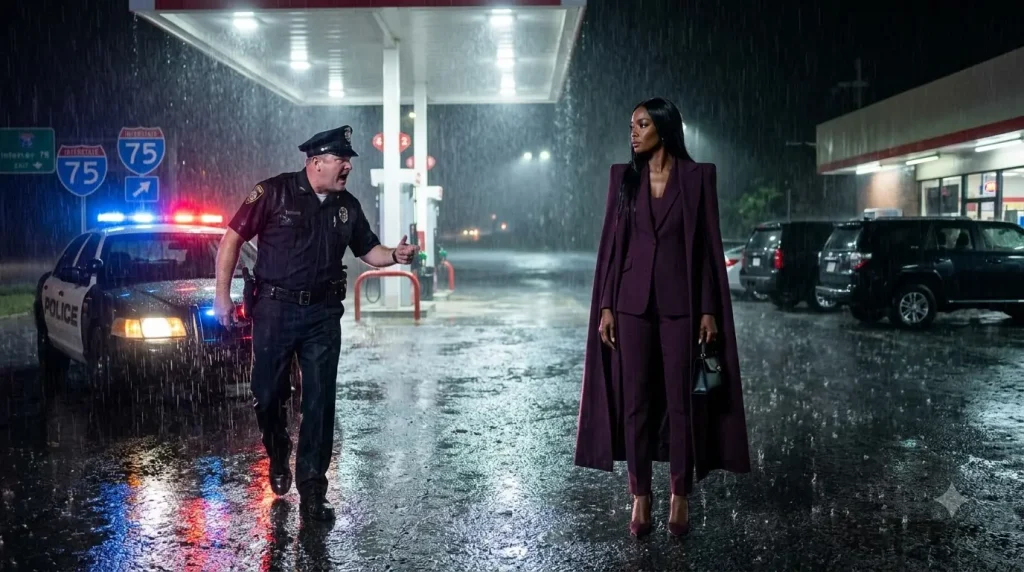
“He is not here to be interrogated about roadside incidents that were handled entirely by Officer Keller.”
Nia stopped directly behind Captain Vance’s chair.
She rested both hands on the high leather backrest.
“At 11:03 p.m. on Tuesday night, you stood beside an ice machine at Exit 41 and accepted an envelope from Calvin Ross,” Nia said.
Captain Vance did not turn around.
His knuckles turned white against the tabletop.
“At 11:22 p.m.,” Nia continued, “you placed a call to Officer Keller’s personal cellular phone.”
“You told him to watch for a woman in a purple coat driving a black truck.”
“You told him not to spook her until he saw the case.”
“And when Keller asked about the split, you said thirty for Price, thirty upstairs, and the rest was his.”
Nia leaned down slightly, her voice dropping into a quiet register that seemed to vibrate through the wood beneath Vance’s palms.
“Who was ‘upstairs,’ Harold?”
The room fell so quiet that the faint horn of a container ship navigating the Savannah River drifted through the double-paned glass.
Captain Vance looked at his lawyer.
Arthur Vance’s mouth opened, then closed again without a sound.
The defense attorney reached toward the legal pad in front of him and turned the page face down.
“The proffer terms protect him from direct self-incrimination regarding that call,” the attorney said, though his voice lacked any genuine confidence.
“The proffer protects him if he tells the complete truth,” Rebecca interjected from the doorway.
She took three steps forward and tossed a printed transcript onto the mahogany table.
“This is the raw audio from Officer Keller’s body camera, mirrored directly to the federal cloud before your client’s administrative cousins could touch the delete key.”
Rebecca pointed a finger at the center of the paper.
“We have your client’s voice, your client’s phone number, and the cellular tower data putting him within two hundred yards of the gas station.”
“If he lies about what ‘upstairs’ means for thirty seconds, the proffer is void.”
“And I will sign an indictment for attempted distribution of cocaine, conspiracy to commit civil rights violations, and honest services wire fraud before the clerk’s office closes at five.”
Captain Vance buried his face in his hands.
His shoulders began to shake.
It was not the weeping of a remorseful man.
It was the ragged collapse of an administrator who had spent thirty years believing his paperwork was bulletproof, only to realize the walls of his castle were made of dry cardboard.
“Douglas took forty percent,” Vance whispered through his fingers.
Nia did not move.
“Say the full name, Captain.”
Vance dropped his hands to the table.
His eyes were red-rimmed and hollow.
“Sheriff Douglas Ray.”
“How did the money move?” Marcus asked, pulling out a digital recorder and setting it beside the transcript.
“Through the county asset forfeiture account,” Vance rasped.
“We didn’t keep the cash in paper bags.”
“We weren’t stupid.”
“Explain the mechanism,” Rebecca commanded.
Vance took a trembling sip of ice water from a crystal tumbler.
“Keller would seize the currency under state administrative law.”
“He’d write the receipt for roughly a third of what was actually in the car.”
“The rest?” Nia asked.
“The rest went into a commercial safe at the towing company owned by Price’s family.”
“Once every quarter, Price would deposit the unrecorded cash into four different commercial accounts associated with private security consulting firms.”
“Firms owned by the sheriff’s son-in-law in Brunswick.”
Nia pulled a small notebook from her jacket.
“And the official forfeiture money?”
“The portion that was actually documented went into the county general fund,” Vance explained.
“The sheriff used it to buy surplus tactical gear, pay for private legal defense retainers, and fund his reelection golf tournaments.”
“Everyone on the county commission knew where the equipment came from.”
“They just didn’t want to ask questions because it kept the local property tax rate flat for ten straight years.”
The cynicism of the arrangement was breathtaking in its simplicity.
The entire county budget had been subsidizing its public services by mugging out-of-town travelers on the shoulder of the interstate.
The sheriff had built a political dynasty on stolen church furnaces, seized payrolls, and manufactured drug stops.
“What about the cocaine?” Nia asked, her voice tightening with razor-sharp intensity.
Vance looked down at his polished fingernails.
“That was Price’s idea.”
“Price said we had to protect the perimeter.”
“He said if the Department of Justice ever sent an undercover unit through the county, we needed a kill switch.”
“A charge so heavy that nobody in the media would care what the officers did during the stop.”
Nia felt a familiar, cold weight settle behind her ribs.
It was the same institutional malice she had encountered in four different states.
The absolute conviction that a Black woman driving an expensive car could be painted with the brush of criminality so thoroughly that the truth would drown beneath the ink of an arrest warrant.
“Where did Keller get the thirty-one grams?” Nia asked.
“From the evidence vault at headquarters,” Vance confessed.
“He checked it out fourteen months ago under a destruction order that was never filed with the court clerk.”
“It had been sitting in his locker ever since.”
“Waiting for someone who looked like you.”
Arthur Vance touched his client’s arm, silently signaling him to stop talking.
It was too late.
The digital recorder between them had captured every syllable, timestamped and authenticated against the federal server in Atlanta.
Rebecca gathered her papers from the table.
“Mr. Vance,” Rebecca said to the attorney, “your client will remain in the custody of the United States Marshals at the federal detention center in Garden City.”
“He will not be granted bail.”
“And if he makes a single phone call to anyone in McKetric County, every deal on this table is canceled permanently.”
Two marshals entered the room and placed Captain Harold Vance in handcuffs.





