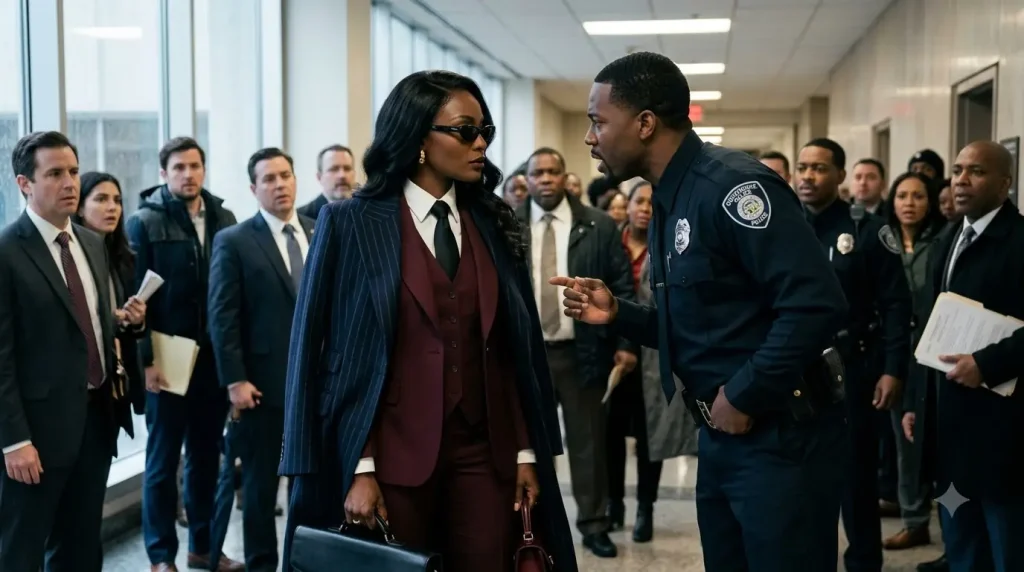
He had transferred into the federal security detachment from a suburban municipal department three years prior, following an “incident of procedural divergence” that his union representative had quietly negotiated down from a termination hearing to an unlisted resignation. Hale viewed the transfer as an insult. In his mind, he had not been reprimanded for excessive aggression; he had been sacrificed by pencil-pushers who had grown terrified of real men who did real police work.
His morning had begun with a closed-door summons from Captain Evelyn Brooks.
Brooks had not offered him a chair. She had stood behind her desk, her reading glasses pushed into her graying hair, a thick manila folder labeled OFFICER INVESTIGATION: HALE, M. lying between them like an unexploded shell.
“You’re off the four-A rotation today, Marcus,” Brooks had said, her voice flat, dry, and lethal.
Hale had stiffened, his fingers curling against his trouser seams. “Fourth-floor security is my post this week, Captain. I’m scheduled for the evidentiary block.”
“Not anymore. Judge Caldwell signed a judicial preservation order at seven-thirty this morning. An emergency supervisory hearing has been convened for ten-thirty.” Brooks leveled her gaze at him. “The federal public defender filed a supplemental complaint yesterday afternoon. They’ve got third-party cell phone footage from the lower lobby last Thursday. The young woman from the bankruptcy docket.”
“She shoved my arm when I told her to clear the doorway,” Hale said, his voice rising, thick with defensive gravel. “I gave her a lawful command. She resisted. I executed a standard balance-displacement maneuver.”
“The girl weighs ninety-five pounds, Marcus. She has two cracked ribs, and the security footage from Camera Six inexplicably blacked out thirty seconds before you put hands on her.” Brooks tapped the folder with an unpolished fingernail. “Your body camera didn’t record either. You claimed a battery fault.”
“Equipment fails in the field.”
“Your equipment fails with an astonishing sense of dramatic timing,” Brooks said coldly. “Judge Caldwell doesn’t tolerate procedural amnesia. She’s demanding an immediate evidentiary audit of all third-floor and fourth-floor camera caches, and she wants your device inspected by digital forensics. You will stay out of her courtroom. You will not loiter in the judicial vestibule. You will work the public corridor between Four-B and the public restrooms. You will keep your hands in your pockets and your mouth shut. Do you understand me?”
“You’re treating me like a felon, Captain.”
“I am treating you like an active liability to the United States District Court,” Brooks said, turning her back to him. “Dismissed.”
Hale had walked out of her office with a hot, iron taste in his mouth. For two hours, he had patrolled the marble floors of the fourth floor like a caged wolf, snapping at nervous teenagers, confiscating legal pads from paralegals who dared cross an arbitrary chalk line near the water fountain, and waiting for an opportunity to assert that he was still the law in this building.
At ten-fourteen, his shoulder radio spat static.
“Fourth-floor units, be advised: bench warrant issued out of Four-B. Defendant Maya Turner failed to appear on misdemeanor trespass. Subject is a Black female, twenty-three, approximately five-foot-four, thin build, braided hair, wearing a gray sweatshirt and light-wash blue jeans. Reports indicate she was spotted heading toward the central elevators. Intercept and escort to holding.”
Hale keyed his mic. “Unit Four-Twelve, copy. On it.”
He turned on his boot heel, his eyes scanning the corridor. The fourth floor was a long, limestone-lined barrel vault, flanked on the left by the massive oak doors of the courtrooms and on the right by the glass-fronted offices of the clerk and the restricted corridor labeled JUDICIAL CHAMBERS — AUTHORIZED PERSONNEL ONLY.
The brass-trimmed doors of Car Three slid open.
A woman stepped out.
She was nearly six feet tall in her white heels, moving with an effortless, predatory elegance that owned the floor. She wore a tailored burgundy three-piece suit that cost more than three months of Hale’s salary, a navy pinstripe overcoat resting across her shoulders, her hair tumbling down her back in gleaming obsidian waves. In her hand was a thick leather litigation briefcase.
She walked straight past the queue for Courtroom 4B, turning her face toward the double frosted-glass doors marked JUDICIAL CHAMBERS.
Hale’s vision narrowed to a pinprick.
In his mind, there were only two categories of people on the fourth floor: the people who wore badges, and the people who were brought here to be judged. He saw a Black woman walking toward a restricted security perimeter. He did not see the cut of the wool. He did not see the five-inch difference in height. He did not see the absence of braids, the absence of the gray sweatshirt, the absence of blue jeans.
He saw an insolent civilian attempting to bypass his authority.
“Hey!” Hale barked.
The woman didn’t break her stride. She had spent twelve years listening to the white noise of crowded courthouses; a shouted monosyllable in an open public corridor was simply part of the ambient masonry.
Hale’s boots hammered against the terrazzo. “Hey! You! Stop!”
Attorneys holding manila folders froze. A court reporter carrying a steno machine stepped out of the way.
Josephine paused three feet from the brass keypad of the judicial entrance. She turned slowly, her overcoat settling around her shoulders, her dark eyes clear and inquisitorial.
Hale closed the distance, stopping eighteen inches from her chest, his thumbs hooked aggressively into the tactical loops of his vest. “Courtroom Four-B is the other way, lady.”
Josephine looked at the officer’s nameplate—M. HALE—then up to his eyes. “I have no business in Four-B, Officer.”
Hale smirked, the thin, bitter expression of a bouncer who had caught an underage kid with a fake ID. “Right. Sure you don’t.”
“I beg your pardon?”
“Don’t play dumb with me,” Hale sneered, stepping laterally to block the frosted glass doors. “You missed your docket check-in ten minutes ago. Judge Miller just signed the warrant.”





