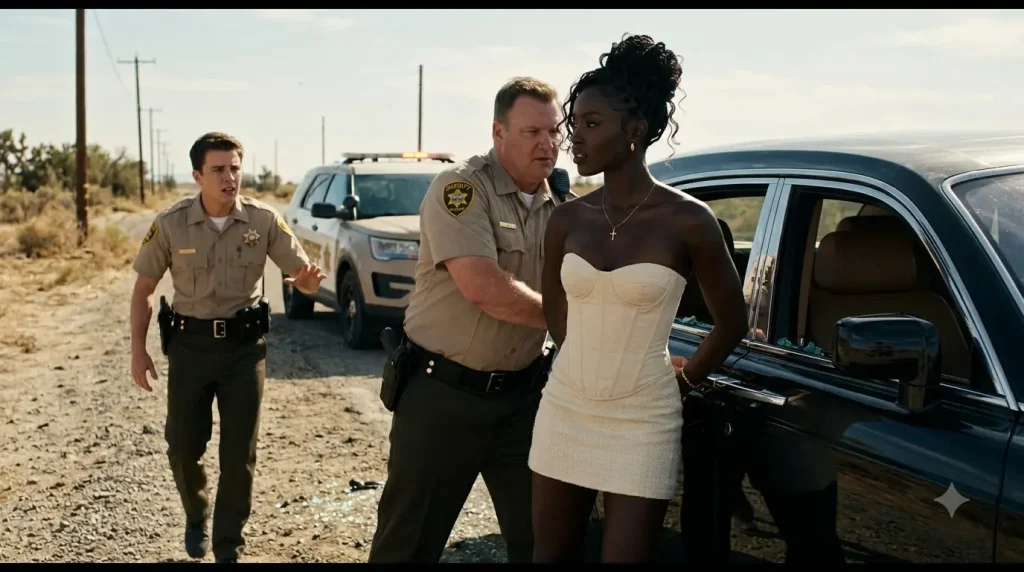
“The car really did call you.”
“Yes.”
“Embarrassing.”
“For who?”
“Everyone.”
Mercer almost smiled.
Then his expression changed.
“Gity’s name familiar?”
Renata thought.
“Maybe.”
“Meaning yes.”
“Probably from complaints.”
“Already checking.”
Renata looked at him.
“Daniel.”
“What?”
“Don’t build the case backward from today.”
He stared.
“If there are old complaints, investigate them independently.”
“Do not decide every old allegation is true because of what happened to me.”
Mercer shook his head.
“You’re lying in a hospital bed defending his due process.”
“No.”
Renata glanced at the bandages around her wrists.
“I’m defending ours.”
That was Renata Cole.
It was also why she made both activists and police unions angry with remarkable consistency.
Her father had been a patrol officer in Maryland.
Thirty-two years.
Black man in a department that had not always known what to do with Black officers.
He had been good.
Not perfect.
Renata refused to turn dead people into saints.
He could be impatient.
Too proud.
Bad at apologies.
But he taught her one rule before she was old enough to understand why it mattered.
“If you only believe process when it protects people you like, you don’t believe in process.”
Renata had been fourteen.
She was angry because a man accused of killing a child had gotten evidence suppressed after an unlawful search.
“How can that be fair?”
Her father looked toward her.
“It isn’t fair to the family.”
“Then why throw the evidence out?”
“Because police do not get extra rights when we believe we found the right bad guy.”
She hated the answer.
Years later, it became the center of her career.
The morning after the roadside incident, Renata asked for Garrett Gity’s complaint history.
Seven formal complaints in six years.
Four from Black motorists.
Two from Latino motorists.
One from a white teenager.
None sustained.
Three classified as insufficient evidence.
Two exonerated.
One policy compliant.
One withdrawn.
Gity also had commendations.
He had pulled a driver from a burning pickup.
Found an elderly man lost overnight in winter.
Rendered aid after a school-bus crash.
Those facts remained true.
Renata insisted the review include them.
Mercer looked at her.
“You want commendations in an investigative matrix?”
“Yes.”
“Why?”
“Because if we reduce him to one dimension, we make the same analytical mistake we’re investigating.”
Mercer sighed.
“You make simple cases difficult.”
“Simple cases are usually stories people told before looking at all the evidence.”
The first complaint Renata reviewed involved a Black dentist named Anthony Wallace.
He had been driving his wife’s German coupe after a hospital fundraiser.
Gity stopped him shortly after ten at night.
Reason:
Rear plate partially obscured by road grime.
Wallace produced registration.
Gity asked him where he bought the car. Wallace answered honestly. Gity then asked to search the vehicle. Wallace refused. Gity detained him for twenty-five minutes while waiting for a K-9 unit. The dog found nothing. Wallace filed a complaint. It was closed for insufficient evidence because no camera was active. The second involved a Latino college student. Stopped for rolling a stop sign. Asked if he had drugs in the vehicle. Searched without consent. No drugs found. Complaint withdrawn. The pattern was clear. Garrett Gity did not need a reason to suspect a minority driver in an expensive car. He assumed they were suspicious until proven otherwise. And when they refused to be proven otherwise, he became aggressive. Just like he had with Renata. Just like he had with Anthony Wallace. And just like he had with the college student. He was a man who believed his instincts were better than the law. He was a man who used his badge to enforce his prejudices. Renata closed the file. She knew exactly what she needed to do. She needed to find the dash camera footage from those previous stops. She needed to find the K-9 unit handler. She needed to find the college student who had withdrawn his complaint. She needed to build a case so tight that Garrett Gity would never wear a badge again. The following morning, Renata arrived at the federal building in Ashford County. Her wrists were still bandaged, but she refused to stay home. She walked into the task force operations center. Mercer was already there, surrounded by screens displaying the Rolls-Royce telemetry data. “Morning,” he said, barely looking up. “Morning.” She sat down across from him. “Did you get the dash camera footage from the Wallace stop?” Mercer shook his head. “No.” “Why not?” “Because the Ashford County Sheriff’s Department claims the footage was corrupted.” Renata’s eyes narrowed. “Corrupted.” “Yes.” “And the college student’s stop?” “Also corrupted.” Renata leaned forward. “Two stops involving the same deputy, both resulting in complaints, and both dash camera recordings are corrupted.” “That’s a remarkable coincidence.” Mercer finally looked at her. “I thought the same thing.” “So I sent a team to the Ashford County Sheriff’s Department server room this morning with a warrant.” “They are currently mirroring the entire server.” Renata smiled. “Good.” “Now we need to find the K-9 handler.” “Already found him,” Mercer said. “He retired two years ago and moved to Florida.” “I’ve got an agent flying down there today.” Renata nodded. “And the college student?” “He’s still in the area.” “I’ve got an interview scheduled for tomorrow.” Renata looked at the screens displaying the Rolls-Royce data. The silent escalation protocol had worked perfectly. The system had recognized the danger and summoned help. But it hadn’t prevented the danger. Garrett Gity had still smashed her window. He had still forced her to the ground. He had still treated her like a criminal simply because of the color of her skin and the car she was driving. Renata Cole was a federal agent. She had the power and resources to fight back. But what about Anthony Wallace? What about the college student? What about all the other people Garrett Gity had targeted? They hadn’t had federal agents rushing to their aid. They hadn’t had emergency telemetry modules in their cars. They had been alone. And that was why Renata Cole was going to make sure Garrett Gity was held accountable. Not just for what he did to her. But for what he did to everyone else. The interview with the college student, Mateo Rios, took place in a small, windowless room at the federal building. Mateo was nervous. He kept fidgeting with his hands. Renata spoke softly. “Mateo, you filed a complaint against Deputy Gity three years ago.” “And then you withdrew it.” “Can you tell me why?” Mateo looked down at the table. “He came to my house.” Renata’s expression hardened. “Deputy Gity came to your house?” “Yes.” “What did he say?” “He told me that if I didn’t withdraw the complaint, he would make sure I got arrested for drug possession.” “He said he knew people who could plant drugs in my car.” Renata took a deep breath. “Mateo, are you willing to testify to that?” Mateo looked up at her, tears in his eyes. “I don’t know.” “I’m scared.” “I understand that you’re scared,” Renata said, her voice steady. “But Garrett Gity is a dangerous man.” “He uses his badge to intimidate and abuse people.” “And he will keep doing it until someone stops him.” “I’m going to stop him.” “But I need your help.” Mateo hesitated, then slowly nodded. “Okay.” “I’ll testify.” Renata smiled. “Thank you, Mateo.” The pieces were falling into place. The corrupted dash camera footage. The witness intimidation. The pattern of racial profiling. Garrett Gity was going down. And Renata Cole was going to be the one to take him down. Three days later, Garrett Gity was arrested by federal agents. He was charged with multiple counts of civil rights violations, witness intimidation, and obstruction of justice. The news of his arrest sent shockwaves through Ashford County. The Ashford County Sheriff’s Department was forced to launch a comprehensive review of all previous complaints against its deputies. Lieutenant Harold Brennan resigned. Deputy Miles Ansar was commended for his actions during the traffic stop. And Renata Cole went back to work. She knew that Garrett Gity was just one bad cop. There were many others like him. But she also knew that she had made a difference. She had stopped one dangerous man from abusing his power. And she would keep fighting until all the bad cops were held accountable. The Rolls-Royce Phantom was repaired and returned to the federal asset pool. Renata Cole was reassigned to a new case. But she never forgot the heat of the sun-baked gravel on Ashford County Road 17. She never forgot the sound of the steel baton smashing through the window. And she





