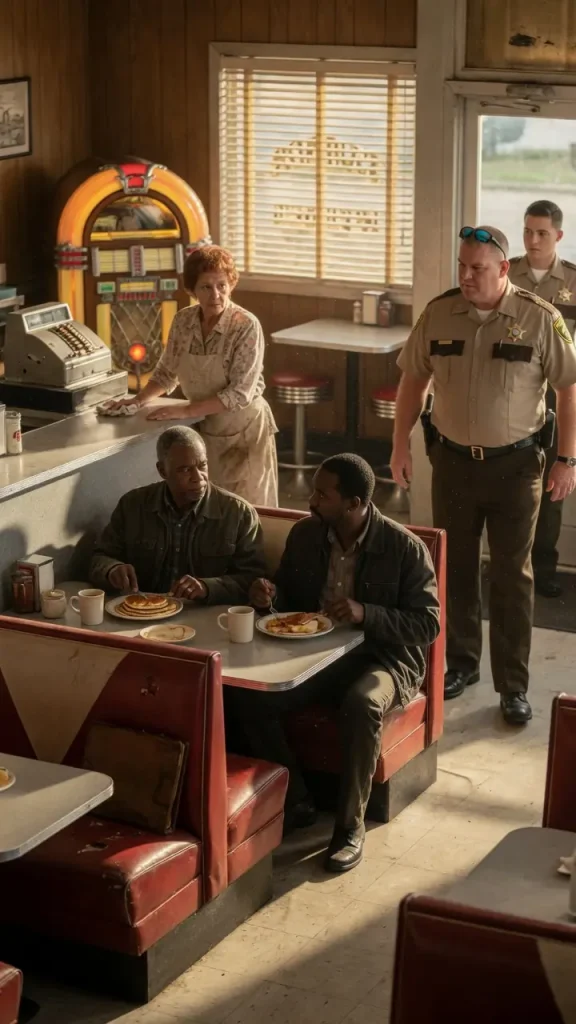
“Show me the procedure that says you can order two law-abiding citizens out of a restaurant based on the color of their skin.” Hutchins’s mouth worked. No sound. “Show me the procedure,” Malcolm said again, “that says you can search a vehicle with no warrant, no probable cause, and no consent.” Nothing. “Show me the procedure that says you can grab a man by his collar and threaten him with arrest for the crime of eating pancakes.” Hutchins looked around, desperate, like he was searching for a lifeline.
His eyes landed on Lassiter. Lassiter took three steps backward, hands raised, shaking his head, distancing himself physically and symbolically. The two other deputies did the same. One of them actually turned around, faced the other direction, like he couldn’t bear to watch.
Malcolm pulled out his phone, the one Hutchins had thrown onto the hood of the cruiser, unlocked it with his thumb, tapped the screen, held it to his ear. “Captain Crawford,” he said, professional, clipped. “This is Owens. We have more than enough.
Requesting immediate suspension and custodial escort for Sergeant Dale Hutchins, Ridgedale County Sheriff’s Office.” Hutchins’s knees actually buckled, just slightly, like the ground shifted under him. Malcolm listened for a moment. “Yes, ma’am.” Multiple civil rights violations, illegal detention, illegal search, discriminatory language, all on body cam and audio. I’ll send you the files within the hour.” He paused.
“Affirmative. We’re holding position.” He lowered the phone, looked at Hutchins. State units are en route. ETA 30 milesnutes.
Hutchins’s face went through about six different expressions in three seconds. Shock, denial, anger, fear, desperation. Then back to fear. This is “This is a mistake.” he stammered.
“I treat everyone the same. Everyone. You can ask anyone in this town.” “We did ask.” Terrence said. He pulled a small notepad from his pocket, flipped it open.
“Eight formal complaints filed against you in the last three years. All alleging racial profiling, excessive force, and abuse of authority. All closed by your department without investigation.” Hutchins shook his head. “Those were false.
Every one of them. People lying to get out of tickets.” “We interviewed all eight complainants last week.” Malcolm said. “Their stories match. Right down to the words you used.
The same words you used on us today.” The diner door swung open. Brenda Carlyle stepped out onto the porch. Hand over her mouth. Eyes wide.
Behind her, faces pressed against the glass. The whole diner watching now. No pretense. No looking away.
One of the old men at the counter, the one who’d been staring at his eggs, stood up. Walked to the window. Put his hand on the glass. His lips moved.
Malcolm couldn’t hear it. But he could read it. “About damn time.” Hutchins tried again. Scrambling now.
“I was doing my job. That’s all. Just doing my job.” “Your job,” Malcolm said, “is to serve and protect. Not to humiliate.
Not to target people based on skin color. Not to abuse your authority because you think nobody’s watching.” He stepped closer, close enough that Hutchins had to look up at him now. The power dynamic had completely inverted, flipped like a switch. “But we were watching, Sergeant.
We’ve been watching you for three years, and now everyone else is about to watch, too.” Hutchins opened his mouth, closed it. His shoulders sagged. Lassiter spoke up. His voice was quiet, shaky.
“Sergeant Hutchins, I think… I think you should stop talking. Maybe call a lawyer.” Hutchins turned to him. “Lassiter, you know I’m not— Tell them.
Tell them I’m not—” Lassiter looked at the ground. “I can’t tell them anything, Sergeant. I was here. I saw what I saw.” Hutchins’s face crumbled.
Malcolm pulled out a small card from his wallet, Miranda rights printed on it. He held it up. “Sergeant Dale Hutchins, you are not under arrest at this time. However, you are being relieved of duty pending an internal affairs investigation.” “You have the right to remain silent.
You have the right to legal representation. Anything you say from this point forward can and will be used in administrative and criminal proceedings.” He lowered the card. “Do you understand these rights as I’ve explained them to you?” Hutchins didn’t answer. He just stood there, staring at nothing.
In the distance, sirens, faint, getting louder. Two unmarked black sedans pulled into the parking lot, state vehicles. No lights, no drama, just quiet, professional efficiency. Four agents in plain clothes stepped out.
Badges on their belts. They walked over to Malcolm. One of them, a woman in her 50s, gray hair pulled back, extended her hand. “Investigator Owens, Captain Crawford sends her regards.” Malcolm shook her hand.
“Appreciate the quick response.” She looked at Hutchins. No expression, just cold assessment. “Sergeant Hutchins, I’m Agent Marsh with the State Bureau of Professional Standards. You’re hereby relieved of active duty.
I need your service weapon, your badge, and your keys.” Hutchins stood there, frozen. “Sergeant,” she said again, firmer. “Your weapon. Now.” His hands shook as he unbuckled his gun belt, handed it over.
Then his badge, then his keys. Agent Marsh handed them to another agent, turned back to Hutchins. “You’ll be escorted to the county administration building for formal processing. You’re not under arrest, but you are not to leave the state.
Do you understand?” Hutchins nodded, barely. “Out loud, please.” “I understand,” he whispered. Two agents flanked him, walked him to one of the sedans, opened the back door. He got in.
The man who’d ordered two black men out of a diner was now the one being removed. The door closed. The sedan pulled away. And just like that, it was over.
The gravel crunched under the tires as the sedan disappeared down Main Street. The sound faded, then silence. Malcolm stood in the parking lot, Terrence beside him. Four deputies still standing there like statues.





