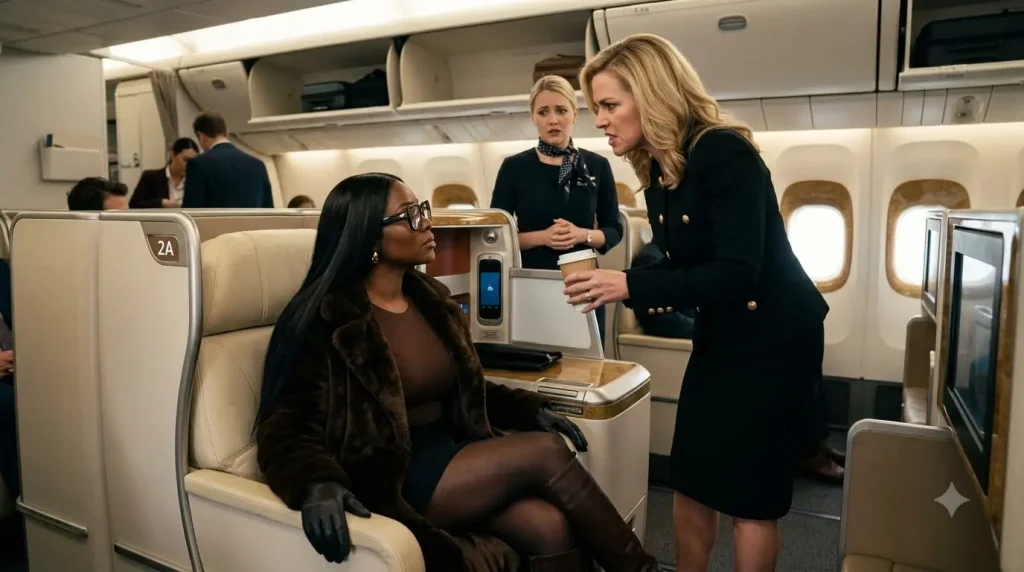
“I’m calling my husband.”
The officer said:
“You may make calls after we step off the aircraft.”
“I am not stepping anywhere.”
Amara moved away from the conflict.
This was no longer hers to direct personally.
That distinction mattered.
Jennifer looked at her.
“You caused this.”
Amara stared.
Jennifer continued.
“You sit there like you’re above everyone.”
“I asked you for one seat.”
“You humiliated me.”
Amara’s voice stayed even.
“You asked me to surrender property assigned to me.”
“I said no.”
“You poured coffee over my belongings.”
“You shoved me.”
“You hit me.”
“What happened after that is a consequence.”
Jennifer’s expression twisted.
“You think because you have some government badge—”
“No.”
Amara cut in.
“I think consequences should have occurred if I had been a teacher.”
“A nurse.”
“A student.”
“A retiree.”
“A woman flying home from a funeral.”
“My title should be irrelevant.”
The cabin was silent.
Jennifer looked around, searching for someone willing to restore the version of reality she preferred.
Nobody did.
The airport officer repeated:
“Mrs. Collins.”
This time Jennifer followed.
Not calmly.
But she followed.
As she passed Rachel, she leaned close enough to whisper:
“You’re done.”
Amara heard.
So did Captain Reynolds.
Rachel’s face drained.
Amara looked at Elaine Porter.
The vice president had heard too.
And had looked away.
That was the most important reaction in the cabin.
More important than Jennifer’s threat.
Because people threaten.
Systems decide whether threats work.
The aircraft was deplaned twenty-two minutes later.
Not because Amara requested special handling.
Because local police needed statements, cabin staff had to document the event, and coffee had soaked enough of the seating console that maintenance needed to check the electronics beneath it.
Passengers were irritated.
Then curious.
Then overwhelmingly patient after the man in 1D quietly told several of them what had happened.
Amara remained aboard until everyone else exited.
Captain Reynolds approached.
“I’m sorry.”
She looked at him.
“For?”
He hesitated.
“For what happened.”
“That was not your act.”
“No.”
“But it was my aircraft.”
“That makes you responsible for response.”
“Not for preventing every irrational person from raising a hand.”
He absorbed that.
Then:
“I should have recognized Jennifer sooner.”
Amara looked at him.
“Would that have changed how you responded?”
He did not answer quickly enough.
There it was.
Amara said:
“That is the wrong lesson.”
Reynolds lowered his eyes.
“Yes.”
“You should not need to recognize a passenger as powerful before treating the incident seriously.”
“I know.”
“Do you?”
His jaw tightened.
Not defensively.
Ashamed.
“I think I do now.”
Amara nodded.
“Good.”
Rachel stood near the galley.
She had not moved much since Jennifer left.
Amara walked toward her.
“Are you safe talking to me?”
Rachel looked toward Elaine Porter, who stood near the boarding door speaking into her phone.
“No.”
The answer came so quietly Amara almost missed it.
Amara did not react.
“Who would make it unsafe?”
Rachel’s eyes filled.
“I can’t.”
“All right.”
The flight attendant looked surprised.
Amara continued.
“You do not have to disclose anything to me here.”
“I’m going to give you an independent contact number.”
“It routes outside the airline.”
“No supervisor will receive notification merely because you call.”
Rachel swallowed.
Amara handed her a card.
Not her personal one.
A whistleblower-intake number under the Commission’s protected-review office.
Rachel looked at it.
“Will you know if I call?”
“Not unless you authorize your identity to be shared with my team.”
Rachel stared.
“You really won’t?”
“No.”
That seemed to matter more than anything Amara could have promised personally.
Rachel slid the card into the inside pocket of her uniform jacket.
Elaine Porter ended her phone call and approached.
“Director Washington.”
Amara turned.
“The airline has arranged a private lounge for you while we rebook—”
“No.”
Elaine blinked.
“No?”
“I’ll wait where the displaced passengers wait.”
“Director, under the circumstances—”
“Under the circumstances, upgrading my inconvenience creates the wrong record.”
Elaine’s face tightened.
Amara continued.
“I was assaulted.”
“That should be documented.”
“I also experienced the same delay as everyone else after the aircraft became unavailable.”
“That should be documented too.”
Elaine nodded slowly.
“Of course.”
Amara studied her.
“Who were you speaking to?”
The question was simple.
Elaine hesitated.
“Corporate.”
“Who?”
“Our executive customer-relations office.”
“Why?”
Elaine’s eyes flickered.
“Mrs. Collins contacted them.”
“Already?”
“Yes.”
“What did she request?”
“I’m not sure.”
“That is not what I asked.”
Elaine took a breath.
“She wants the incident treated as a mutual altercation.”
Captain Reynolds, standing several feet away, looked sharply at her.
Amara felt something cold settle inside her.
“How long ago did she leave this aircraft?”
“About nine minutes.”
“And executive customer relations is already discussing classification?”
Elaine did not answer.
Amara said:
“Who called you?”
The vice president looked toward the open door.
Then back.
“Martin Keene.”
Amara knew the name.
Executive Vice President of Premium Customer Strategy.
He had appeared on the airline’s organizational chart.
Not in her core review meetings.
But his division controlled high-value corporate accounts, VIP handling, and service recovery.
“Did Mr. Keene instruct you to alter an incident classification?”
“No.”
Amara waited.
Elaine’s face strained.
“He asked me to ‘avoid inflammatory language until facts are clear.’”
“Which words did he consider inflammatory?”
“Assault.”
Captain Reynolds exhaled through his nose.
Amara looked at Elaine.
“Did a passenger strike another passenger?”
“Yes.”
“Then assault is descriptive, subject to law enforcement determination.”
Elaine nodded.
“Did Mr. Keene ask whether the other passenger was injured?”
“No.”
“Did he ask whether crew witnessed it?”
“No.”
“Did he ask whether video existed?”
Elaine looked away.
“No.”
Amara took out her phone.
She opened a secure notes application.
Recorded the time.
“Preserve that call record.”
Elaine looked alarmed.
“Director—”
“Not content if legally restricted.”
“Metadata.”
“Time.”
“Participants.”
“Any written follow-up.”
Elaine swallowed.
“Yes.”
Amara looked toward Rachel.
The flight attendant’s hands had stopped shaking.
Not because she felt safe.
Because somebody had finally noticed the mechanism.
At the airport police substation, Jennifer Collins had already changed tactics.





