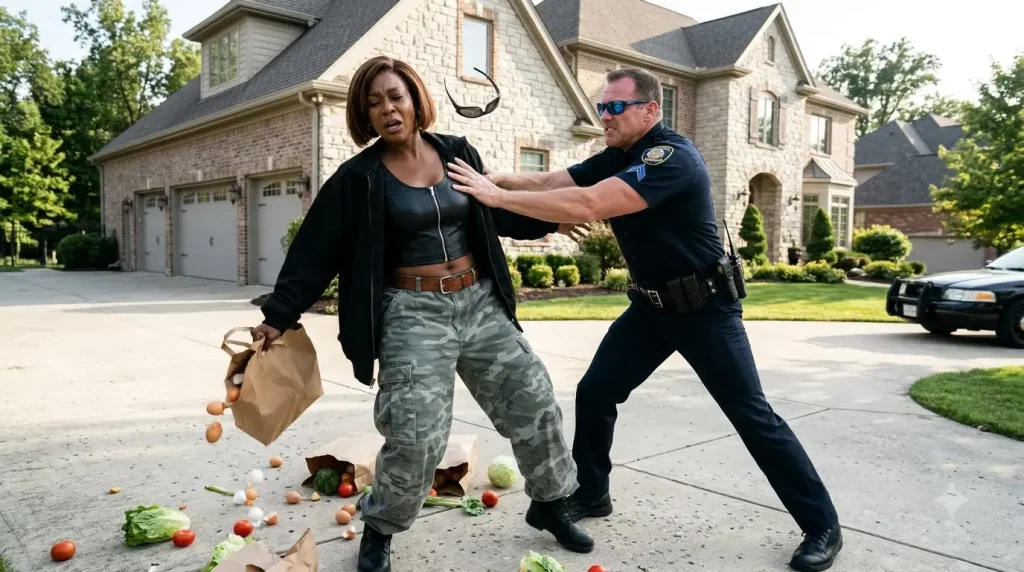
Halverson was fifty-four, silver-templed, with the tanned, patrician face of a golf-course regular and twenty-six years of favors banked across every precinct in the county. Beside him stood his handpicked enforcers from the patrol division, including Senior Field Training Officer Brent Colter, whose arms were folded so tightly over his chest that the brass buttons on his dress blouse strained.
When Mayor Glass finished her introduction and stepped aside, Naomi approached the cluster of microphones. She didn’t open the leather folder holding her prepared remarks. Instead, she looked past the flashing DSLR cameras of the Richmond Times-Dispatch and fixed her eyes directly on the wall of dark blue uniforms in the back row.
“A badge is not a shield against questions,” Naomi said, her clear contralto carrying into the vaulted dome without straining. “I believe a community is only safe when its residents feel safer the moment a patrol car turns down their street. That applies to the homeowner calling for help at two in the morning, and it applies to the teenager walking home from a shift who wants to know why an officer has asked him to stop.“
In the back row, Halverson’s thin lips curved into a faint, patronizing smile, and he leaned half an inch toward Colter to murmur something out of the corner of his mouth.
Naomi saw the movement and held her gaze right on them.
“Real courage in law enforcement isn’t measured by how loudly an officer can shout an order,” she continued smoothly. “Sometimes courage means walking through a door when everyone else is running out. Sometimes it means telling a veteran colleague that he has crossed the line. And most often, it means having the discipline to slow down for ten seconds and verify a simple fact before arrogance turns an ordinary afternoon into a tragedy.“
Twenty minutes after the cameras packed up, as Naomi walked down the basement corridor toward the personnel office to collect her temporary identification wallet and command keycards, Victor Halverson fell into step beside her. He smelled of expensive sandalwood cologne and peppermint breath mints.
“Quite a sermon up there, Chief Brooks,” Halverson said, keeping his voice pitched to a genial purr as he held open the heavy fire door for her. “The city council loves that academic reform language. Really plays well in the papers.”
“It wasn’t prepared for the papers, Deputy Chief Halverson,” Naomi replied, not breaking stride. “It was a job description.“
Halverson chuckled softly, though the skin around his pale gray eyes stayed tight. “Just a word of friendly advice from someone who’s kept the lid on this town for a quarter-century, Naomi. Northbridge isn’t Richmond. My guys out on patrol work hard to keep the riffraff from creeping up the highway into neighborhoods like Rosemont Ridge. When you start telling veteran street cops to second-guess their instincts and stop to ask permission before they control a scene, things get messy on the pavement real fast. I’d hate to see your honeymoon end before Monday morning roll call.“
Naomi stopped outside the frosted glass door of the credentialing office and turned to face him. At five-foot-nine in low heels, she looked him nearly dead in the eye.
“And I’d hate for any officer under my command to mistake a personal prejudice for a police instinct, Victor,” she said calmly. “By Wednesday at five o’clock, I want the complete internal audit of the last thirty-six months of use-of-force complaints that were administratively closed without body-camera review—specifically the eleven files bearing Officer Brent Colter’s badge number that never made it to the civilian review board.“
For a fraction of a second, the country-club warmth vanished from Halverson’s face, revealing something cold, cornered, and vicious underneath. Those eleven files didn’t just hold Brent Colter’s career together; every single one of them carried Victor Halverson’s personal signature on the dismissal memo.
“Enjoy unpacking your boxes this weekend, Chief,” Halverson said softly, turning on his heel. “Rosemont Ridge is a very particular neighborhood. People out there call the police over the smallest things.“
At the time, Naomi had taken the remark as the parting petty jab of a passed-over bureaucrat.
She hadn’t realized it was a blueprint.
Instead, she had driven home to Larkspur Lane determined to give her daughter the one thing her career had perpetually stolen from them: forty-eight hours of uninterrupted peace.
On Saturday evening, the two of them had sat cross-legged on a drop cloth in the middle of the upstairs back bedroom, surrounded by half-emptied cardboard boxes and the sharp, clean scent of primer. Twelve-year-old Ava had her mother’s high cheekbones and dark, searching eyes, her thick curls gathered into a loose puff at the crown of her head and flecked with tiny white splatters of drywall dust. In her lap rested her charcoal sketchpad, open to a half-finished drawing of the iron fire escape outside their old third-floor apartment in Richmond.
“You’re drawing the old street again,” Naomi said gently, setting down a roll of blue painter’s tape.
Ava didn’t look up from the page, her thumb smudging a shadow along the brick edge of the sketch. “If I don’t draw it before Monday, I’ll forget which window had the cracked flower box.“
Naomi’s chest tightened with a familiar, quiet ache. Over the past six years—from Violent Crimes to Special Investigations to Bureau Commander—every promotion had come with a different lease, a different school bus route, and another round of Ava quietly deleting phone numbers of friends who drifted away after two months of long-distance texts.
“Are we only here until they need somebody to fix another department somewhere else?” Ava asked, her voice small in the high-ceilinged room.





