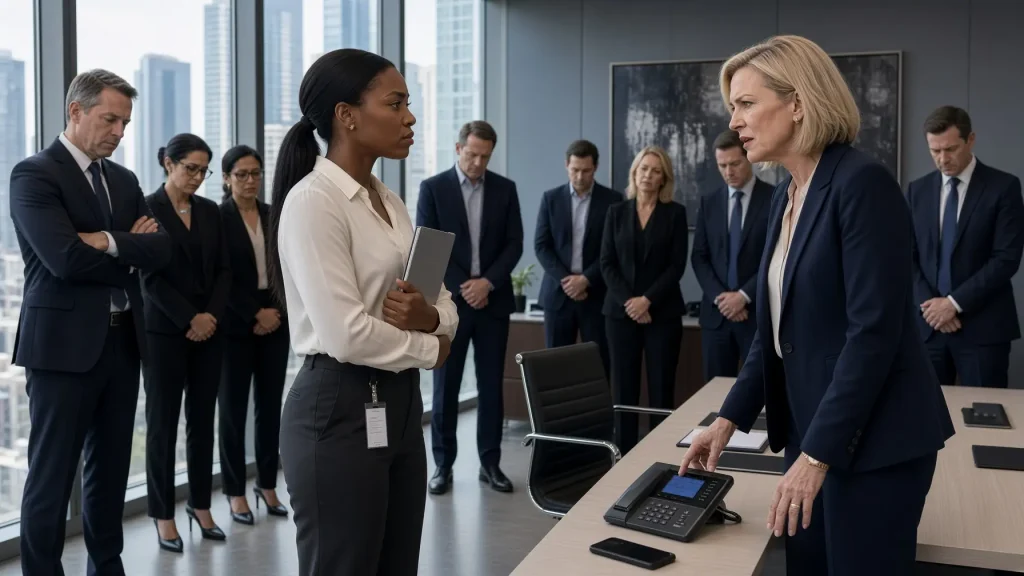
The color in her face had changed. Not vanished. Not yet. But something had cracked behind her expression. For the first time since Maya entered the room, Victoria looked like she no longer understood the shape of the situation.
Maya remained completely still.
The folder was still against her chest.
Her eyes never left Victoria’s face.
The silence stretched.
Then Mercer’s voice came again, firmer this time.
“Victoria.”
“Yes?”
“Put. Maya. On.”
Victoria swallowed.
The movement was tiny, but visible.
She reached toward the conference table, picked up the phone, then seemed to think better of it. Instead, she tapped the speaker button to ensure the line remained open and pushed the device an inch forward like it had suddenly become hot.
“Maya,” she said.
It was the first time she had spoken Maya’s name that morning without contempt.
Maya stepped forward.
Not hurriedly.
Not triumphantly.
Calmly.
She set the folder down on the table, beside Victoria’s notebook, and leaned just enough toward the phone for her voice to carry.
“This is Maya Carter.”
“Ms. Carter,” Mercer said, and the respect in his tone hit the room harder than a shout would have. “I’ve been asking for your revision notes since eight this morning.”
Victoria’s eyes flicked sharply toward Maya.
Maya answered evenly.
“I sent the debt restructuring notes at eight twelve, the covenant-risk memo at eight twenty-six, and the revised sensitivity table at eight forty-one.”
Mercer did not hesitate.
“Yes. Those.”
A pause.
“None of them came from Victoria.”
No one in the room breathed.
Maya didn’t look at anyone.
“They were sent to Ms. Blake’s office for review.”
Mercer gave a short, humorless laugh.
“Review.”
Now people were looking at Victoria.
Not openly yet.
But enough.
Enough that she felt it.
Mercer continued.
“For the last four days, the only person on your team asking the right questions has been Maya Carter.”
The vice president nearest the window lowered his eyes.
One assistant glanced involuntarily at the folder on the table.
Victoria found her voice.
“Daniel, perhaps there’s been a misunderstanding. Maya is a junior analyst. I’ve been overseeing—”
Mercer cut her off.
“I know exactly what Maya is.”
His tone had changed.
The polished friendliness from the beginning of the call was gone.
“She’s the one who caught the pension liability exposure your directors missed.”
No one moved.
An older executive near the door slowly straightened.
“And,” Mercer said, “she’s the one who emailed me last night to warn that your draft presentation still contained last quarter’s assumptions.”
This time the shock passed physically through the room.
Victoria’s head turned toward Maya.
Maya kept her gaze on the phone.
She had not wanted that email to matter.
At 11:48 p.m., after seeing her corrected numbers removed from the deck for the second time, Maya had sent a short message directly to Mercer’s chief of staff—not to expose anyone, just to prevent Blake & Rowe from walking into a billion-dollar conversation with the wrong model. She assumed it would be buried, maybe forwarded, maybe ignored.
Apparently, it had not been ignored.
Mercer spoke again.
“I asked this morning who built the revised model.”
No one answered.
“I’m asking again now, while we all seem to be listening.”
Maya could feel the air shift around her.
There were people in the room who knew the answer.
There were people in the room who had watched her work late all week.
There were people who had nodded vaguely at her in hallways while carrying presentations shaped by her labor.
But truth is a slow thing in rooms accustomed to hierarchy.
Finally, one of the vice presidents cleared his throat.
“Maya assembled the updated package.”
Victoria turned sharply toward him.
He did not look at her.
Mercer said, “Thank you.”
Then, more quietly:
“Maya?”
“Yes?”
“I’d like you to walk me through the revised downside scenario yourself.”
Another silence.
This one felt different.
Not cruel.
Not stunned.
Precise.
The kind that descends when the room realizes the center of gravity has moved.
Victoria tried again.
“That won’t be necessary. I can present the takeaways.”
Mercer’s response came instantly.
“No.”
One word.
Flat.
Final.
“I asked for Maya.”
Victoria went very still.
Maya looked at the speakerphone, then at the folder she had set down. It suddenly felt lighter, as though some invisible weight had shifted off her hands and onto the table where it belonged.
“All right,” she said.
She opened the folder.
Inside were color-tabbed pages, clean and orderly despite the morning.
Maya turned to the revised summary table and began.
“The downside scenario assumes a nine percent contraction in industrial demand over four quarters instead of the five percent in the original deck.”
Her voice was calm.
Measured.
Professional.
No tremor.
No revenge.
No need to dramatize what the room had already witnessed.
She walked Mercer through the model the way she had always walked herself through it at midnight in her apartment, seated cross-legged at her kitchen table with cold coffee and a laptop full of other people’s deadlines.
She explained the cash-flow pinch in quarter two.
The covenant breach risk if raw-material pricing stayed elevated.
The pension liability distortion that made the original optimism dangerous.





