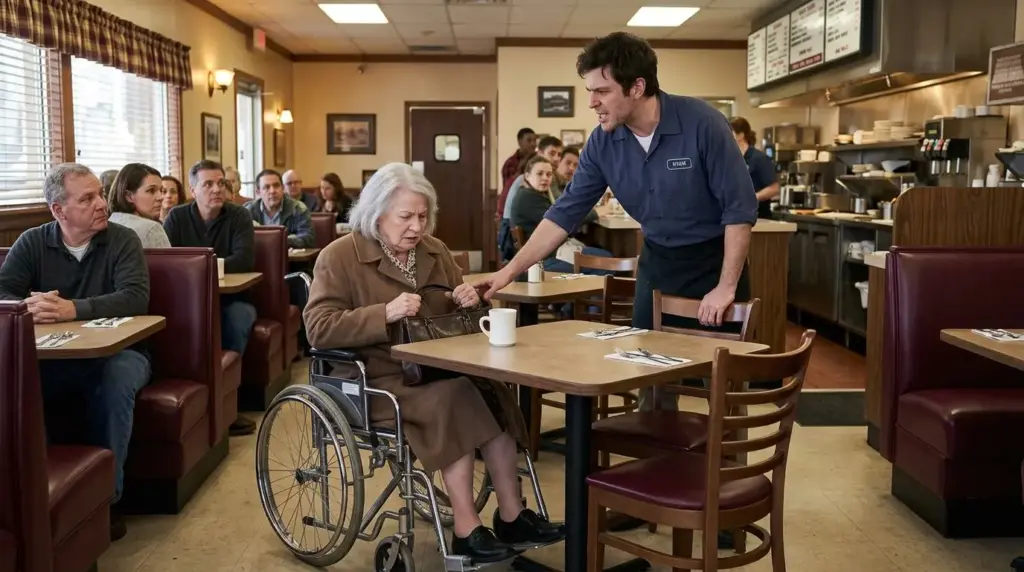
“Responsible for his own behavior. Pressure explains choices. It doesn’t erase them.”
Marcus nodded.
“Good.”
Eleanor studied him.
“You expected me to fire him in the dining room?”
“Part of me did.”
“So did part of me.”
“Why didn’t you?”
“Because power should be slower than anger.”
Marcus smiled faintly. “You sound like somebody who’s made expensive mistakes.”
“I own a hospitality company. Of course I have.”
He laughed.
Over the next two weeks, Marcus walked through Dawson’s before sunrise with engineers, accessibility consultants, and an architect who initially spoke to him as if he were a subcontractor hired to carry tools. By the third site visit, the architect stopped doing that.
Marcus understood the building in ways drawings did not show.
He found trapped moisture behind the kitchen wall, identified an original drainage line that could be reused, and proposed shifting two booth partitions instead of demolishing the entire dining room. He designed a ramped side entry that matched the historic brick instead of attaching a metal structure to the front facade. He widened the route to the accessible restroom without sacrificing more than six seats.
His revised estimate came in at one hundred thirty-eight thousand dollars.
Less than half the number Dana had used.
The board approved the project contingent on final permits.
Marcus won the contract.
Not because Eleanor ordered them to choose him.
His bid scored highest on preservation, accessibility, timeline, and cost.
When Camille called to tell him, Marcus sat on the edge of his bed for almost a full minute without speaking.
Ava was brushing her teeth in the bathroom.
“Daddy?”
He covered his face with one hand.
“We got the diner.”
Ava appeared with toothpaste foam at the corner of her mouth. “We own it?”
Marcus laughed through the sudden pressure behind his eyes. “No, baby. We get to fix it.”
“Can I help?”
“With what?”
“The table.”
He knew exactly which one she meant.
The investigation concluded three days later.
The cloud backup preserved everything Dana thought she had deleted from the local camera system. Footage showed Ryan repeatedly moving older guests toward the smallest tables, discouraging wheelchair users during peak hours, and telling one man with a walker that he would be “more comfortable somewhere quieter.” Marisol and four other employees admitted Dana had pushed a table-turn policy that categorized customers by average spend.
The emails were worse.
Dana had written that “low-yield occupancy” needed to be reduced before property valuations were reviewed. She specifically listed seniors ordering coffee, teenagers splitting meals, and “mobility-device guests requiring oversized clearance” as examples of inefficient seating.
Then auditors found the altered accessibility estimate.
Dana had changed the consultant’s figure and attached the inflated number to a redevelopment presentation.
The board terminated her employment for falsifying records and undisclosed conflict of interest. The company referred the altered documents and related financial issues to outside counsel for review.
Ryan received a final warning, unpaid suspension, and mandatory retraining, but Eleanor insisted his case be separated from Dana’s.
“He did something cruel,” she told human resources. “Find out whether he understands why it was cruel before deciding whether he’s incapable of doing better.”
Ryan surprised everyone by asking to apologize in person.
Eleanor agreed on one condition.
Marcus and Ava would not be asked to attend.
“They don’t owe you an audience,” she told him.
Ryan met Eleanor at the closed diner before renovations began.
He looked younger without the uniform.
“I thought you were wasting the table,” he said after several failed attempts to explain himself. “That’s the truth. Dana kept talking about numbers. Covers per hour. Average checks. I started looking at people like seats instead of people.”
Eleanor listened.
“And the wheelchair?”
Ryan looked down.
“I knew what I was doing.”
“Why?”
“Because I was frustrated, and I knew you couldn’t just move wherever I wanted you to. So I used it against you.”
That answer mattered more than an excuse would have.
“Do you expect me to forgive you?” Eleanor asked.
“No.”
“Good. Because this isn’t about making you feel better.”
He nodded.
“What do I do then?”
Eleanor looked around the diner.
“You learn what hospitality means when the customer can’t increase your numbers. Then you decide whether you’re capable of practicing it.”
Ryan returned after suspension as a busser, not a server.
It embarrassed him.
Eleanor considered that useful.
Marcus’s renovation began in early spring.
He hired four tradespeople he trusted, including a young carpenter named Darnell who had spent a year bouncing between temporary jobs because every contractor wanted three years of experience for entry-level work. He also insisted that the accessibility consultant remain involved through construction instead of appearing only at final inspection.
Ava visited on Saturdays.
She wore safety glasses too large for her face and carried a tiny tape measure Marcus bought specifically so she would stop stealing his.
Eleanor visited too, though not as often as she wanted.
Her health had become unpredictable. Some mornings her hands trembled badly enough that holding a coffee cup required both palms. Other days she arrived sharp-eyed and impatient, correcting people who tried to move her wheelchair without asking.
Marcus noticed the difference between helping and taking over.
Ava understood it instinctively.
“Do you want me to push?” she always asked.
Sometimes Eleanor said yes.
Sometimes no.
Ava accepted both answers exactly the same way.
One Saturday, Marcus uncovered an inscription beneath the end booth closest to the kitchen.
T.P. + E.P. 1979.
Thomas Price had carved it into the underside of the oak before installing the booth.
Marcus called Eleanor over.
She reached beneath the edge with trembling fingers and traced the letters.
For a long time, she said nothing.
Then she laughed and cried at once.
“He told me he’d hidden my initials somewhere in this building,” she said. “I never found them.”
Marcus smiled. “Guess he trusted the right carpenter.”
Eleanor looked at him. “He would have liked you.”





