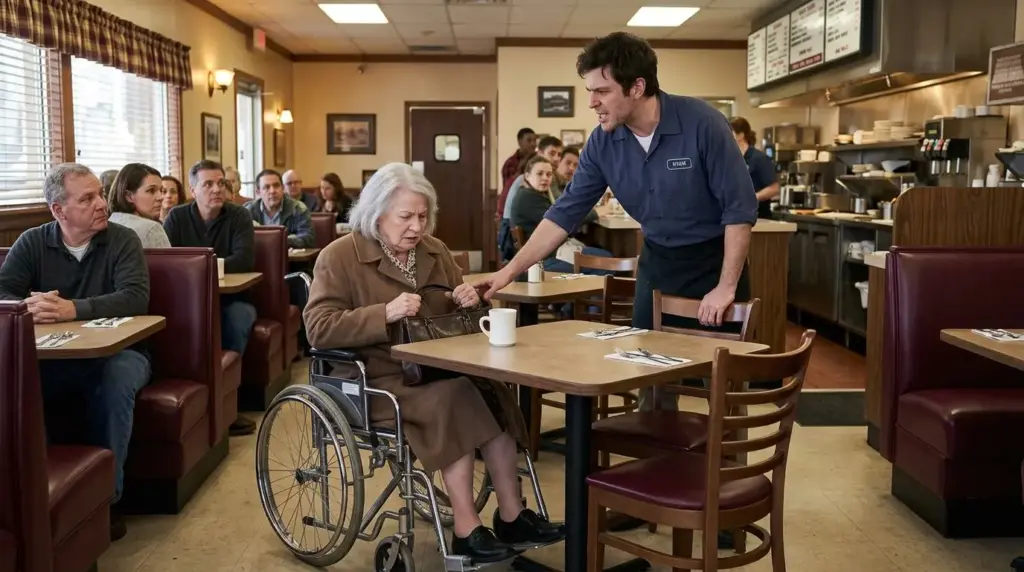
That sentence stayed with Marcus longer than he expected.
The deeper twist came a week before reopening.
Corporate legal called Eleanor with the results of the property review.
Dana’s brother-in-law was not merely employed by the developer trying to buy Dawson’s.
He held a hidden financial interest in the project through a limited partnership.
Emails showed Dana had been promised a consulting position after the sale closed.
The plan depended on making the diner look operationally weak and physically obsolete.
Driving away customers who needed more time or space was not officially written anywhere as a redevelopment strategy.
It did not need to be.
Dana had built a culture where staff understood which customers she wanted gone.
Eleanor read the report in silence.
For years, she had believed the greatest risk to the company was losing money.
Now she understood another kind of loss.
A business could keep its buildings and still lose the reason it deserved to exist.
She called Graham, her nephew and CEO, into her office.
He expected a discussion about legal exposure.
Instead, Eleanor placed Ava’s drawing on the table between them.
OUR TABLE.
“Do you know what this is?” she asked.
Graham stared at it. “A child’s drawing.”
“It’s a business plan.”
He looked confused.
Eleanor explained.
Dawson’s would reopen under a new service policy built around one principle: nobody would be treated as less valuable because they ordered less, needed more time, used mobility equipment, looked poor, or arrived alone. Peak-hour operations would still matter. Tables still had to turn. But efficiency would no longer be allowed to disguise contempt.
Graham listened, then said something Eleanor did not expect.
“We should do it everywhere.”
She leaned back.
“Every location?”
“Every location. And we audit the ones where complaints are highest.”
Eleanor studied him.
“You know that’s expensive.”
“So is becoming the kind of company that needs a child to explain what a table is for.”
For the first time in months, Eleanor felt hopeful about what would happen after she was gone.
Reopening morning arrived with rain.
Marcus considered that appropriate.
Dawson’s looked almost exactly like itself.
That was the achievement.
The old oak booths remained, stripped and refinished. The cracked ceiling was repaired properly. The accessible route from the entrance was wider without feeling clinical. The corner table where Eleanor had been insulted now had adjustable clearance and a small brass plaque mounted beneath the edge where most people would never notice it.
Ava knew what it said.
OUR TABLE.
She had insisted.
Customers filled the diner before ten.
Some came because local news had covered the preservation project. Others came because they had been eating at Dawson’s for thirty years and wanted to complain that the coffee cups looked different even though they were exactly the same.
Eleanor arrived at eleven.
No black sedan stopped at the entrance this time.
She came in a wheelchair-accessible van with Camille and asked to be left at the curb.
Marcus opened the door for her.
Ava ran up wearing a purple dress and shouted, “You’re late.”
“I own part of the company,” Eleanor said. “I thought that meant people waited for me.”
“Not at lunch rush,” Ava replied.
Marcus laughed.
The three moved toward the corner table.
Then they stopped.
Someone was already sitting there.
An elderly man with an oxygen tank occupied one side. Across from him sat a teenage girl dividing one plate of pancakes between herself and a younger boy.
For half a second, Marcus wondered whether staff would move them for Eleanor.
A server approached.
It was Ryan.
He looked at Eleanor, then at the occupied table.
“We have another accessible table opening in about five minutes,” he said. “Or, if you prefer, I can ask whether they’d be comfortable sharing. Their choice and yours.”
Eleanor studied him.
“Five minutes is fine.”
“Coffee while you wait?”
“Tomato soup.”
Ryan smiled slightly. “Already ordered.”
He walked away.
Ava tugged Eleanor’s sleeve.
“He’s nicer now.”
“He’s learning.”
“Did you teach him?”
Eleanor looked at Marcus.
“Life did most of it.”
When their table opened, Marcus helped move one chair aside but did not touch Eleanor’s wheelchair. She positioned herself exactly where she wanted.





