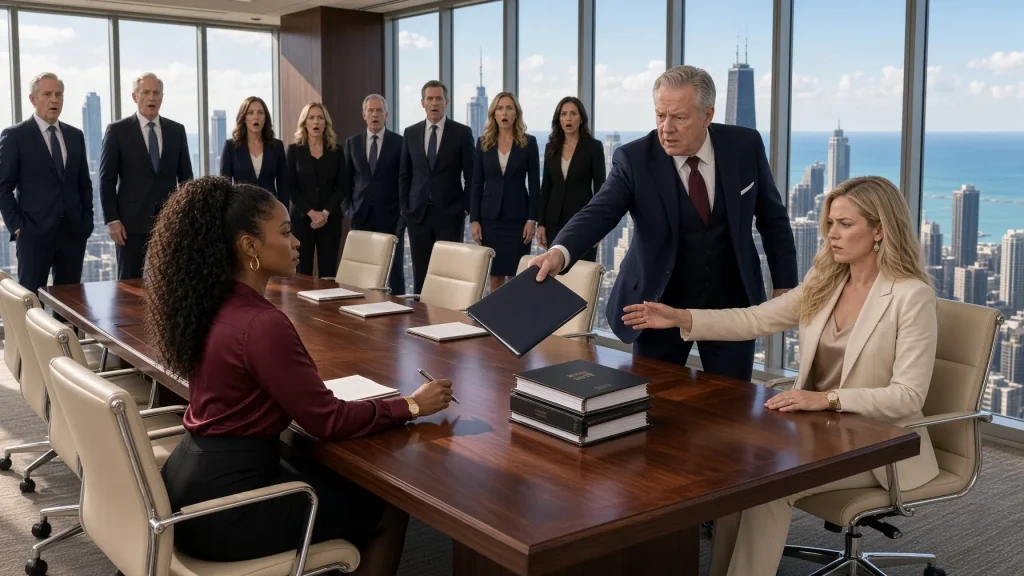
Naomi’s title merely exposed it.
Her signature saved Blakewell from an immediate liquidity crisis.
The financing protected payroll, bought the company time, and gave a viable business room to restructure.
But Blakewell had been facing another kind of failure too.
A company could survive bad debt.
It could survive a failed product.
It could survive one terrible acquisition.
It could even survive an executive making an awful decision.
What it could not survive forever was a culture where people had to prove they were powerful before they were treated as worthy of respect.
That lesson had been sitting in the boardroom from the moment Naomi walked in.
Simple brown blazer.
Clean boots.
Outstretched hand.
Waiting for someone important enough to notice.
The quiet in the auditorium lingered long after Naomi capped her dry-erase marker. The young analyst who had asked the first question sat with his pen suspended above his notebook, staring at the three words on the board. No one in the lecture hall stood up to leave, even though the scheduled time had expired ten minutes earlier. Naomi gathered her notes from the lectern, slipped them into her worn leather portfolio, and looked out over the rows of ascending seats. She saw herself fifteen years ago in those eager, defensive faces. She remembered the sharp ache of wanting to prove that she belonged in rooms filled with people who had inherited their confidence like family silver. She stepped down from the stage and walked toward the double doors at the back of the hall. Outside, the Chicago wind came off the lake with an autumn bite, carrying the scent of damp pavement and falling leaves. Her phone vibrated in her coat pocket. She pulled it out and saw a notification from the executive secretariat of Blakewell Systems. The quarterly earnings release had crossed the wire forty minutes ago. Operating income was up twenty-four percent year-over-year. The legacy hardware division had secured a multi-year municipal transit contract that guaranteed factory utilization in Ohio through the end of the decade. The debt that had once threatened to pull nineteen hundred families under was now fully amortized down to investment-grade territory. Attached to the formal release was a short, unadorned note from Daniel Reeves.We closed the secondary note offering this morning without a discount.The floor in Akron is adding forty machinists next month.Thank you for making us do the inventory count twice. Naomi smiled, slid the phone back into her pocket, and adjusted the lapels of her coat against the breeze. She hailed a cab on Michigan Avenue, sliding into the back seat as the driver merged into the midday traffic moving south toward the Loop. She thought about her father standing beside the hydraulic press in Johnston County. She remembered how Isaiah Carter used to run his calloused thumb along the edge of a fresh-cut steel flange, testing for burrs that a customer might never see but that would eventually chew through a seal five years down the line.You don’t finish a part when it looks good, he had told her while the metal dust settled around them.You finish it when the man who has to rely on it won’t ever have to curse your name in the dark.
That was what the spreadsheets never captured. The people who drafted the restructuring memos never had to look an assembly-line supervisor in the eye and explain why his pension calculation had been re-benchmarked against an artificial treasury yield. Her phone buzzed again as the cab crossed the bridge over the river. It was Thomas Avery. She tapped the screen and brought the phone to her ear. “Thomas.” “Naomi, are you still in town?” “I have a four-fifteen flight out of O’Hare.” “Do you have thirty minutes before you head to the expressway?” Naomi checked her watch. “What do you need, Thomas?” There was a brief pause on the other end of the line, the sound of papers rustling in the background. “Charles is stepping down from the board at the annual meeting next month.” Naomi leaned back against the leather seat, watching the glass towers reflect the grey Midwestern sky. “He told me he was considering it during the summer audit.” “The nominating committee met this morning,” Thomas said. “They voted unanimously to recommend you as non-executive chair.” Naomi did not answer immediately. The silence stretched between them, filled only by the hum of the cab’s tires against the bridge grating. “Thomas, I’m the managing partner of an institutional rescue lender.” “You converted the debt to common equity fourteen months ago,” Thomas countered smoothly. “You hold twelve percent of the voting shares through the turnaround fund.” “And more importantly, the union representatives on the pension oversight committee explicitly asked for your name.” Naomi looked down at her hands resting in her lap. She could see a tiny faded scar across the knuckle of her right index finger, earned when she was twelve helping Marcus clear a jammed drill press in the shop back home. “Does Victoria know?” Naomi asked. Thomas cleared his throat softly. “Victoria was the one who submitted the motion to the family voting trust.” Naomi closed her eyes for a second. The image of that morning in the walnut-paneled boardroom flickered across her mind with sudden, startling clarity. The white suit. The dramatic retraction of the hand. The diamond bracelet flashing beneath the chandelier. The ugly, unearned certainty of a woman who thought the world began and ended with her father’s checkbook. It would have been easy to feel a surge of vindication. It would have been satisfying in the shallow, brittle way that revenge always felt when it was packaged as justice. Instead, Naomi felt only the quiet, heavy responsibility of what the offer actually meant. “Tell the committee I’ll take it on two conditions,” Naomi said. “Name them,” Thomas replied without hesitation. “First, the apprentice training program in the manufacturing division gets five percent of the net operational savings permanently carved out into an independent endowment.” “Done.” “Second, the board never holds another quarterly review in the executive tower.” Thomas laughed softly, a dry, tired sound that carried the relief of an old lawyer who had survived a long war. “Where do you want us to meet, Naomi?” Naomi watched a delivery truck navigate an alleyway between two brick warehouses along the riverbank. “In the break room at the Akron plant,” she said evenly. “Where the people who make the sensors eat their lunch.” Thomas paused, his voice softening. “Charles said you would say that.” “Tell Charles I’ll see him at the plant on Tuesday.” She ended the call and looked out the window as the cab turned toward the expressway leading to the airport. The city opened up around her in broad bands of concrete, steel, and autumn grass. Her mind drifted back to the machine shop forty miles east of Raleigh. Her father was retired now, his knees stiff from forty years of concrete floors, spending his mornings tending a small garden behind the house while her mother still kept the emergency cash jar on the top shelf of the pantry. They had never asked her how much money Carter Ridge managed. They had never asked about the private equity rankings or the articles in the financial press that called her a rising star in distressed debt. When she went home for Thanksgiving, her father would sit at the end of the wooden kitchen table, pass her the biscuits, and ask one simple question.Did you treat people fair this year, baby? And she would look at him across the scarred oak tabletop, thinking of every meeting, every contract, and every signature that had passed through her hands.Yes, Daddy, she would tell him.I treated them fair. The cab accelerated onto the highway, joining the steady, unglamorous stream of commuters moving beneath the gray Illinois sky. Naomi leaned her head against the cool glass of the window, let out a slow, quiet breath, and watched the road unroll before her.





