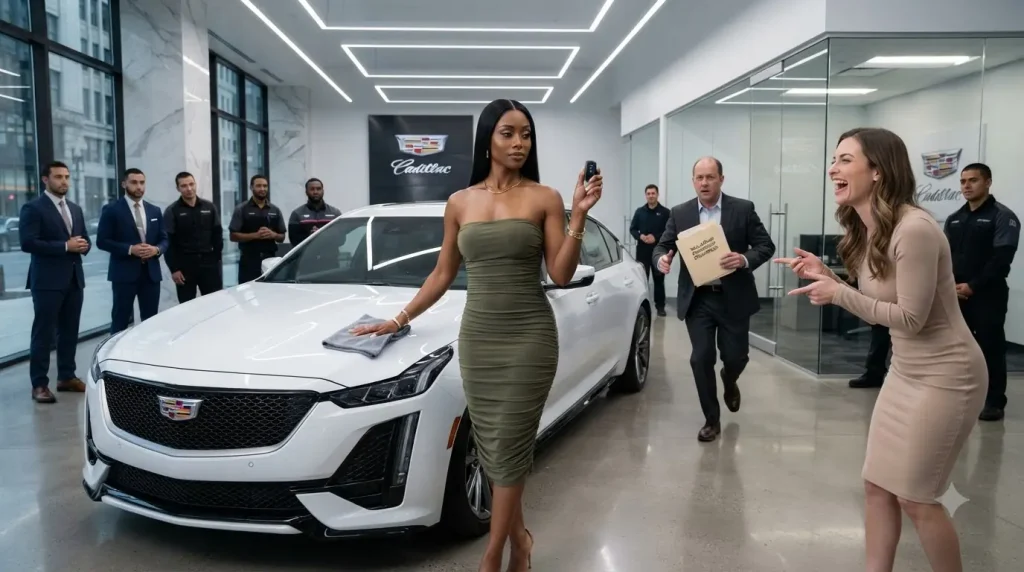
Simone did not look up from the document she was reading. She turned a page, her finger tracing a line item near the bottom.
“On August fourteenth of last year,” Simone read aloud, her tone as dry as an insurance actuary’s report, “you handled the purchase paperwork for a 2021 certified pre-owned hybrid sedan. The buyer was Elena Ramos. A certified nursing assistant from East Charlotte. Her credit score was seven hundred and twelve.”
Cassandra’s tapping finger paused, then resumed its rhythm. “I don’t recall individual retail clients from fifteen months ago. We sell two hundred units a month.”
“I’m sure you don’t,” Simone continued. “Because if you remembered them as people, it would be much harder to do what you did. A seven-hundred-and-twelve credit score qualified Ms. Ramos for tier-one captive financing at three-point-nine percent through the manufacturer. But your desk submitted the paperwork to a secondary sub-prime lender based in Scottsdale, Arizona. You marked her down as an undocumented hospitality worker with unverifiable income.”
Arthur Vance, the prosecutor, raised his eyebrows slightly, looking over the rim of his reading glasses at Cassandra.
“The Arizona lender approved the paper at fourteen-point-two percent,” Simone said. “They paid an upfront dealer acquisition premium of five thousand two hundred dollars. You then added a four-hundred-dollar window-etching fee—which was never applied to the car—and an eighteen-hundred-dollar tire-and-wheel protection policy that had an exclusion clause on page twelve specifically invalidating claims for vehicles with aftermarket wheels. The car had aftermarket wheels when it arrived from the auction.”
Simone finally looked up.
Her gaze was not fiery. It was worse. It was entirely dispassionate, the look of an engineer examining a sheared bolt that had caused an engine failure.
“The total overcharge on that single transaction was eight thousand seven hundred and forty dollars,” Simone said. “Ms. Ramos’s monthly payment went from three hundred and ten dollars to five hundred and forty-five. She defaulted six months later. The car was repossessed by the Arizona lender, who then sold it back to your brother-in-law’s wholesale lot in Concord for thirty percent of its wholesale book value.”
“My brother-in-law operates a fully licensed independent auto dealership,” Cassandra hissed, her face burning. “Whatever transactions occurred post-repossession are between the financial institutions and the registered wholesale buyers. You cannot tie that to my desk.”
“We didn’t have to,” one of the auditors said, turning his laptop screen forty-five degrees so it faced the center of the table. “Your personal IP address was logged into the Arizona lender’s dealer portal from your home in Myers Park at eleven-forty-five on the night of the repossession. You submitted the bid on behalf of your brother-in-law’s LLC using an administrative login registered to this store.”
Cassandra stared at the screen. The blue light reflected in the wide, dilated pupils of her eyes.
The tapping stopped.
“You thought the acquisition was a change of logos, Cassandra,” Simone said, leaning forward, resting her elbows on the polished wood. “You thought some faceless investment group from Atlanta was going to wire the funds, look at the net operating profit on the year-end statement, sign off on your performance bonus, and send you a gift basket at Christmas.”
“I built this store’s luxury book,” Cassandra whispered, her knuckles turning white against the edge of the table. “Before I took over this desk, this place was selling run-out inventory to fleet managers. I brought in the Myers Park crowd. I brought in the Quail Hollow money. You wouldn’t have paid seventy-eight million dollars for this group if the margins weren’t here!”
“The margins are fictional,” Simone said. “You didn’t build a book of business. You built a tollbooth. You flattered the people who had enough money to hire lawyers, and you bled the people who were too tired to argue with you at eight o’clock at night.”
Simone stood up.
She walked to the window, looking down through the rain-streaked glass at the rows of luxury cars sitting in silent, gleaming ranks beneath the high sodium lights of the front lot.
“My father worked forty hours a week behind a building just like this,” she said, her back to the room. “And then he worked twenty hours on the weekend washing city buses down on Wilkinson Boulevard. He had calluses on his palms so thick he couldn’t feel the heat from a coffee cup. Every Friday, he brought his check home, sat down at the kitchen table with an envelope, and put forty dollars into an account for my college tuition.”
She turned around.
“He used to tell me that there are two kinds of people who handle cars: the ones who respect the work it takes to build them, and the ones who think the car is just a mirror to show everyone how rich they are.”
She looked directly at Cassandra.
“You looked at me this morning and saw a woman with a rag in her hand. You saw someone who looked like my father. You saw someone you thought you were allowed to step on because nobody had ever taught you that the foundation is the only thing keeping the roof off your head.”
Simone turned to Arthur Vance. “The files are yours, Arthur. Carter Mobility will provide full documentation, employee depositions, and our audit trails without subpoena. We’ll be closing the store for three days starting tomorrow to re-audit every active contract written in the last thirty-six months.”
Martin Hale let out a small, broken sound. “Three days? Simone… the floor inventory interest alone will run eighty thousand dollars.”
“Then we’ll pay it,” Simone said without hesitation. “Honesty is expensive when you haven’t practiced it for a decade, Martin. Consider it the cost of cleaning the clear coat.”
Arthur Vance stood up, buttoning his jacket. He signaled to two plainclothes investigators waiting in the hall.





