The hearing officer began by reviewing the school’s anti-bullying policy, its rules concerning physical assault and property destruction, and the procedures for evaluating student testimony.
Then she turned to the boys.
“Each of you will have an opportunity to respond. We will examine the evidence before reaching any conclusions.”
Derek’s father immediately interrupted.
“My son has been falsely accused by a child who struggles to control his behavior.”
The hearing officer looked at him.
“Your son’s behavior is also part of the matter under review. We will not use another student’s diagnosis as a substitute for evidence.”
For the first time that morning, Richard said nothing.
The school resource officer presented the photographs from the activity room.
The overturned table.
The cake container.
The frosting on the floor.
My son’s injuries.
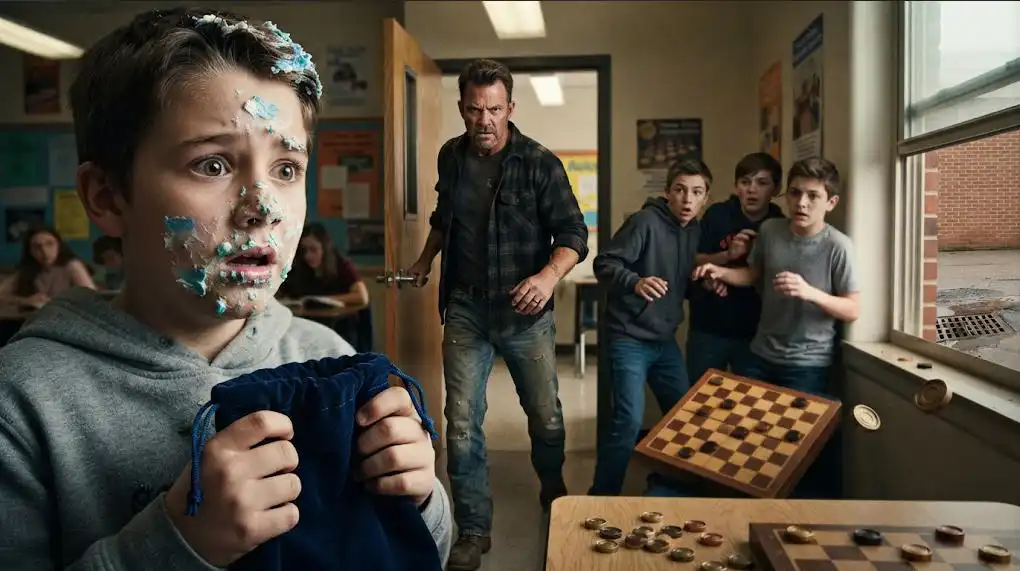
The original video showed me rushing through the doorway, the three older boys stepping away from my son, and Derek’s hand still covered with blue frosting.
Then the officer displayed the photographs of the exterior railing.
The blue handprint was clearly visible.
Richard leaned toward his lawyer and whispered.
The officer continued.
“The recovered property was documented immediately after retrieval. Each piece was photographed, labeled, and stored separately. The third king checker contains a suspected biological trace. Laboratory confirmation is pending.”
Richard stood.
“This proves nothing!”
The hearing officer raised her hand.
“Sit down, Mr. Lawson. You will have your opportunity to respond.”
Then she asked my son to approach the table.
He looked at me.
I nodded.
He stood, holding the velvet bag.
The hearing officer spoke gently.
“We understand that reading printed notation can be difficult for you. You may explain the position in the way that works best for you.”
My son placed the checkers on the demonstration board.
“I set up this position before they came in,” he said.
He described the thirty-two-move endgame he had been studying.
He identified the original positions of the pieces, the sequence he had intended to test, and the moves he had planned to make next.
The board had been photographed after the incident, before it was reset. The photographs were already part of the record.
My son matched the documented arrangement.
Then he closed his eyes.
“Can I do the next part blindfolded?”
The hearing officer looked at the checkers instructor, who had been asked to attend as a neutral technical adviser.
The instructor nodded.
My son placed the blindfold over his eyes.
For a moment, the room was completely still.
Then he began describing the moves.
He named the square, the direction of travel, the available jump, and the position that would result. He corrected one piece that the instructor had placed incorrectly and explained why the alternative would leave the king vulnerable.
He continued through the sequence without hesitation.
When he finished, the instructor compared the final position with the documented solution.
They matched.
The hearing officer removed the blindfold from his eyes.
My son blinked at the lights.
“I know the board,” he said quietly. “Even if I can’t read everything quickly, I can remember where the pieces go.”
No one laughed.
The instructor looked at the district representatives.
“This is a sophisticated positional reconstruction. His reading difficulty has no bearing on the validity of the demonstrated skill.”
Richard shifted in his chair.
But my son was not finished.
He picked up the third king checker.
“I can tell you which one this is without looking.”
He ran his thumb over the edge.
“This is the third king. My dad cut a little notch here because I kept mixing it up with the other pieces when I first learned to play blindfolded.”
He turned it over.
“And this is the groove that got scratched when Derek grabbed the bag.”
The hearing officer asked the officer to bring forward the evidence photograph.
The close-up showed a small dark trace inside the same groove.
My son looked at the picture.
“I remember that mark.”
He pointed to the notch.
“That’s my dad’s cut. It’s the same piece.”
The officer explained that the piece had been recovered from the storm drain, documented, and preserved. The initial biological examination had not yet established whose blood it was, but the suspected trace had been collected for further analysis.
Derek’s right thumb was visibly bandaged.
He had told the school nurse that he had cut it while working on a home project.
The hearing officer asked him whether he had touched the checkers.
“No,” he said.
My son lowered his eyes.
Then he spoke again.
“He had a cut on his right thumb when he took the bag. I saw it when he grabbed the zipper. The sharp edge caught him.”
Derek shook his head.
“He’s making that up!”
My son flinched at the shout.
I moved closer but did not answer for him.
He took a breath.
“I don’t want him to get hurt,” he said. “I just want people to know what happened.”
That sentence changed the room more than any accusation could have.
He was not asking for revenge.
He was asking to be believed.
The hearing officer called for a recess while the district reviewed the video, the statements, the physical evidence, and the applicable conduct rules.
During the break, Richard Lawson approached me.
“You’ve made a serious mistake,” he said quietly.
I looked at him.
“By asking the district to investigate an assault?”
“By embarrassing my son.”
“Your son embarrassed himself when he chose to hurt a younger child.”
Richard’s jaw tightened.
“You think this makes you a hero?”
“No.”
I looked through the glass panel toward my boy, who was carefully arranging his checkers on the table.
“I think it makes me his father.”
Richard walked away.
When the hearing resumed, the hearing officer announced that the district had found the evidence sufficient to establish that Derek and the two other students had participated in a coordinated act of bullying and physical assault.





