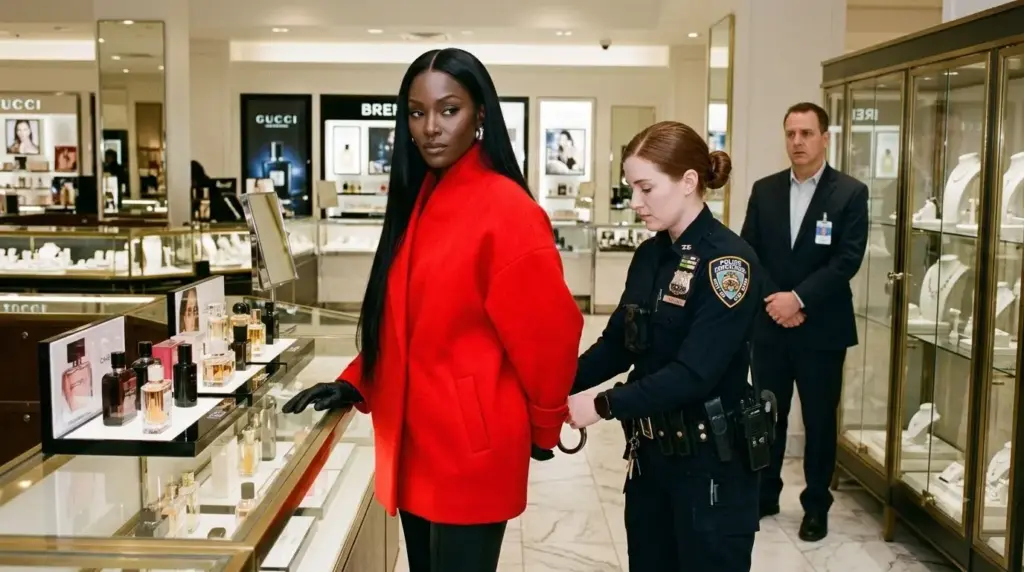
“Officer Bennett,” Lieutenant Price said, leaning back in his chair. “When the manager suggested moving the suspect and the evidence to a private room, before you had even verified the theft, what went through your mind?”
Claire looked at the still frame on the monitor. Gary’s polished, calm face.
“I thought he was following store policy,” she answered truthfully, her voice raspy. “I thought he was trying to de-escalate a public scene.”
“And did it occur to you that moving a suspect and a supposedly unsearched bag to a private room without an independent witness could also be a tactic to plant evidence?”
The question hung in the air. Claire felt sick.
“No,” she whispered. “It didn’t.”
Price wrote something down. “You accepted his narrative completely, and you dismissed hers entirely.”
“Yes.”
“Why?”
The single word echoed. It was the question Claire had been agonizing over since 2:00 a.m.
She looked at her union representative, who offered a subtle shake of the head, a silent warning not to over-explain.
But Claire was done hiding behind procedure.
“Because he sounded like someone who was supposed to be in charge,” Claire said slowly, forcing herself to maintain eye contact with Price. “And she sounded like someone who was challenging that authority.”
“I let my perception of who belonged in control dictate how I treated them.”
Sergeant Knox, sitting quietly in the corner, raised an eyebrow. It wasn’t an excuse; it was an admission of bias, and a surprisingly honest one.
Price closed his folder. “The disciplinary board will convene next week, Officer Bennett.” “You remain suspended pending their decision.”
Claire stood up, her legs feeling like lead. She left the room, the weight of her own admission pressing down on her.
Meanwhile, across the city, the investigation into the Bright Harbor Foundation was accelerating at a terrifying pace.
Denise Reed sat in the secure conference room of the district attorney’s office. Nora Patel spread a series of financial documents across the table.
“We executed the warrant at Leonard Shaw’s residence early this morning,” Patel said, her voice devoid of emotion.
Denise tensed. “And?”
“We found the missing forty-eight-thousand-dollar bracelet,” Patel confirmed. “It was in a safe hidden in his home office.”
Denise closed her eyes. The betrayal was profound, a physical ache in her chest. Leonard, the man who had eaten dinner at her table, who had played with her children, had been systematically looting the emergency housing fund.
“How did it work?” Denise asked, her voice tight.
Patel pointed to a flow chart on the whiteboard. “Shaw was authorizing purchases using the restricted charity funds.” “Gary Mills, the store manager, would process the transactions, but the merchandise never left the vault.”
“Mills would then issue a fraudulent ‘administrative refund’ for a slightly lesser amount, routing the money to offshore accounts controlled by Shaw, while keeping the merchandise for himself or selling it on the black market for pure profit.”
“The bracelet was likely intended to be part of that scheme, but you interrupted it.”
Denise opened her eyes. “How?”
“When you asked accounting for the invoices, Shaw panicked,” Patel explained. “He contacted Mills.” “When you showed up at the store, Mills knew you were getting close.”
“He needed to discredit you, to create a scandal that would force you to step down from the foundation, effectively shutting down the internal audit.”
“He called the police, intending to plant the bracelet on you in the security office, but your refusal to be moved prevented that.” “He panicked and kept the bracelet, later handing it off to Shaw.”
The sheer audacity of the plan left Denise temporarily speechless. They hadn’t just tried to steal from her; they had tried to destroy her reputation to cover their tracks.
“Where is Naomi?” Denise finally asked, remembering the whistleblower who had risked everything. “The sales associate.”
Patel’s expression softened slightly. “She is safe.” “We located her yesterday afternoon.” “Mills had threatened to fire her and implicate her in the theft if she didn’t corroborate his story.” “She fled, but she contacted our office once the news broke.”
“Her testimony is the final nail in the coffin for Mills and Shaw.”
Three days later, the district attorney announced a sweeping indictment against Leonard Shaw and Gary Mills. The charges included grand larceny, wire fraud, conspiracy, and filing false police reports.
The press conference was a media circus. The fifteen-second viral clip of Claire and Denise was replayed endlessly, but now the narrative had shifted entirely.
Denise Reed was no longer the ‘entitled wife’ or the ‘wrongfully accused victim’; she was the relentless investigator who had exposed a massive charity fraud ring.
Thomas Reed stood at the back of the press room, watching his wife address the cameras with a quiet, unbreakable dignity. He felt a deep sense of pride, mingled with the lingering shame of his own initial reaction at the department store.
He had let his anger cloud his judgment, forgetting the very principles his wife had spent her life defending.
That evening, Denise sat in her home office, reviewing the final audit report for the Bright Harbor Foundation. The stolen funds would eventually be recovered, but the trust would take years to rebuild.
There was a knock on the door. Thomas stood in the hallway, looking uncharacteristically uncertain.
“Can I come in?” he asked.
Denise gestured to the chair across from her desk. “Of course.”
Thomas sat down, clasping his hands together. “I submitted my formal apology to Professional Standards regarding my conduct with Officer Bennett.”
Denise looked at him, surprised. “You didn’t have to tell me that.”
“I did,” Thomas said earnestly. “You were right, Denise.” “I let my position and my anger override the process.” “I was ready to destroy a young officer’s career without a second thought because she hurt you.”
“That makes me no better than the men who abuse their power every day.”





