The room went quiet for only a second.
Then someone laughed.
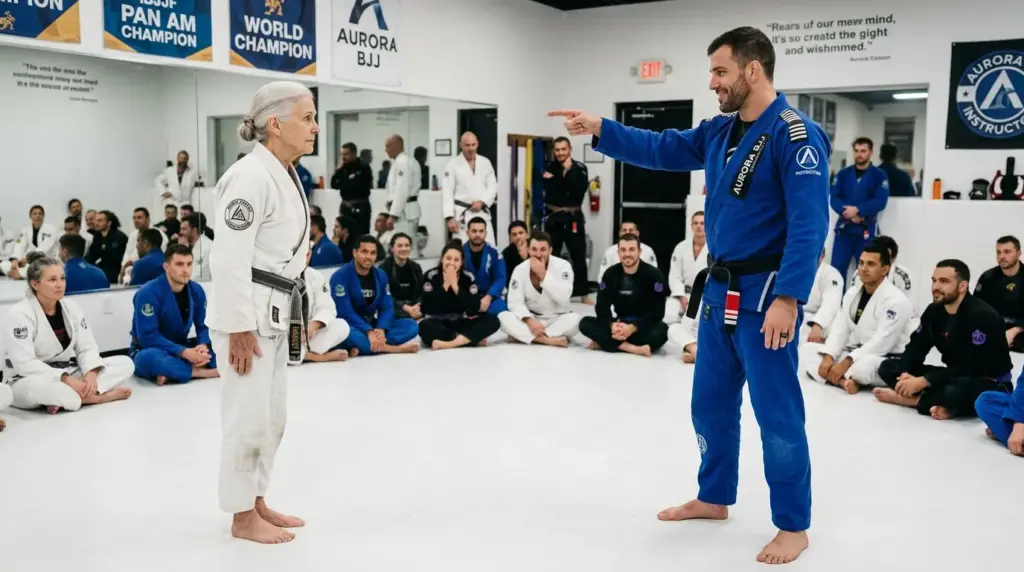
“Get out, Grandma,” Coach Adam Jackson said from the center of the mat, his voice loud enough for the whole class to hear. “Senior Tai Chi is down the hall.”
The students laughed with him. Some covered their mouths. Others didn’t bother. To them, Edith Simmons looked like someone’s grandmother who had wandered into the wrong building. She was seventy-two years old, her face lined with time, her movements measured and careful. Her hands looked delicate. Her posture looked old-fashioned. Nothing about her seemed to belong among young athletes in fitted rash guards and competition kimonos.
But when Coach Jackson challenged her to spar, nobody in that academy expected what happened next.
Least of all him.
That morning, Edith Simmons had stood in her modest apartment, folding her white kimono with the same care she had used for more than forty years. She placed it gently into her gym bag, then rested her hand on the faded black belt beside it. The belt was frayed at the edges, the fabric worn soft by decades of sweat, pressure, discipline, and quiet repetition.
To anyone else, it might have looked old.
To Edith, it held her life.
She had moved to the suburban community only three weeks earlier, after the death of her husband, Robert. Starting over at seventy-two was not simple. Every box she unpacked reminded her of a home they had built together. Every quiet room seemed to hold the echo of his voice. Their children had helped her move, had begged her to stay close to them, had offered extra bedrooms and guest suites and soft places to land.
But Edith had chosen her own small apartment.
She loved her children dearly, but she was not ready to become someone who needed permission to live. She had spent her life standing on her own feet, and even now, with grief pressing heavily against her ribs, she intended to keep standing.
After the furniture was arranged and the dishes were placed in the cabinets, there was one thing left to do.
Find a place to train.
“Your joints aren’t getting any younger, Edie,” she muttered to herself as she stood from the edge of the bed, wincing slightly.
Her doctor had been clear. Keep moving, or start declining. For Edith, there had never been much of a question. Movement was not just exercise. It was memory. It was breath. It was the one language her body still spoke fluently after all these years.
She checked herself in the mirror. Silver hair pulled back in a practical bun. Clean kimono. Calm eyes. She nodded once, a private ritual she had performed before training sessions since 1980, when she first stepped onto a mat at twenty-eight years old.
Few people knew what Edith Simmons had been.
She had trained under Master Hiroshi Takahashi for fifteen years, back when women in jiu-jitsu rooms were still treated as curiosities. She had earned her black belt when most people assumed women were too fragile for serious grappling. She had raised two children, supported her husband through his career as a school principal, packed lunches, attended parent meetings, washed uniforms, and still found time to train before sunrise or after dinner.
Eventually, she earned her second-degree black belt.
She never bragged about it. Edith was not the sort of woman who turned life into a list of achievements. But the knowledge lived in her muscles. It lived in her balance, her patience, her timing, and the quiet confidence with which she moved through the world.
“First day at a new dojo,” she told herself, picking up her keys. “Just like riding a bicycle.”
The drive to Elite Martial Arts Academy took fifteen minutes. The building looked impressive from the outside: wide glass windows, modern signage, clean parking lot, and expensive vehicles lined neatly in front. Edith’s modest sedan looked out of place beside the shiny SUVs and sports cars, but that did not bother her. She had long ago learned that the outside of things rarely told the truth.
She watched young men and women walk into the academy, most in their twenties and thirties, fit and confident in branded gymwear. Edith adjusted her plain white kimono and stepped out of the car.
The receptionist was a young woman with styled hair, perfect nails, and a polite smile that did not reach her eyes.
“Can I help you?” she asked, in the tone people use when they are trying to redirect someone gently.
“Yes,” Edith replied. “I’m interested in joining your jiu-jitsu program.”
The receptionist’s eyebrows lifted. “Our adult classes are quite intensive. Maybe you’d be more comfortable with our senior yoga sessions on Tuesday mornings.”
Edith smiled. “I’ve been practicing jiu-jitsu for over forty years, dear. I’m looking for a place to continue my training.”
For a brief second, disbelief crossed the young woman’s face.
“Well,” she said carefully, “we do have an open mat session starting in fifteen minutes. New students can observe, and then one of our instructors can speak with you about placement.”
“That sounds perfect.”
“You’ll need to sign these waivers,” the receptionist said, sliding several papers across the counter. “Coach Jackson will evaluate your abilities.”
Edith signed with a steady hand. She could feel the receptionist watching her as she walked toward the changing area. No doubt the young woman was wondering what an old lady thought she was doing in a competitive jiu-jitsu academy.
Edith smiled faintly.
It would not be the first time she had been underestimated.