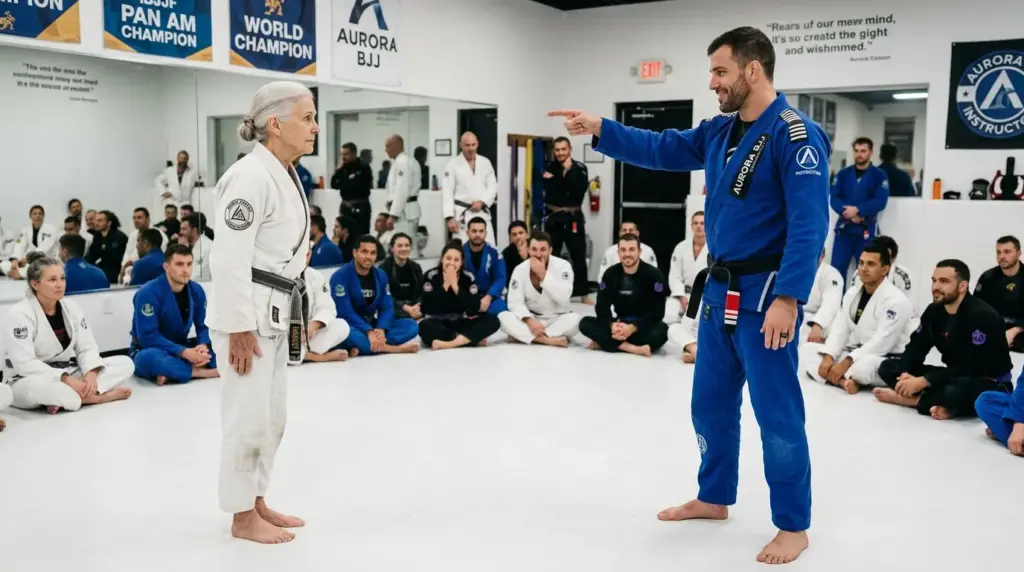
As Jackson’s fingers touched her kimono, Edith shifted her weight almost imperceptibly. Her hand closed around his wrist with surprising firmness. Before Jackson could adjust, she executed a clean sleeve drag, disturbing his balance and pulling him one step forward.
It was textbook.
And he walked straight into it.
In the next instant, Edith dropped smoothly to a seated position. Her legs shot between his, one foot hooking his ankle while her grip transferred from sleeve to collar. Her hip turned. Her weight vanished from where Jackson expected it to be and reappeared exactly where he could not resist it.
Jackson toppled forward.
By the time his knees hit the mat, Edith had already moved.
She secured a technical mount so clean that several students gasped at once.
Jackson’s face flashed with confusion. “What the—”
He tried to push against her, a powerful direct shove meant to recover space. It was the wrong answer, and Edith knew it before he finished making the mistake.
She redirected his force, created the angle, slid her leg over, and attacked the arm.
Jackson recognized the danger too late.
He tried to stack. She adjusted.
He tried to pull free. Her knees pinched. Her hips settled. Her grip tightened with practiced calm.
The armbar locked in.
Pressure increased steadily, not violently, not recklessly, but with absolute control.
“Tap!” Jackson gasped, slapping the mat with his free hand.
The whole exchange had lasted less than ten seconds.
Silence fell over the academy.
Students stood frozen, mouths open, eyes wide. The elderly woman they had laughed at had just submitted their head coach with a sequence so clean it could have been used in an instructional video.
Edith released him immediately. She rose with surprising ease, straightened her kimono, and bowed respectfully.
“Thank you for the assessment opportunity, Coach Jackson,” she said. “I hope that addresses your concerns about my abilities.”
No one made a sound.
Jackson slowly got to his feet, face flushed red with embarrassment. The image he had built in that room—untouchable coach, dominant competitor, unquestioned authority—had cracked in front of everyone.
Finally, he asked, much more quietly, “Who are you? Really?”
Edith adjusted her belt. “I told you. Edith Simmons. Second-degree black belt under Master Takahashi.”
One of the older students stepped forward, recognition dawning on his face.
“Wait,” he said. “Takahashi as in Hiroshi Takahashi? The one who trained those champions in the nineties?”
Edith nodded modestly.
The student stared at her. “And you’re that Edith Simmons? I read about you in old martial arts journals. You won the Eastern Regional Championships three times, didn’t you?”
A murmur spread through the class.
Jackson’s embarrassment shifted into dawning realization. He had not dismissed a confused elderly beginner. He had insulted a seasoned martial artist whose knowledge ran deeper than his own.
“That was a long time ago,” Edith said. “I never sought the spotlight. The practice itself was always what mattered.”
Jackson swallowed hard. To his credit, pride did not completely defeat him. He looked at Edith, then lowered his head in a formal bow.
“Mrs. Simmons,” he said, “I owe you an apology. My behavior was disrespectful and unbecoming of an instructor.”
Edith accepted with a slight nod.
“We all make judgments based on appearances,” she said. “It’s a human weakness. What matters is whether we are willing to correct those judgments when the truth is placed in front of us.”
A young woman with a purple belt stepped forward carefully.
“Ma’am,” she said, “that armbar transition was incredible. Would you be willing to show it again?”
Edith glanced at Jackson, raising an eyebrow.
After a moment, Jackson nodded. “I think we could all learn something today,” he said. This time, there was genuine respect in his voice. “If Mrs. Simmons is willing.”
For the next hour, what had started as a mockery became a master class.
Edith demonstrated techniques with the precision of someone who had spent decades refining the smallest details. She was not as fast as she had been at thirty-five. She did not pretend to be. But her timing was remarkable. Her leverage was exact. Her movements were economical, patient, and difficult to stop.
She showed the sleeve drag again, this time slowly. She explained how the grip should not pull with the arms alone, but connect to the hips. She showed where Jackson’s balance had broken, and why his first instinct—to push—had given her the armbar.
Students leaned closer.
The same people who had laughed were now taking notes.
She explained small adjustments most of them had never considered: the angle of the knee, the timing of the hip shift, the pressure through the shoulder, the patience required before moving from control to submission.
“In my forty-four years of practice,” Edith said as Jackson helped demonstrate a guard pass, “I have learned that jiu-jitsu is not about power or speed. Those fade with time. It is about principles that do not fade. Leverage. Timing. Balance. Patience. And most important, respect—for your opponent, your partner, and yourself.”
The students listened with full attention.
Something rare had entered the room, and they knew it.
By the end of class, the energy in the academy had changed completely. Students approached Edith one by one, asking questions that were no longer sarcastic. She answered each of them patiently, without bitterness, without trying to humiliate anyone in return. She shared knowledge because that was what knowledge was for.
Jackson watched from the edge of the mat, thoughtful and quieter than he had been at the start.
When the last student walked away, he approached Edith again.
“Mrs. Simmons,” he said, “I’d like to offer you a position here at Elite.”
Edith raised an eyebrow. “A position?”
“We have women’s classes and youth programs that would benefit tremendously from your experience. Honestly, the whole academy would benefit from your knowledge.”
“I didn’t come here looking for employment,” Edith said. “I only wanted a place to continue my own practice.”





