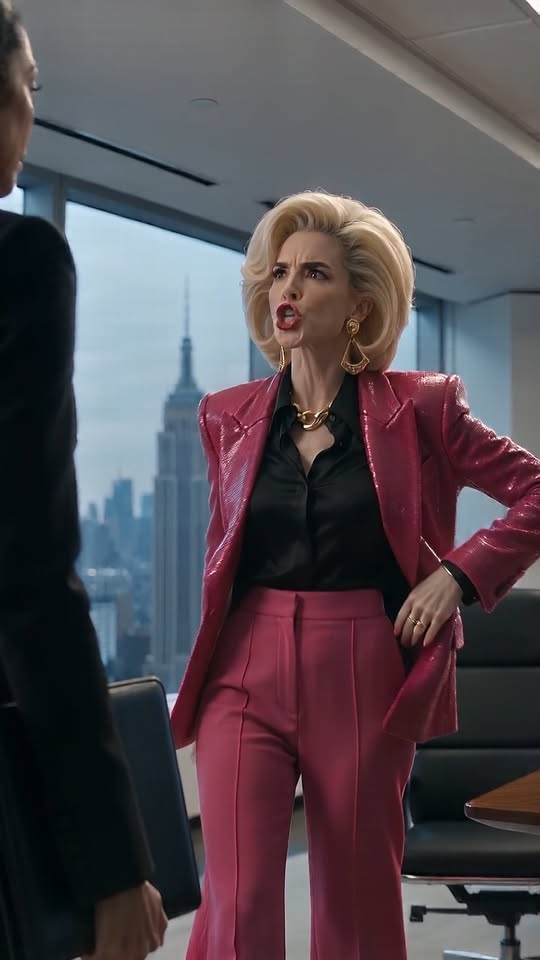
Seeing no allies among the seats, Victoria pivoted sharply toward her brother-in-law.
“Richard, invoke Article Seven!” Victoria demanded, her voice climbing an octave. “Under the founding charter of Apex Vance Holdings, no Class-A block exceeding ten percent can be transferred to an outside party without a thirty-day Right of First Refusal offered in writing to existing family shareholders! Nobody offered me your shares! That makes her entire buyout null and void!”
Richard blinked, a flicker of desperate hope suddenly lighting up his pale face. Even though he had already pocketed Eleanor’s cash to cover his Miami real estate losses, the prospect of an ugly pension audit terrified him.
“She’s right,” Richard said quickly, straightening his pinstriped jacket as he looked at Arthur. “Article Seven! The family right-of-first-refusal! If Tori wasn’t formally notified and given thirty days to match Meridian’s bid, the transfer has to be frozen pending review by General Counsel!”
“I demand an immediate parliamentary recess!” Victoria declared, seizing the momentum and lifting her chin back into its familiar, haughty angle. “Two hours! I want David Ross up here from Legal with the original charter bylaws, and until he arrives, nobody touches another piece of paper on this table!”
Every eye in the boardroom turned back to the woman in the deep plum suit.
Eleanor didn’t argue. She didn’t raise her voice or bang a gavel. She simply looked at the slim gold watch on her wrist, then lifted her calm dark eyes to Victoria.
“You may have thirty minutes, Mrs. Vance,” Eleanor said evenly. “Not two hours. You are welcome to bring Mr. Ross and any charter document you wish into this room at ten-thirty sharp. Until then, this meeting stands in recess.”
Victoria let out a sharp, triumphant breath through her nose, smoothing the sequined lapels of her blazer as if she had just won the war. She snatched her designer handbag off the credenza, jabbed a finger toward Richard, and snapped, “With me. Now.”
The glass doors swung shut behind them as Victoria dragged Richard toward the private corner lounge down the hall. One by one, the other four directors muttered polite excuses about coffee and restrooms, filing out quickly until only Arthur Jennings remained at the table with Eleanor.
In the sudden quiet of the fifty-fourth floor, Arthur slowly let out a breath he looked like he’d been holding for ten minutes. He adjusted his wire-rimmed glasses and looked down at the black leather portfolio under Eleanor’s hand.
“Ms. Sterling,” Arthur said quietly, his voice heavy with decades of weary observation. “Article Seven is still in the corporate charter. When old Harold Vance drafted it in nineteen eighty-eight, he made it ironclad so the family couldn’t be bought out piecemeal. If Victoria never signed a waiver…”
“She signed one, Mr. Jennings,” Eleanor said calmly.
Arthur blinked. “She did? When?”
Eleanor didn’t answer right away. Instead, she unclasped a small inner pocket inside her black leather portfolio and drew out an object that looked completely out of place in the gleaming Manhattan boardroom. It was a battered, tarnished silver pocket calculator from the late nineteen-eighties—an old Hewlett-Packard engineering model with faded black keys and the initials T.S. scratched neatly into the metal casing at the bottom.
She set the old calculator gently on the walnut surface beside her folder.
Arthur frowned, leaning slightly closer. His eyes dropped to the engraved initials, then rose slowly to Eleanor’s face—taking in the high cheekbones, the steady, unblinking gaze, and the last name printed on the eighty-inch monitor behind her.
Sterling.
Arthur’s breath caught in his throat. “Thomas Sterling,” he whispered.
“You remember him,” Eleanor said softly. For the first time since she had walked into the room, the cool corporate steel in her voice warmed into something deeper, older, and infinitely more personal.
“Remember him?” Arthur’s hand came up to touch his chest. “Tom Sterling was the chief structural engineer when I started here as a junior clerk in ninety-four. He designed the entire automated freight-switching grid in Newark and Jersey City. This company wouldn’t have survived the nineties without his patents.” Arthur’s face darkened with old shame. “And in ninety-nine, when Harold and Victoria’s late husband reorganized the logistics division under a shell bankruptcy, they stripped the engineering staff’s equity pool and cut their pension payouts by sixty percent. Tom fought them in court for three years until his heart gave out.”
“Four years,” Eleanor corrected gently, her fingertips brushing the worn silver edge of her father’s calculator. “He died in a two-bedroom apartment in Queens with stacks of Apex Vance legal motions on his kitchen table. While I was working my way through Wharton on night scholarships, he made me promise two things: never sign a contract I hadn’t read to the last footnote, and never let people in loud clothes convince you they own the room.”
Before Arthur could speak, a sharp, urgent voice echoed from the marble hallway just outside the partially open service door at the side of the boardroom.
“I don’t care what the dual-signature protocol says, Maya! You’re a junior compliance analyst, not the FBI!”
Eleanor’s eyes shifted toward the side door. Rising smoothly from her chair, she walked across the carpet on silent heels and paused beside the frosted glass panel.
Out in the corridor near the water alcove, Victoria Vance had a young Asian woman in her late twenties backed squarely against the wood-paneled wall. The young woman—wearing a simple navy cardigan and an employee ID badge reading Maya Lin, Internal Audit—was clutching a silver encrypted flash drive against her blouse while Victoria towered over her in neon pink sequins.





