The rain against the floor-to-ceiling glass of the fifty-eighth floor sounded like handfuls of gravel being thrown against a vault. Below, Manhattan was a blurred lattice of headlights and neon, a city of millions drowning in the sudden autumn squall. Up here, in the penthouse office of Whitmore Global Holdings, the silence was absolute, engineered, and terrifying.
Adrian Whitmore sat behind a desk of reclaimed dark walnut, his hands steepled beneath his chin. His bespoke charcoal Brioni suit fit his lean, angular frame like armor. His eyes, the color of a bruised winter sky, locked onto the trembling man standing on the other side of the desk.
“It was a clerical error, Mr. Whitmore,” the man stammered, sweat beading at his hairline. “The routing number on the offshore account was transposed. A matter of twelve minutes before we caught it.”
“Twelve minutes,” Adrian echoed. His voice never rose above a conversational murmur, which was precisely what made it so lethal. “In twelve minutes, global markets shift. Fortunes evaporate. Empires bleed. You bleed my empire, Higgins, because you lack the discipline to read a sequence of nine digits.”
“It won’t happen again. I swear to you.”
“You are absolutely correct. It will not.” Adrian pressed a silver button on his intercom. “Security. Escort Mr. Higgins from the building. Box his desk. He is no longer employed here.”
The man opened his mouth to beg, but the door behind him was already opening.
When the office was empty again, Malcolm Reed stepped out from the shadows near the executive bar. Malcolm was sixty, with silver hair and the weary eyes of a man who had spent two decades trying to steer a shark away from shallow waters. He was Adrian’s senior advisor, and the only person in the hemisphere permitted to speak to him without a script.
“That makes three today, Adrian,” Malcolm said quietly, pouring two fingers of scotch and setting the glass on the edge of the desk. “A misplaced file. A stuttered pitch. A twelve-minute delay. You’re not trimming the fat anymore. You’re cutting into the bone.”
“Perfection is not optional,” Adrian said, not touching the drink.
“They’re human beings.” Malcolm sighed, leaning against the leather sofa. “With respect, people are starting to fear you more than they respect you. The whisper in the bullpen is that you don’t have blood in your veins, just liquid nitrogen. They obey because they are terrified.”
Adrian finally looked up, his expression unreadable. “Good. Fear is a reliable metric. Kindness breeds complacency. Loyalty is a commodity, Malcolm. I buy it, and I enforce the warranty.”
“Someday,” Malcolm warned, walking toward the door, “you are going to need someone to throw you a rope, Adrian. And you’re going to find out that fear doesn’t make people reach out. It makes them turn away.”
The heavy mahogany door clicked shut. Adrian sat alone in the dim light. He picked up the scotch, swirled it, and stared at his own reflection in the dark window.
Fear is reliable. He believed it. He had built a net worth of fourteen billion dollars on it. But Malcolm’s words had unlodged a dormant, parasitic thought in his mind. It was a question that had haunted him since his father died, leaving him with an empire and an echoing emptiness: Would anyone in this world cross the street for me if I couldn’t buy them, break them, or fire them?
Adrian stood up. The reflection in the glass followed him. The billionaire. The kingmaker. The apex predator.
By midnight, the predator was dead.
The transformation was methodical, an exercise in calculated degradation.
In a nondescript motel on the edge of Queens, Adrian left his wallet, his phone, his tailored coat, and his platinum watch in a locker. He put on clothes purchased from a Salvation Army sorting bin: a frayed flannel shirt smelling of mildew, a pair of jeans with the knees blown out, a heavy canvas coat stained with motor oil, and a gray knit cap pulled low over his forehead. He rubbed ash and damp soil into his meticulously manicured hands, working the dirt deep under his fingernails. He let his beard grow for two days, uneven and silver-flecked, masking the sharp, aristocratic lines of his jaw.
He did not take a car. He walked. He took buses. He slept one night on a bench in a commuter rail station, shivering as the damp cold gnawed at his bones. He learned, in forty-eight hours, the terrifying superpower of the destitute: invisibility. People didn’t just ignore him; they actively un-saw him. Their eyes slid off him like water off glass.
On the morning of the third day, a thick, freezing fog rolled off the Long Island Sound, blanketing the manicured hills of Connecticut.
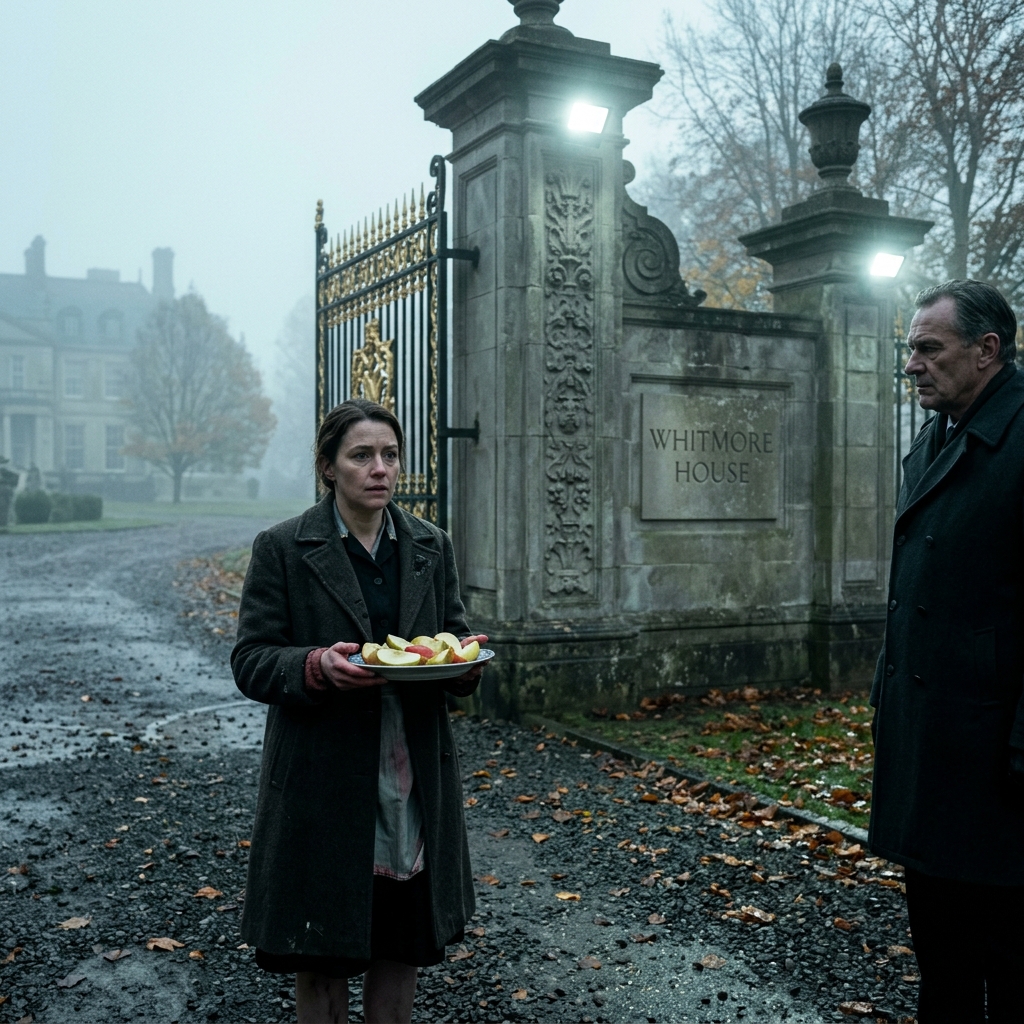
Adrian’s boots—cracked at the soles, letting the icy water seep into his socks—crunched against the gravel shoulder of the private road. Through the mist, the colossal iron gates of Whitmore House materialized.
The estate sprawled across seventeen acres. Beyond the wrought-iron bars, pristine white stone fountains sat dormant for the winter. Sculpted hedges stood like silent sentinels. The glass terraces of the fifty-room mansion gleamed coldly in the weak morning light. It was a monument to absolute, unassailable wealth. His wealth.
Adrian leaned heavily against the cold stone pillar, his breath pluming in the air. He was genuinely exhausted, genuinely shivering, driven by a perverse need to see the machinery of his own life from the bottom of the gears.
He gripped the iron bars. His hands shook.
“Excuse me,” he called out, his voice hoarse and raw from the cold. “Could someone… could someone spare a little food?”
Inside the heated guard booth, Victor Haines looked up from his smartphone. Victor was a former private military contractor, built like a cinderblock, wearing a bespoke tactical uniform that Adrian himself had signed off on. Victor stepped out of the booth, the automatic gates humming slightly behind him. His face twisted in visceral disgust.





