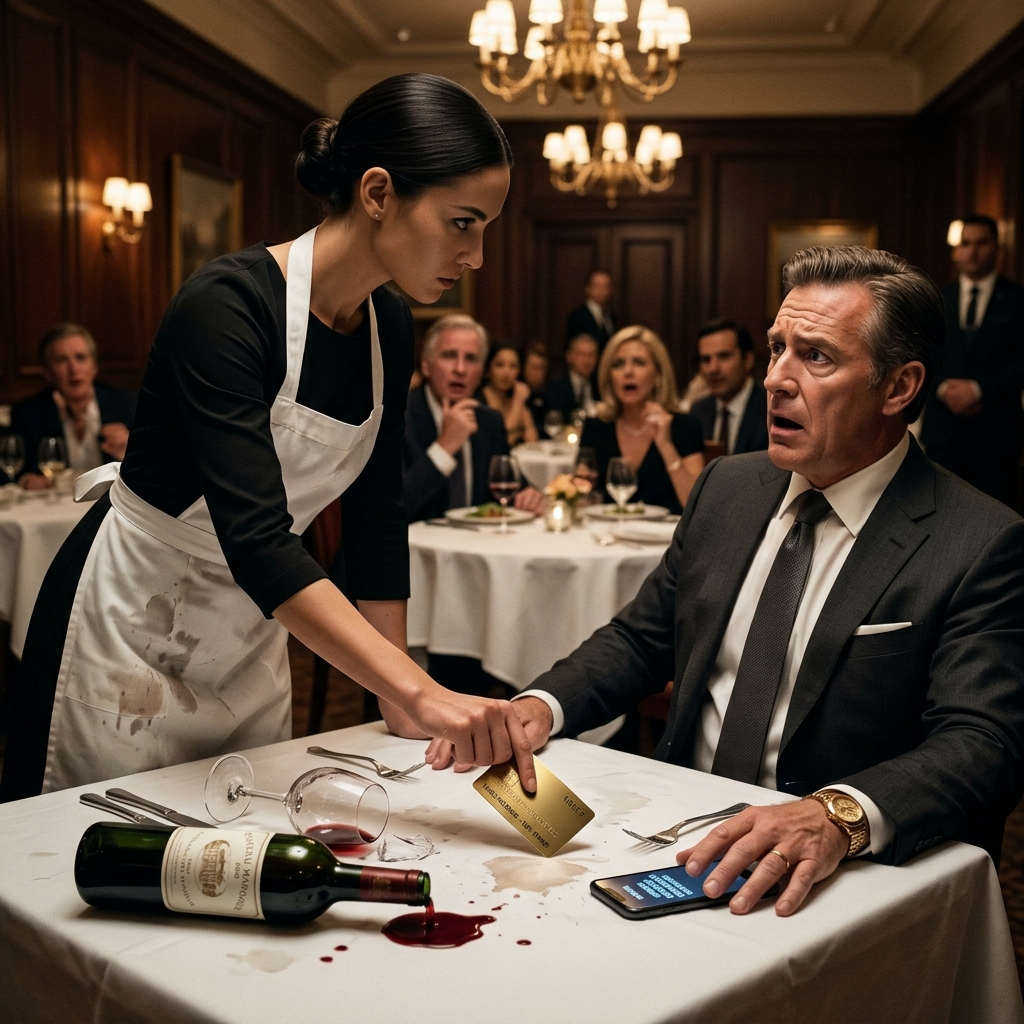
She walked out the back service door into the grimy alleyway and took her first deep breath of the humid night air. The illusion was broken. She pulled her phone, a simple burner-style flip phone she used for her Elara life, from her pocket. She ignored it. Instead, she walked two blocks, her practical shoes clicking on the pavement, until she reached a black unmarked Lincoln sedan parked in the shadows. The driver, a man built like a bank vault, immediately stepped out and opened the rear door. “Good evening, Ms. Vance,” he said. “Hello, James,” Elara replied, sliding onto the plush leather. The Elara persona dissolved. She leaned her head back and closed her eyes as the car pulled silently into traffic. The calm was replaced by a bone-deep exhaustion. From the center console, she retrieved a second phone, a military-grade encrypted smartphone. She powered it on. It exploded with notifications, missed calls, urgent emails, board alerts. She was Elara Vance, 28 years old and the sole anonymous chairwoman of Vance Global Holdings.
Vance Global wasn’t just a company. It was a ghost, a $300 billion private equity behemoth that owned everything from German tech firms to Brazilian mining operations to, as of 8 months ago, a boutique hospitality group that included a three-Michelin-star restaurant called Aurelia. Her father, Richard Vance, had been a phantom. He built his empire in silence and shadows, allergic to the press and the flashbulb arrogance of men like Marcus Thorne. When he died of a sudden aneurysm a year ago, his will was a masterpiece of paranoid eccentricity. Elara inherited everything, all of it, but with one condition delivered via his lawyer and lifelong confidant, Arthur Covington. “You have the power, Elara, but you don’t have the perspective. You’ve been to Wharton. You’ve run the London office, but you’ve never stocked a shelf or cleaned a toilet. You can’t rule a world you don’t understand. For one year, you will live and work inside our
She had chosen Aurelia first. She wanted to see the luxury segment of her empire. For 6 months she had lived in a tiny studio in Queens, taken the subway, and endured the sneers of men who, if they only knew, would have been offering her their kidneys on a silver platter. She scrolled to Arthur Covington’s name and hit call. “Arthur.” “Elara, you’re late. How was the shift?” His voice was dry, British, and devoid of humor. “I was fired,” she said flatly. A long pause. “Well, that is problematic. Clause 4B of the will states termination for gross misconduct could be interpreted as—” “It wasn’t misconduct, Arthur. It was Marcus Thorne.” Another pause. This one different, sharper. “Thorne. What was he doing at Aurelia?” “Eating. Insulting. Being himself. He called me nothing and demanded Jeffrey fire me.” “And you? How did you respond?” “I,” Elara said, a ghost of the smile returning, “asked him why he worked for me.” Arthur let out a sound that was perilously close to a chuckle. “Oh dear. Oh my. You didn’t?” “I did. And he still doesn’t know. He thinks I’m insane. A waitress who snapped. He has no idea.”
“Elara,” Arthur said, his voice sobering. “This complicates things. The Titan project is up for final review on Friday. Thorne has been difficult.” “Difficult how?” Elara asked, her tone shifting. This was Ms. Vance, the chairwoman, speaking now. “He’s pushing back on the environmental impact reports. He’s trying to bypass the new community oversight committee you mandated. He’s arrogant and he’s moving too fast. He seems to believe Vance Global is just a silent bank. Not his new boss.” “He’s about to find out,” Elara said. The car turning onto the private road leading to her penthouse, the one she hadn’t slept in for 6 months. “He fired Elara, the waitress. Fine. On Friday, he’s going to meet Elara Vance.” “He’s not going to recognize you?” “In an apron with my hair in a bun, looking exhausted. I’m invisible, Arthur. That was the whole point. He didn’t see me. He saw a uniform. And on Friday,” Elara said, her voice dropping to a steely calm, “he’s going to see the woman who owns his entire company.”
Marcus Thorne didn’t sleep. He conquered. At 5:00 a.m. the day after the Aurelia incident, he was on his private squash court, smashing a small rubber ball against a wall with a violence that was surgical. His opponent, his personal trainer, was already drenched in sweat. Marcus hadn’t broken a sweat. The





