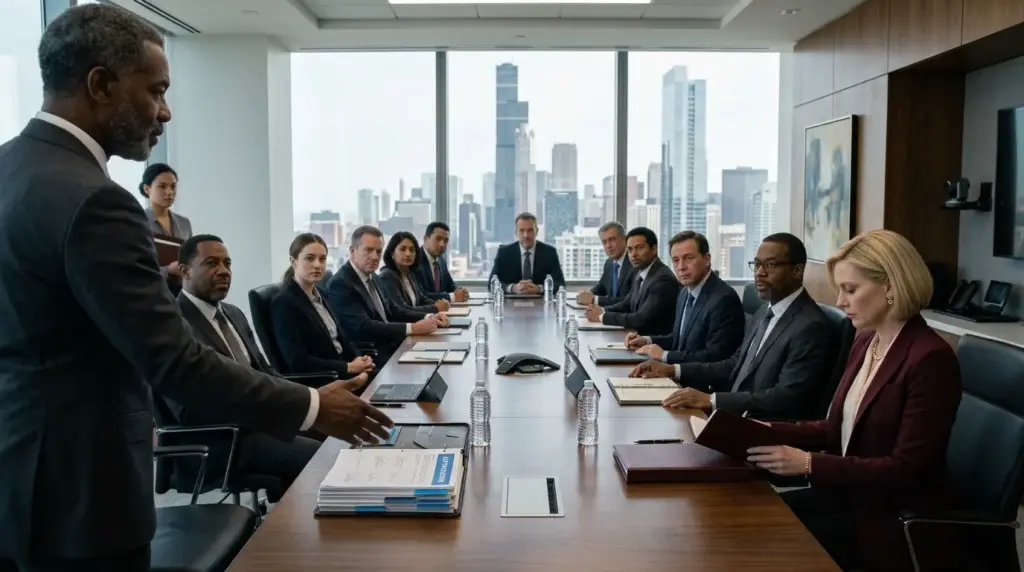
The man who had mistaken Amos for technical support was Grant Keller, Crown Point’s vice president of operations. He did not apologize when Amos entered the boardroom. He checked the visitor badge as if the plastic might explain the mistake. 11 voting seats ringed the table, although Vanessa’s chair at the head remained empty.
Alicia Monroe, Crown Point’s procurement director, occupied a separate chair near the wall as a non-voting observer, close enough to answer questions, but far enough to remember that the real decisions belonged to others. She was the only other black person in the room. When Amos met her eyes, she gave the smallest nod. Miriam restored the missing water and folder at Amos’s place.
Norah Ellis rose to greet him, but the door opened before she reached him. Vanessa Crowe entered with the energy of someone who expected every conversation to reorganize around her. She shook hands as she moved down the table. When she reached Evan Mercer, the consultant Amos had watched pass through the lobby without showing identification.
She smiled and asked about his golf swing. Evan laughed. The room relaxed. Amos stood when Vanessa turned toward him.
He extended his hand. Her gaze touched his face, dropped to the worn edge of his cuff, then settled on the leather portfolio beside his chair. Her hand remained flat on the meeting binder. “We’re waiting for someone authorized to sign the capital commitment,” she said.
“Not the person delivering the documents.” Silence entered the room before anyone could hide from it. Amos kept his hand extended for one more second, long enough for everyone to understand that Vanessa had seen the gesture and chosen not to return it. Then he lowered it.
“Amos Davenport,” he said. “I make the final investment decision for Davenport Meridian Capital.” Norah answered at once. “That’s correct. Mr. Davenport is the fund’s founder and managing partner.”
Miriam added his title was confirmed in the meeting brief and visitor file. Vanessa had room to stop. A simple apology would have changed the temperature. Instead, she looked at Miriam.
“Verify it again. A fund that size usually doesn’t send its founder alone.” Amos sat down. Vanessa began the presentation as though the interruption belonged to him.
When she addressed the board, her pace was quick. When she turned to Amos, she slowed each sentence and explained bridge financing and staged deployment in the careful tone used for someone new to the subject. Amos let her finish. He had designed the structure she was describing.
Ten minutes later, he asked why Crown Point’s cash reserve assumed two state contracts would renew before written extensions had been issued. Vanessa’s expression tightened. “There’s no need to become defensive,” she said. “We know our clients.”
Norah opened her mouth, but Grant cut across her. “The assumption is too soft. We should treat both renewals as unconfirmed.” Vanessa nodded.
“Exactly. That’s the decisive thinking we need.” Alicia’s pen stopped moving. Amos noticed.
Vanessa continued. Crown Point works with governor’s offices, transit authorities, and public agencies. Our partners have to project the right stature when they enter those rooms. Amos folded his hands.
Is stature measured by financial performance? He asked, “Or by what you believe an investor should look like?” No one answered. Howard Keane shifted forward, his lips parted.
Vanessa glanced toward him, and whatever he had intended to say disappeared. He looked down. Alicia saw it happen. Amos opened his portfolio and removed the capital commitment package.
More than 100 pages with the final authorization tab marked in blue. He set it before him without opening it. The sound was soft, yet it traveled the table. “I came here to evaluate an investment,” he said.
“You’ve helped me complete the most important part.” Vanessa leaned back. “Mr. Davenport, if this is some kind of test—” Amos returned the package to his portfolio.
“It wasn’t,” he said. “That’s why the result matters.” He stood, buttoned his jacket, and looked from Norah to Miriam, from Howard to Alicia, then across the remaining faces that had chosen silence because it felt safer than interruption. “I have enough information to make my decision.”
He lifted the portfolio and walked toward the door. No one tried to stop him until his hand was on the handle. Miriam caught the door before it closed behind Amos. Mr. Davenport, he stopped near the elevator, one hand on his portfolio.
The hallway had gone quiet, the way corporate hallways do after something public and ugly when everyone suddenly finds a screen to study. Miriam reached him slightly out of breath. “I’m sorry,” she said. “What happened in there was not acceptable.”
Amos looked at her. Her apology carried no performance. Only the strain of someone who had watched a line crossed and knew silence had helped it happen. “You weren’t the one who left my hand in the air,” he said.
But you will decide whether the minutes record what happened or turn it into a convenient misunderstanding. The elevator arrived. Miriam lowered her eyes then met his again. “I understand.”
Amos stepped inside. The doors closed. He called Calvin Reed before the elevator passed the 25th floor. Calvin answered on the second ring.
“How did it go?” “Freeze the Crown Point commitment,” Amos said. No anger sharpened his voice. That made Calvin sit straighter.
“All $180 million. All of it.” Preserve every email, note, draft, and diligence file. Trigger the withdrawal clause inside the review window.
“No public statement.” Calvin paused. The co-investors are following our lead. If we pull, the rest may unravel faster than Crown Point expects.
Amos watched the floor numbers descend. “I know. Do you want me to give them a reason?” “Not yet.”
Amos shifted the portfolio beneath his arm. We cannot place our clients’ money in the hands of people who see status before they see a person. Calvin did not ask for details. Sixteen years beside Amos had taught him restraint was never indecision.





