To understand why those words didn’t make me cry—why they instead lit a cold, blue furnace inside the hollowed-out ribs of my chest—you have to go back to December 17, 2022.
It was a Friday afternoon, eight days before Christmas, and a light, powdery snow was dusting the brick sidewalks of Newbury Street.
It was my third wedding anniversary with Michael Lane.
At ten o’clock that morning, the city comptroller had finally cleared the four-million-dollar municipal grant for my boutique architectural firm, Vanguard Heritage Restoration. For two years, while Michael struggled to get his commercial contracting startup off the ground, my firm had paid the mortgage on our Back Bay brownstone, leased his Mercedes, and floated his payroll whenever his subcontractors threatened to walk. I hadn’t minded. When you love someone the way I loved Michael—with the fierce, blind loyalty of an orphan who had grown up in three different foster homes before finding her footing—you don’t keep a ledger.
Because the city check had cleared early, I canceled my four o’clock site inspection in Cambridge. For the past six months, whenever we walked past the Tourneau boutique at Copley Place, Michael had slowed his pace to admire a vintage-style Rolex Cosmograph Daytona in eighteen-karat rose gold.
I spent forty-one thousand dollars on that watch at two-thirty in the afternoon.
The saleswoman, an older woman with pearls and warm eyes, had noticed the way my fingers lingered over the engraved gold clasp as she wrapped the green velvet box in cream silk ribbon.
“Anniversary gift?” she’d asked, smiling.
“Three years today,” I’d told her, feeling a foolish, girlish warmth bloom in my cheeks. “He thinks I’m stuck in a zoning hearing until seven.”
On the drive home through the twilight traffic on Commonwealth Avenue, with Sinatra playing softly on the radio and the heater warming my knees, I had actually considered stopping at the florist on Clarendon for white lilies. I didn’t, only because I wanted to get the champagne into the ice bucket before five.
I was happy.
During the thousand nights I spent staring at the rusted springs of the top bunk in Framingham, that was the memory that cut me the deepest. Not the blood. Not the sirens. Just the memory of me humming in my car, carrying a forty-thousand-dollar watch in my purse for a man who was already stripping the copper wiring out of my life.
I parked in our rear alley space so my headlights wouldn’t sweep across the front bay windows and spoil the surprise. Using my key with practiced quiet, I eased the heavy oak front door open and stepped into the warm, cedar-scented foyer.
The downstairs recessed lights were off, leaving the living room bathed in the amber glow of the streetlamps outside. At first, I thought Michael wasn’t home yet.
Then I looked down at the radiator bench beside the walnut shoe cabinet.
Sitting neatly on the marble drip tray were Michael’s wet Italian leather Oxfords. And lying on its side right next to them, kicked off in a careless hurry, was a size-seven Christian Louboutin suede pump with a crimson sole—the exact pair I had bought Rachel Hayes for her thirtieth birthday in October.
My heart didn’t speed up. Instead, it seemed to drop into a vat of liquid nitrogen, beating once every ten seconds with a heavy, sickening thud.
From the second-floor master suite directly above my head came the rhythmic, muffled creak of our custom walnut headboard striking the plaster wall, followed by a woman’s breathy, familiar laugh.
My body understood the geometry of that sound long before my brain permitted the thought to form.
I set my handbag and the Tourneau shopping bag silently onto the console table. I didn’t take off my winter coat. I walked up the curved mahogany staircase, placing my boots near the outer edge of each riser where the ninety-year-old wood didn’t groan.
The master bedroom door stood three inches ajar, casting a thin wedge of warm bedside lamplight across the hallway runner.
I pushed the door open with two fingers.
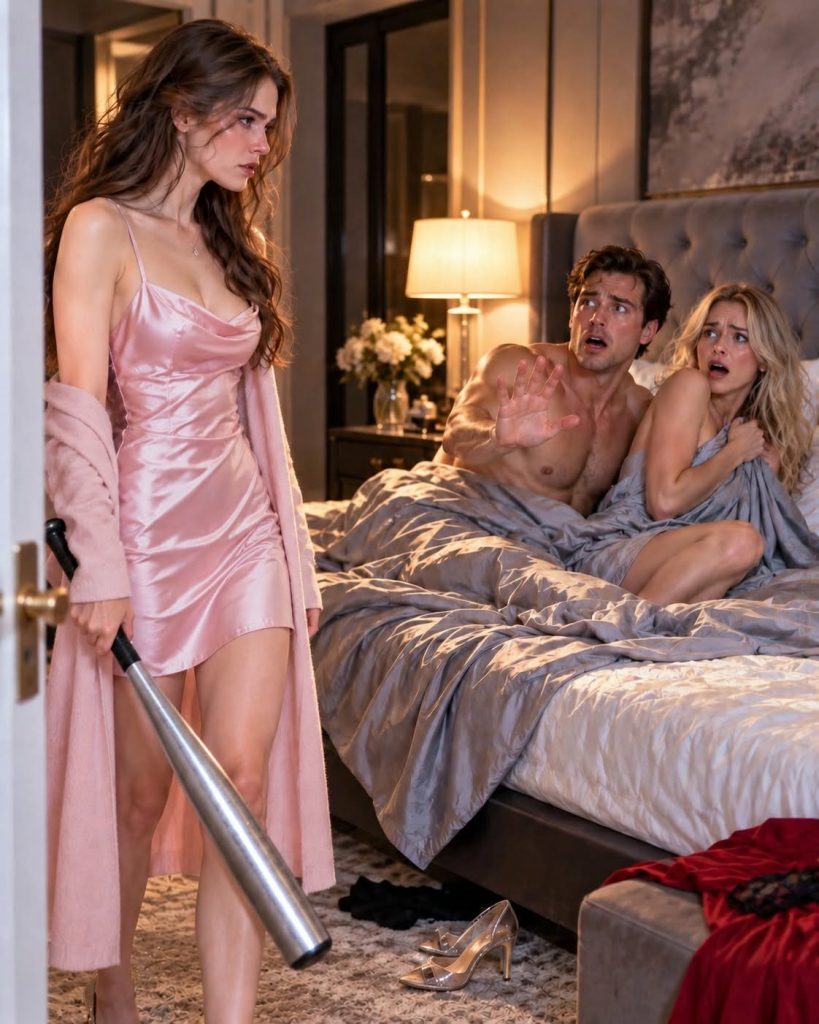
The Egyptian cotton sheets I had ironed on Sunday were tangled at the foot of the mattress. Michael was there, his back slick with sweat under the warm amber glow of the Tiffany lamp.
And beneath him, her blonde hair spread across my pillow, her manicured fingernails dug into the muscles of my husband’s shoulders, was Rachel Hayes.
Rachel. The girl who had split her peanut-butter sandwiches with me behind the bleachers of South Boston High when my foster family forgot to sign my lunch-program forms. The woman who had stood beside me at the altar in pale blue silk, weeping so hard during my vows that she’d had to borrow Michael’s handkerchief. The woman whose father’s six-figure oncology bills at Mass General I had quietly paid off out of my personal savings two winters ago so her parents wouldn’t lose their house in Quincy.
Rachel saw me first over Michael’s shoulder.
For one suspended second, her blue eyes locked with mine. Then she let out a sharp gasp and scrambled violently backward against the headboard, yanking the down duvet up to her chin.
“Evelyn!”
Michael twisted around, pulling back onto his knees.
I looked at my husband’s face, waiting—praying, in some pathetic, dying corner of my soul—to see horror, or shame, or the crushing realization of what he had just thrown away.
I saw none of it.
Instead, Michael’s brow furrowed into a look of sharp, entitled irritation, as if I were a housekeeper who had barged in without knocking while he was on a conference call.
“What are you doing here?” Michael snapped, reaching for his silk robe at the edge of the mattress. “Didn’t you say your Cambridge zoning board meeting ran until seven?”
That single sentence didn’t break my heart. It incinerated it, leaving nothing behind in my chest but grey, weightless ash.





