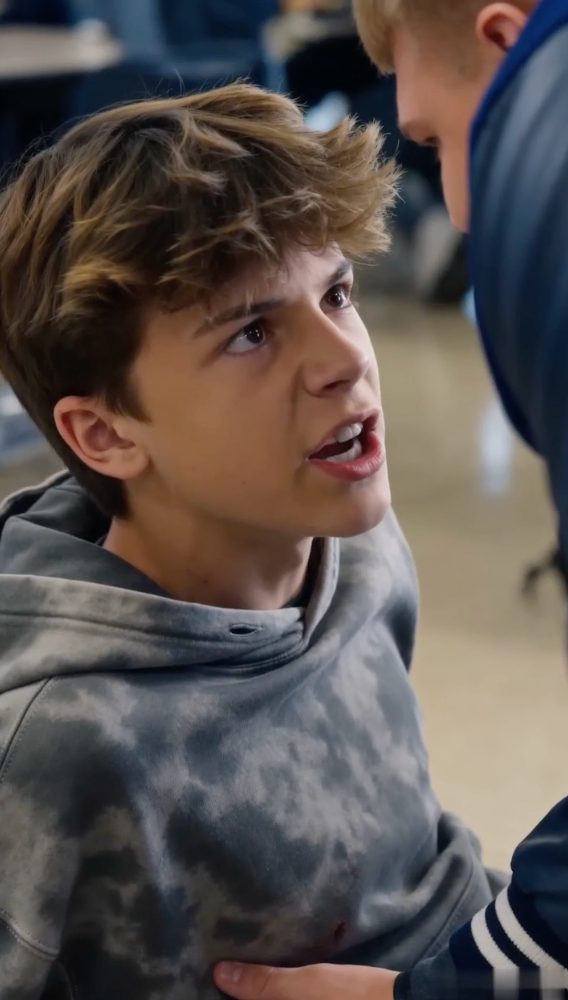
The cafeteria was always loudest on Fridays.
By the time the lunch bell rang, hundreds of students were already moving through the hallways, talking about weekend plans, football games, and everything that seemed important when you were seventeen years old.
Sneakers squeaked against the polished floors, lockers slammed shut, and voices bounced from one end of the building to the other.
For most students, Friday meant freedom was only a few hours away, but for me, it meant getting through one more afternoon without giving anyone a reason to notice me.
I had learned to measure my days in small victories.
Getting through first period without hearing my name whispered behind my back was a victory.
Walking past the varsity football players without someone blocking my path was another.
Finding an empty table where I could eat lunch without attracting attention sometimes felt like the greatest victory of all, even though I knew how strange that would sound to someone who had never been afraid of an ordinary school day.
For eight months, I had been the quietest boy in school, and for eight months, that quietness had made me an easy target.
I did not think I was especially different from anyone else.
I liked reading, preferred listening to talking, and usually thought about what I wanted to say before opening my mouth.
My grades were good, though I never tried to draw attention to them, and I had never been interested in becoming popular.
I simply wanted to finish high school, make my mother proud, and move toward a future where every day did not depend on the mood of someone stronger than me.
My mother used to tell me that being quiet was not the same thing as being weak.
She said some people needed to fill every silence because they were afraid of what they might hear if they stopped talking.
Others were comfortable listening, watching, and understanding things that louder people missed.
I wanted to believe her, but after months of being pushed aside, laughed at, and treated as though I did not matter, her words had become harder to hold on to.
The person responsible for most of that change was Travis.
At six feet four inches tall, Travis was impossible to miss.
He was the captain of our varsity football team, broad-shouldered and confident, with the kind of presence that made crowded hallways seem to open naturally in front of him.
Teachers knew his name, younger students recognized him from football games, and his teammates followed him almost everywhere.
When he walked into a room, people looked up, not because he asked them to, but because he had grown used to being noticed.
I had never understood why he had chosen me.
There had been no argument between us before everything started.
I had never insulted him, challenged him, or tried to embarrass him in front of anyone.
I was simply another student who happened to occupy the same school building, and somehow that had been enough.

What began as little jokes about how rarely I spoke slowly became a habit, then a routine, until seeing me uncomfortable seemed to be one of his favorite ways to entertain his friends.
At first, I believed the teasing would end if I ignored it.
That was what adults often said, and I wanted to believe there was wisdom in the advice.
If I did not react, perhaps Travis would get bored and find something else to do.
So I kept walking when he made comments, looked down when his friends laughed, and pretended not to hear the things they said whenever I passed.
Instead, my silence seemed to encourage him.
There were days when he called me little guy so loudly that students at nearby lockers turned to look.
Other times, he stepped into my path and waited for me to move around him, smiling as though he had won something important.
His teammates laughed at these moments, sometimes because they genuinely thought he was funny and sometimes, I suspected, because laughing was easier than being the person who questioned him.
I learned to recognize the sound of their laughter before I even saw their faces.
The worst part was not always what Travis did.
Sometimes it was the way everyone else behaved afterward, as though nothing important had happened.
Students who had watched him embarrass me would return to their conversations, teachers would continue walking, and the school day would carry on without the smallest sign that anything had changed.
I understood that people had their own problems, but understanding did not make the loneliness disappear.
After a while, I stopped asking myself why Travis treated me that way and started wondering whether anyone would care enough to make him stop.
That question followed me everywhere.
It was there when I walked into classrooms and chose a seat near the back.
It was there when I opened my locker and listened for familiar footsteps approaching behind me.
It was there when I passed the gymnasium and heard the football team shouting to one another.
Even when nobody was bothering me, I carried the feeling that something unpleasant could happen at any moment.
I became good at noticing details.
I could recognize Travis’s voice from the opposite end of a hallway, even when dozens of other students were talking.
I knew which tables his teammates preferred in the cafeteria and which doors they usually entered after morning practice.
I knew that when their conversations suddenly became quieter, it sometimes meant one of them had noticed me.
These were not skills I had wanted to learn, but they had become part of how I got through the school day.
My mother noticed that I had changed long before I admitted it.
She noticed how quickly I went to my room after school, how rarely I talked about classmates, and how often I answered questions with the same tired sentence.
“School was fine.”





