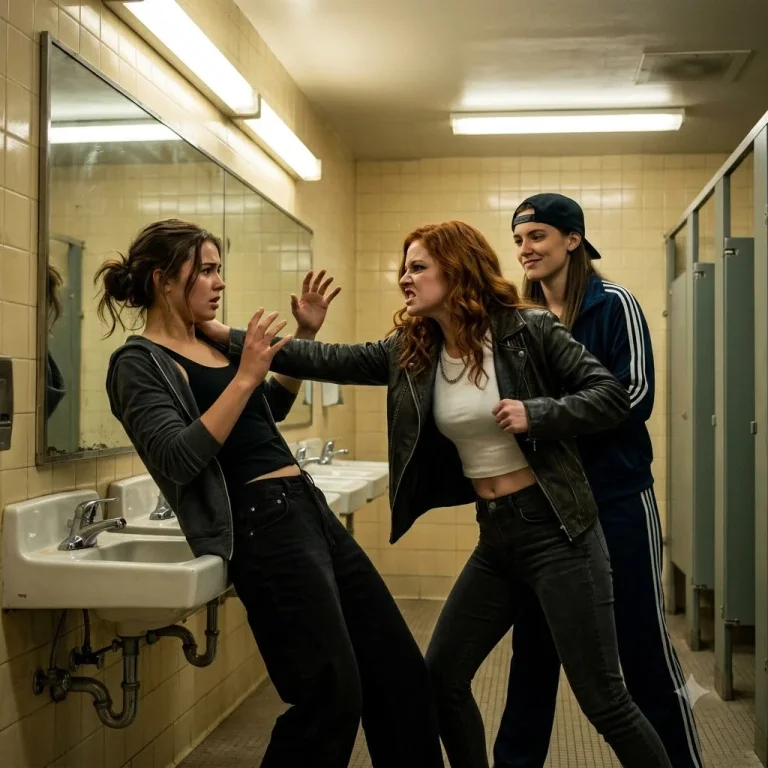
But when Travis looked back at me, his face had turned red.
For a second, I thought he might realize how far things had gone.
I hoped he would step back.
Instead, he pointed at me.
“YOU THINK THAT’S FUNNY?”
His shout was loud enough to draw attention from the serving counter.
I shook my head.
“No.”
“Then why are you smiling?”
I wasn’t smiling.
My mouth felt stiff, and my face was numb with fear.
“I’m not.”
He took another step.
“You making fun of me?”
“No.”
I could hear students whispering.
Someone said his name.
Someone else urged him to calm down.
But he didn’t seem to hear them.
I pushed myself upright, keeping a hand on the table for balance.
My elbow hurt, but I could move it.
I stood slowly, both hands open and visible.
“I don’t want to fight.”
The words sounded small beneath the noise of the cafeteria.
But they were true.
I didn’t want to hurt him.
I didn’t want to prove anything.
I wanted to collect my lunch, go to my next class, and somehow get through the rest of the day.
Travis stared at me.
His chest rose and fell beneath his jacket.
“You should’ve thought about that before you started acting tough.”
I glanced toward the supervisor.
She was looking in our direction now, but several students stood between us and the counter.
I considered calling out.
Then Travis moved.
He came toward me with the speed of someone used to running into people on a football field.
His shoulder lowered.
His expression hardened.
I recognized what he intended a fraction of a second before he reached me.
He was going to knock me over.
The thought triggered a burst of panic.
I could almost feel myself hitting the floor again.
But beneath the panic, another memory surfaced.
The recreation-center instructor’s voice.
Keep your balance.
Create space.
Move away from the force.
I wasn’t thinking about winning.
I was thinking about not falling.
So I stepped aside.
Travis expected me to remain directly in front of him.
When I moved, he couldn’t stop immediately.
His own momentum carried him past my shoulder and straight toward the empty lunch table behind me.
He struck the edge with his hip.
The table rattled violently.
A tray slid across its surface and clattered to the floor.
Travis tried to catch himself, but his shoes slipped against the tile.
He dropped to one knee.
A loud gasp spread through the cafeteria.
Then someone laughed.
Only one person at first.
Then another.
The sound was different from before.
It wasn’t the cruel, easy laughter that had followed my fall.
It was surprised laughter, the kind that escaped before people knew whether they should make a sound.
Travis looked up.
His expression was almost unrecognizable.
The football captain, the person who had made me feel small for months, was kneeling beside a cafeteria table in front of everyone.
I knew what that felt like.
I wished I didn’t.
For one brief moment, I wanted him to understand the humiliation he had been so willing to give me.
But as soon as I saw the fury gathering in his face, I knew he wasn’t thinking about understanding anything.
He was thinking about getting even.
Travis rose sharply.
He pushed away from the table and stepped toward me.
His teammates had stopped laughing.
The boy with the phone lowered it slightly, then raised it again.
A girl near the windows stood from her chair.
“Somebody get a teacher,” she said.
No one answered.
Travis’s eyes remained fixed on me.
“You think you’re better than me?”
I backed away.
“No.”
“You think you can embarrass me?”
“I didn’t do anything.”
He gave a short, angry laugh.
“Yeah?
We’ll see.”
He reached toward the front of my hoodie.
I moved backward, but he kept coming.
The space between the tables was narrow.
I could hear chairs scraping as students moved away.
My heartbeat filled my ears.
I wanted the supervisor to reach us.
I wanted everyone to stop watching.
I wanted the situation to end before either of us got hurt.
But Travis was closing the distance.
His hand caught the fabric near my shoulder.
For one instant, his fingers tightened.
I remembered the drills.
I turned with his movement, freed the fabric from his grip, and kept enough distance to avoid being pulled forward.
He reached again.
This time, I redirected his arms and shifted my weight away from the table.
He lost his balance.
I kept moving with him, guiding his momentum downward rather than striking him.
His knee touched the floor.
Then he settled onto the tile, one hand braced against it.
The movement was awkward rather than dramatic.
There was no spectacular throw.
No punch.
No kick.
Just a larger boy who had charged forward and a smaller boy who had refused to stay where the larger boy expected him to be.
I stepped away immediately.
Both my hands remained open.
I was breathing so hard that my chest hurt.
Travis looked up at me.
His face was flushed.
For a moment, neither of us spoke.
He seemed unable to understand what had happened.
So did I.
I had practiced avoiding simple grabs with partners at the recreation center, but those partners knew what we were doing.
They weren’t angry, and they weren’t trying to humiliate me.
This had been different.
My legs trembled.
I could still feel the ache in my elbow from the first fall.
But I was standing.
And Travis wasn’t.
The cafeteria went strangely quiet.
Not completely silent.
A few voices continued near the serving counter, and somewhere behind me, a chair scraped across the floor.
But the laughter had stopped.
I looked around.
Students were staring.
Some had their mouths slightly open.
Others were watching the phones in their hands as though they had just recorded something they couldn’t explain.
For months, people had treated Travis’s behavior as normal.