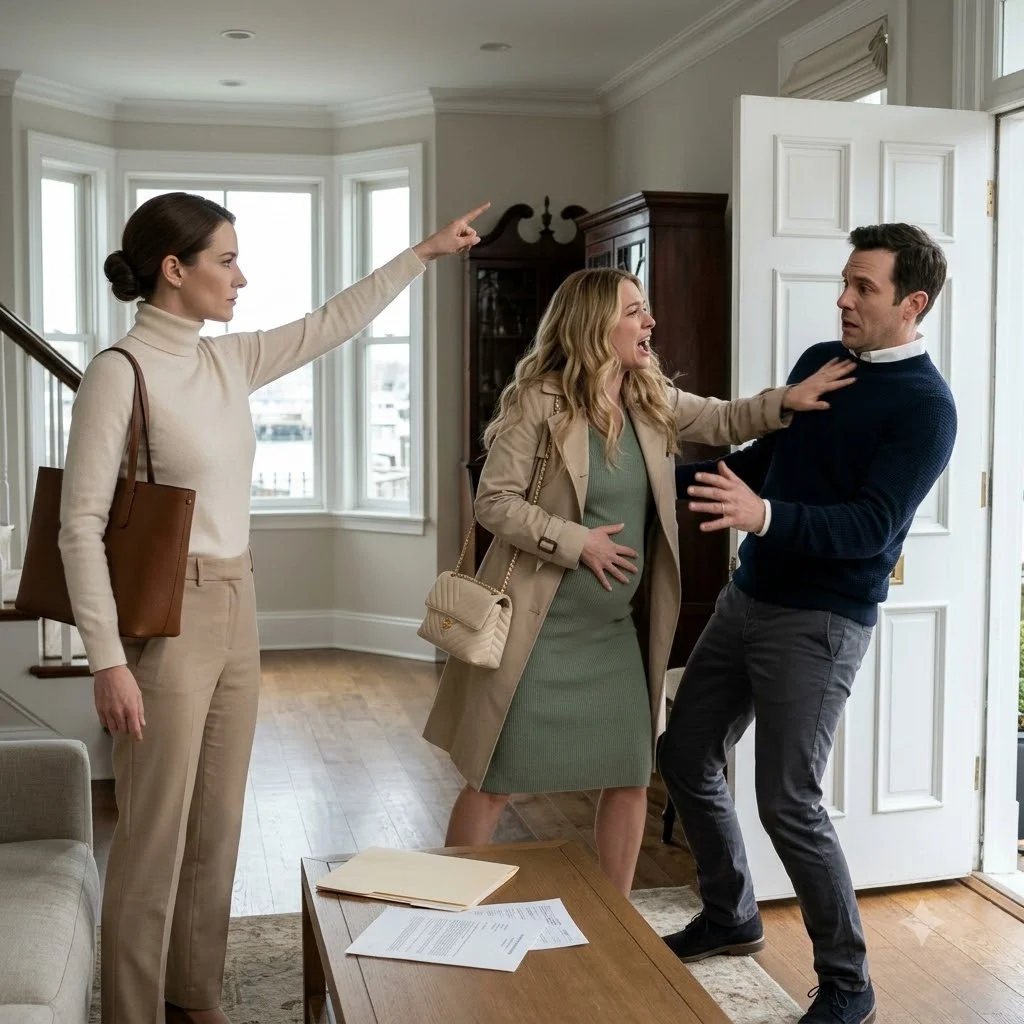
Daniel looked down.
He stared at the deed as if the paper had changed while he was not looking. His eyes moved from the seal of the County Registry of Deeds to the single name printed in bold serif type under Grantee: Claire Marie Bennett, an unmarried woman, as her sole and separate property.
Emily stepped closer, leaning slightly over the edge of the table. Her eyes scanned the document, then lifted from Daniel to Claire.
“You said this house was yours,” Emily said. Her voice was barely above a whisper, stripped of whatever rehearsed composure she had carried through the front door.
Daniel’s mouth opened. Nothing came out. That silence did more damage than any argument Claire could have made. It hung beneath the brass chandelier, heavy and irreversible, while the rain hissed against the glass.
Daniel recovered first, his jaw tightening as his color returned. “I’ve paid for this house for years.”
“You’ve paid household expenses,” Claire said.
“The mortgage.”
“There is no mortgage.”
Emily’s head snapped toward him. “Daniel?”
He didn’t look at her. His eyes were locked on Claire, a flicker of genuine panic breaking through his polished veneer. He had apparently told Emily something else—something grand and reassuring about equity and monthly payments and a man providing a roof. For half a second, Claire almost felt sorry for her. Then she remembered the crib being delivered on Thursday. Almost.
Daniel reached out and picked up the deed, his fingers creasing the edge of the plastic sleeve. “This doesn’t mean I have no claim.”
“I didn’t say that.”
He frowned, thrown off balance. He had expected hysteria; he had prepared for tears, for shouting, for an emotional storm he could calmly weather until she exhausted herself. He hadn’t prepared for Claire standing dry-eyed in her own dining room, sounding like her mother.
Claire had learned enough from Eleanor not to turn legal questions into dinner-table declarations. She knew that nine years of marriage created gray areas. Marital contributions could matter. Renovations could matter. Commingled funds could matter. Ownership was not always as simple as one line on a deed.
But it was simple enough for tonight.
“You are not moving her into this house,” Claire said.
Emily’s face reddened, a blotchy, humiliated crimson spreading up her neck. Daniel straightened, dropping the deed back onto the oak.
“Claire.”
“No.”
“We need to discuss this like adults.”
“You brought your pregnant girlfriend into my living room to tell me to leave,” Claire said, her voice finally sharpening, cutting cleanly through the quiet. “Do not use the word adult as if I’m the one behaving irrationally.”
Daniel flinched.
Emily took a step back from the table, her hand tightening over her stomach. “I didn’t know.”
Claire looked at her. “Which part?”
“That the house was yours,” Emily whispered. “He told me—he told me you’d already agreed to move out, that you were just waiting for the lease at The Mercer to start, and that he’d bought this place before you met.”
Claire studied her face—the wet lashes, the sudden, sickened realization dawning in her eyes. She believed her.
Daniel looked angry at both of them now. That was almost funny. He had built two separate realities, carefully walled off from one another, and he resented the exact moment they collided.
Claire closed the linen folder and tied the ribbon. “You both need to leave.”
Daniel stared at her. “This is my home too.”
“You have lived here.”
“That’s not the same as having no rights.”
“I agree.”
His expression shifted, a flicker of relief crossing his features as he thought he’d found a foothold. “Then you can’t throw me out.”
“I’m not physically throwing you anywhere,” Claire said calmly. “I’m asking you to leave tonight, voluntarily, because I do not want you or Emily staying here. If you refuse, I will call the police to document a domestic disturbance, and your pregnant girlfriend can spend the evening explaining to two uniformed officers why she’s standing in my dining room.”
Emily’s breath caught. She turned toward the foyer, already retreating. Daniel did not move.
“Where am I supposed to go?” he demanded, the smooth, practical mask finally slipping to reveal something petulant and raw underneath.
Claire laughed once, a dry, brittle sound. “You spent several weeks planning where I was supposed to go.”
That landed.
Emily stopped by the archway and whispered, “Daniel.”
He looked at her, his jaw working. “I have a corporate account at the Harborview Hotel. We can go there.”
Emily stared at him. “You told me we’d be here tonight. You told me to give up my lease at the end of the month. My boxes are in your trunk.”
The second lie entered the room, quieter than the first, but far more lethal.
Claire stepped away from the table, putting the oak between them. “Take whatever you need for the night. Tomorrow, communicate through counsel.”
Daniel’s face hardened. “You already called a lawyer?”
“I’m about to.”
That frightened him more than anger ever could. For nine years, Daniel had been the practical one. Contracts. Taxes. Insurance. Investment accounts. He explained things in his warm, authoritative voice, and Claire had trusted his explanations because she loved him and because she had believed they were building the same life. Now he watched her step cleanly out of the conversation he controlled best.
Emily walked out into the foyer without looking back. After a long, tense moment, Daniel followed. He didn’t go upstairs for a bag; he already had one in the car, Claire realized with a fresh spike of disgust. He had packed for a weekend away and told her he was going to a conference in Hartford, only to circle back once he thought the stage was set.
At the front door, he turned. The rain blew in behind him, cold against Claire’s ankles.
“Claire,” he said, his voice dropping to that familiar, pleading register. “Don’t do something permanent because you’re hurt.”





