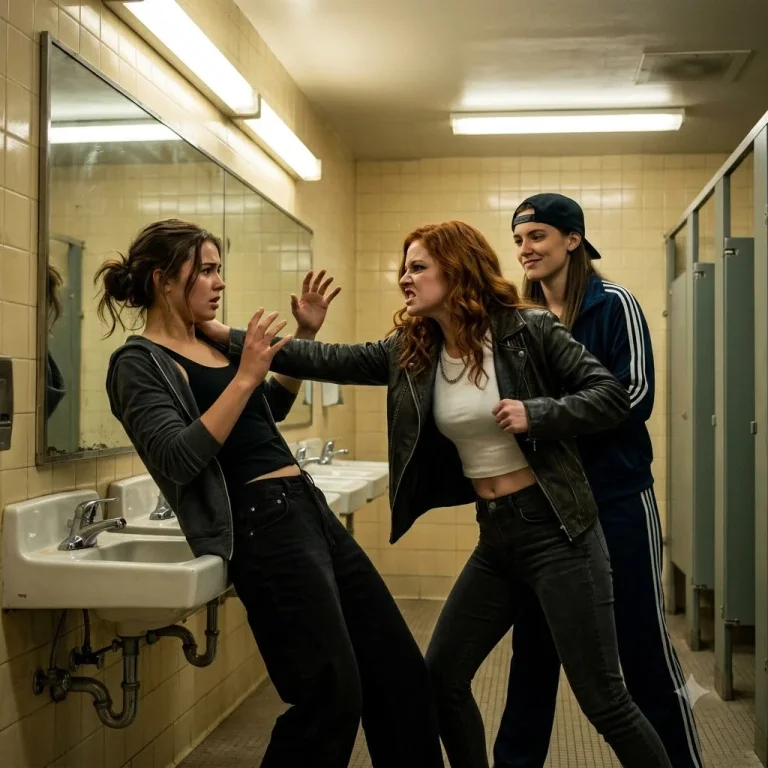
A few people laughed because they genuinely enjoyed it.
The rest laughed because they didn’t want to be the person who refused.
I had heard that pattern before.
It sounded almost identical in every school, regardless of how different the students believed themselves to be.
Trent stood in front of me, enjoying the attention.
I could hear the smile in his voice.
More importantly, I could hear how little effort he was making to hide his intentions.
He wasn’t nervous.
He wasn’t uncertain.
He had already decided that I couldn’t challenge him.
In his mind, there was no possibility of embarrassment.
There was only the question of how long he could keep everyone laughing.
I shifted my cane slightly to the right.
Then I moved half a step in the same direction, leaving enough room to pass.
Trent’s shoes scraped across the floor.
He moved sideways at precisely the same moment.
My path was blocked again.
I stopped.
A few students laughed.
The movement had been small, but its meaning was obvious.
He wasn’t going to let me walk around him.
I adjusted my grip on the cane.
“Excuse me,” I said.
“What’s the rush?”
His tone became exaggeratedly friendly.
“Where exactly are you trying to go?”
“I’m just looking for somewhere to sit.”
“Somewhere to sit?”
He repeated the words as though they were unusually amusing.
“That’s all?”
“Yes.”
One of his friends chuckled.
Trent took a small step forward.
I heard his jacket shift across his shoulders.
“Well,” he said, “maybe there’s a toll.”
I tilted my head.
“A toll?”
“Yeah.
You know.
You want to get past me, you’ve got to pay.”
He waited for the reaction.
A few nearby students laughed.
I imagined the pleased expression spreading across his face.
“What kind of toll?”
I asked.
It was a mistake to ask, at least according to the ordinary rules of dealing with a bully.
Questions gave him more opportunities to perform.
But I wanted to understand how far he intended to go.
There was a difference between a boy making a foolish joke and a boy deliberately preventing another student from leaving.
I needed to know which one I was dealing with.
Trent leaned closer.
I could smell his cologne more strongly now.
Something sharp and artificial, with an underlying musky sweetness that seemed determined to fill the entire room.
“Maybe you should ask nicely,” he said.
I kept my voice quiet.
“Could you please move?”
He laughed.
“See?
That wasn’t so hard.”
For a second, I thought he might actually let me pass.
His shoes shifted.
A narrow opening appeared to my right.
I moved toward it.
Then he stepped back into my path.
The laughter became louder.
He had never intended to move.
The point was making me believe that he might.
My fingers tightened around the cane handle.
Only slightly.
Then I deliberately relaxed them.
I remembered my father’s voice.
Don’t let someone else’s impatience decide what you do.
It was a lesson he had repeated during training whenever I reacted too quickly.
He believed that panic narrowed a person’s options.
Anger could do the same thing.
I wasn’t frightened of Trent in the way he expected.
But I was becoming angry.
And anger, however justified, could still make me careless.
I drew a slow breath.
Around us, the cafeteria continued functioning, though the conversations nearest the confrontation had grown quieter.
Farther away, students still talked about lunch and classes, unaware of what was happening.
Closer to us, chairs scraped as people turned to watch.
Trent knew he had an audience.
He wanted it to become larger.
I could hear that intention in every exaggerated pause.
He wasn’t merely obstructing my path anymore.
He was constructing a scene in which I would be the helpless girl and he would be the person powerful enough to decide what happened to her.
The thought brought an unexpected feeling of sadness.
I wondered how many people had laughed at his jokes before that day.
How many had smiled because it was easier than objecting.
How many had learned to stay out of his way.
He was only sixteen or seventeen, yet the silence around him had already taught him a dangerous lesson.
He believed the absence of opposition meant approval.
I made another attempt to pass.
This time, I moved to the left.
Trent followed.
His friends were close enough that I could distinguish their movements from the larger cafeteria crowd.
One shifted backward, probably making room for Trent.
Another seemed to be laughing so hard he was struggling to speak.
I heard a chair scrape sharply against the floor.
Then a student’s quiet voice came from somewhere beyond Trent.
“Come on, man.”
It wasn’t loud enough to stop anything.
Trent ignored it.
“What’s wrong?” he asked me.
“Nothing.”
“You sure?”
“Yes.”
“Because you look a little lost.”
More laughter.
I could feel my patience thinning.
It wasn’t the insult itself that bothered me most.
I had heard worse.
What bothered me was his absolute confidence that he was entitled to interfere with my day.
I had spent years learning how to navigate rooms filled with obstacles.
Most of those obstacles were ordinary objects.
Doors.
Chairs.
Tables.
Unexpected changes in flooring.
But people could become obstacles too, and their behavior was far less predictable than furniture.
I wished, briefly, that my father were standing nearby.
Not because I needed him to rescue me.
I was old enough to understand that his presence would probably make the situation worse.
I simply wished he could hear what I was hearing.
He had worked so hard to teach me how to move through the world.
And now a boy who knew nothing about that effort was treating my independence like a joke.
I straightened very slightly.
Then I caught myself.
Trent was close enough to notice a change in my posture.
I returned to the uncertain stance I had adopted that morning.
My shoulders rounded.
My chin lowered.