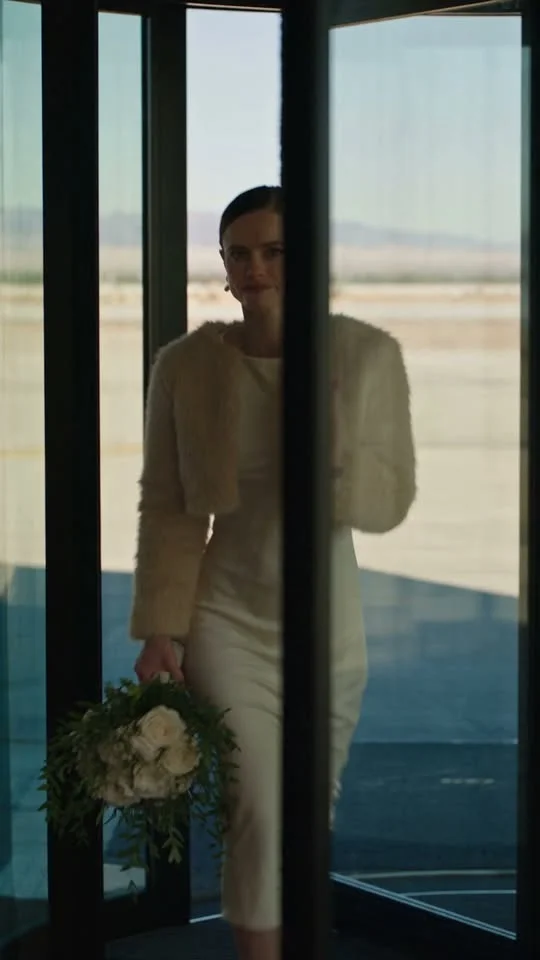
And I hung up the phone and started the car.
Chapter 7 – I Took the Microphone
Chapter 7 – I Took the Microphone
I walked into that ballroom still wearing my wedding dress, but I wasn’t a bride anymore.
I was the woman who was about to stop a crime.
The room was full.
A hundred and twenty people, all of them dressed up and turning to look at me as the doors swung open.
The justice of the peace was already standing at the front with his book open, and Dashiell was next to him in his wrinkled suit, smiling like he’d won something.
When he saw me, his smile flickered.
Just for a second.
Then he held out his hand.
“Nimue.
You came.”
I didn’t take his hand.
I walked right past him, up the two steps to the front, and took the microphone from the stand.
It squealed with feedback, and the room went quiet.
“Good afternoon,” I said.
“I’m Nimue.
The bride.
Or I was supposed to be.”
I looked out at all those faces.
My aunts.
Dashiell’s cousins.
My father’s business friends.
My mother, standing at the back with her hand over her mouth.
“There isn’t going to be a wedding today,” I said.
“And I’m not saying that because I got cold feet.
I’m saying it because the man standing next to me has been lying to all of us.”
Dashiell stepped toward me.
“Nimue, put the microphone down.
You’re upset.
Let’s talk about this privately.”
“No,” I said.
“We’re going to talk about it right here, because half the people in this room are involved whether they know it or not.”
I pulled the folded document out of my bouquet—the forged loan paper I’d taken a photo of that morning—and held it up.
“This is a loan application,” I said.
“It has my signature on it.
Except I never signed it.
Dashiell forged it, and he used our wedding as collateral to borrow money from a man named Gerald, who happens to be my father’s business partner.”
A murmur went through the room.
I kept going.
“This morning, ten thousand dollars disappeared from our joint wedding fund.
That money went into an envelope that Dashiell handed to Tova, our photographer, along with a story that the wedding was canceled.”
Dashiell’s mother stood up.
“That’s a lie!”
“Is it?”
I said.
“Then ask your son why he asked Tova to delete photos of him with another woman from three weeks ago.”
Dashiell’s face went white.
He started toward me again, but the ballroom doors opened behind him, and my father walked in with two police officers.
“That’s far enough, Dashiell,” my father said.
The officers moved past him.
One of them spoke quietly to Dashiell and took his arm.
Dashiell didn’t resist.
He just looked at me, and his eyes were cold in a way I’d never seen before.
As they led him past me, he leaned in close and said, “You think this was about you?
Ask your mother who introduced me to Gerald.”
Then they walked him out.
The room erupted.
People were standing, talking, crying.
The justice of the peace closed his book and slipped out a side door.
I set the microphone down on the table and walked toward the back of the room, where my mother was standing very still, her face pale.
She had heard him.
She looked at me, and her eyes were full of something I couldn’t name.
“Mom,” I said.
“What did he mean?”
Chapter 8 – The Answer I Didn’t Want
Posted Oct 19, 2026
Chapter 8 – The Answer I Didn’t Want
My mother didn’t answer right away.
She took my hand and led me out of the ballroom, down the hall, and into a small coatroom where the noise of the crowd faded to a muffled hum.
She closed the door and leaned against it.
“I didn’t know,” she said.
“You have to believe me, Nimue.
I didn’t know what he was doing.”
“What did you do?”
I asked.
She took a breath.
“About a year ago, your father’s business was struggling.
He didn’t want to tell you.
He didn’t want to worry you before the wedding.”
I felt my stomach drop.
“Gerald came to us with an offer.
He said he could help.
He said he knew investors.”
“And?”
“And I introduced him to Dashiell,” she said.
“Dashiell was so charming.
He said he had business experience.
I thought—I thought he could help us.”
She covered her face with her hands.
“I didn’t know he would forge your signature.
I didn’t know about the loan.
When I found out, I was so ashamed.
I couldn’t tell you.
I couldn’t tell your father.”
I stood there in my wedding dress, in a coatroom that smelled like cedar and dust, and I felt something shift inside me.
Not anger.
Not anymore.
Just a deep, tired sadness.
“Mom,” I said.
“You should have told me.”
“I know.”
“But I understand why you didn’t.”
She looked up at me, and her eyes were wet.
“I’m so sorry,” she whispered.
I hugged her.
The bouquet crushed between us, but I didn’t care.
“We’re going to fix this,” I said.
“Together.”
And we did.
That afternoon, my mother and I went to the police station and gave our statements.
She told them everything about Gerald and the introduction.
I gave them the photos from Tova’s memory card, the forged document, and the record of the unauthorized transfer.
The bank froze the loan.
The police arrested Gerald two days later.
Dashiell was charged with fraud, forgery, and theft.
Gerald was charged as an accomplice.
It took months, but the loan was reversed.
My father’s name was cleared.
He sold the business to a partner he trusted and retired early.
Tova called me a week after the wedding that wasn’t.
She apologized again, and I told her she had nothing to apologize for.
She had been lied to just like I was.
We started meeting for coffee.
Then for lunch.
Then for long walks on Sunday mornings.
She took a photograph of me on one of those walks—standing on a bridge, looking out at the water, no ring on my finger.
“You look different,” she said.
“I feel different,” I told her.
She smiled.
“Good different?”





