Chapter 9 – The Dinner He Didn’t Plan
Chapter 9 – The Dinner He Didn’t Plan
I sent the invitations three days after I opened that blue door.
I wrote each one by hand, on the good stationery I had bought for our anniversary and never used, because I wanted every person at that table to hold something of mine in their hands before they sat down in my dining room.
Elaine, Robert’s mother, got the first one and I delivered it myself.
“Seven o’clock,” I said.
“Dinner.
Just come.”
She looked at me for a long moment from her porch chair, and then she said, “You’ve never once asked me to dinner in seventeen years, Susan.”
“I know,” I said.
I mailed it on Tuesday.
I did not know whether she would come.
On Friday I cooked the same meal I had cooked for our anniversary, because I wanted him to walk into the smell of it and remember what he had ruined.
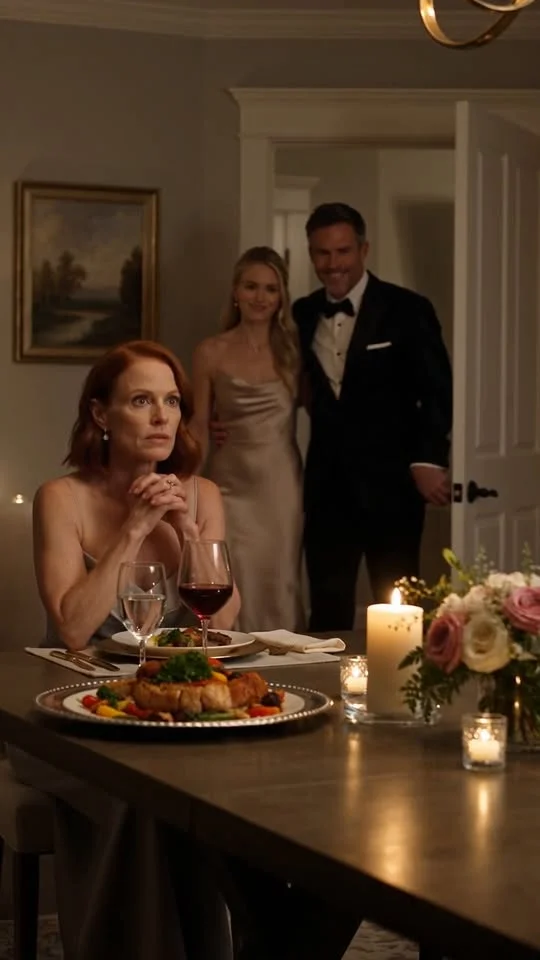
By six-forty everyone was seated except Robert.
He came in at seven-oh-five, holding his keys, wearing the navy jacket I had ironed for him two years ago, and stopped inside the doorway when he saw the table.
His mother on the left.
Teresa at the end.
Denise beside Amy, the two of them sitting like people who had already decided to be on the same side.
And a woman he did not introduce and did not need to, because I watched his face and I knew from the way his mouth closed that he recognized her.
“Susan,” he said.
“What is this.”
“Sit down,” I said.
“What is this.”
“Sit down, Robert.”
He sat, because his mother was watching him.
I put the folder on the table and opened it slowly and dealt everything out like cards.
The bank ledger, twelve pages, every transfer marked AMY – CONSULT.
The lease for the Cedar Street apartment.
The photographs.
The medical bills for a child I had never heard of, folded, stapled, dated.
And the statement showing the second signer on my own joint account.
Robert looked at the table and then looked at me, and something in him switched, because that was what he did, he switched.
“I don’t know what my wife has told you,” he said to the room, “but this is a misunderstanding, and I’m sorry you were dragged into it.”
“Don’t apologize for me,” I said.
“Then for what,” he said.
“You’ll see,” I said.
“I just need you to sit still for a minute.”
He tried to turn it on Teresa.
He said she had managed the accounts and must have made an error.
Teresa looked at him the way a person looks at weather they have stopped arguing with.
She said, “I kept the receipts, Robert.
All of them.”
He tried to turn it on Denise.
He said she had shown up at his office and made assumptions, and that she was the reason I had gone to the apartment in the first place.
Denise said, “You told me you were divorced.”
Chapter 10 – What I Kept
Chapter 10 – What I Kept
I filed for divorce on the last day of that month, and I filed with the ledger attached.
My lawyer was a woman named Paula Rennick, who had a small office on High Street and a skeptical expression she never fully put away.
When I spread the pages across her desk, s
“Mrs. Hayes,” she said, “how many of these women are willing to talk?”
“Three,” I said.
“Then we file a fraud claim with the divorce,” she said, “and we ask the court to freeze the account the day we file, and we do not give him a week to move the money.”
Denise testified as a witness, and so did Amy.
Robert’s lawyer tried to call them unreliable, and Paula asked Denise to describe, from the stand, the exact conversation in my dining room on the anniversary night.
Denise described it correctly, and carefully, and then Paula asked her, “When the defendant told you he was divorced, what was his tone?”
Denise said, “Bored.
Like it was a form he’d filled out before.”
The judge did not like Robert.
I could tell from the way he looked at him when Robert began to explain.
Robert tried to say the transfers were loans to a colleague.
He tried to say the apartment was a business expense.
He tried, once, to say I had been unstable since the death of my father, which made Paula stand up and say, “Your honor, my client’s medical history is not on trial.”
Robert kept his job for six weeks.
The clinic board had been shown the blank billing form and the audit letter.
He resigned in August, on a Friday, with a written statement that called the situation a personal matter and said nothing else.
The contract with the county, the one he had banked on for years, went to another practice.
His mother called me on a Sunday and asked if she could come by.
She sat in my kitchen and drank tea and did not touch the cookie I put on the plate.
“I raised him wrong,” she said.
“I made excuses for him his whole life.
I did the same thing you did, and I called it love.”
She said she was not going to speak to her son again until he made things right, and I knew she wouldn’t, because Elaine Hayes never gave a second chance twice.
She also sent me a check, which I did not cash for two months, and then I did, because it wasn’t a bribe, and she didn’t mean it as one.
I kept the house.
I had paid half of it from a job I did every day for seventeen years, and the judge agreed with Paula that the house was marital property, and that Robert’s hidden account would be divided by the court after all the evidence was entered.
The account was over forty-one thousand dollars.
I got half of it, and the portion that was traceable to my own deposits came back to me as a matter of record.
The apartment was sold in the spring.
I drove past it once and did not stop.
I took a part-time job at a bookkeeping office downtown.
Three days a week.
A small office with good light.
My boss is a woman named Charlotte who does not ask questions and hates waste.
I get paid every other Friday and I actually like the work.
Denise and Amy are the two people I see most.
We are an odd trio, and I know it, but we eat lunch together on Saturdays and we do not talk about Robert more than once a month, and when we do it is not a wound, it’s a chart.
Natalie moved back to Dayton with her son, and she sends me a card every year in December with a wallet-sized photograph, and I keep each one in the back of my address book.
The boy is five now.





