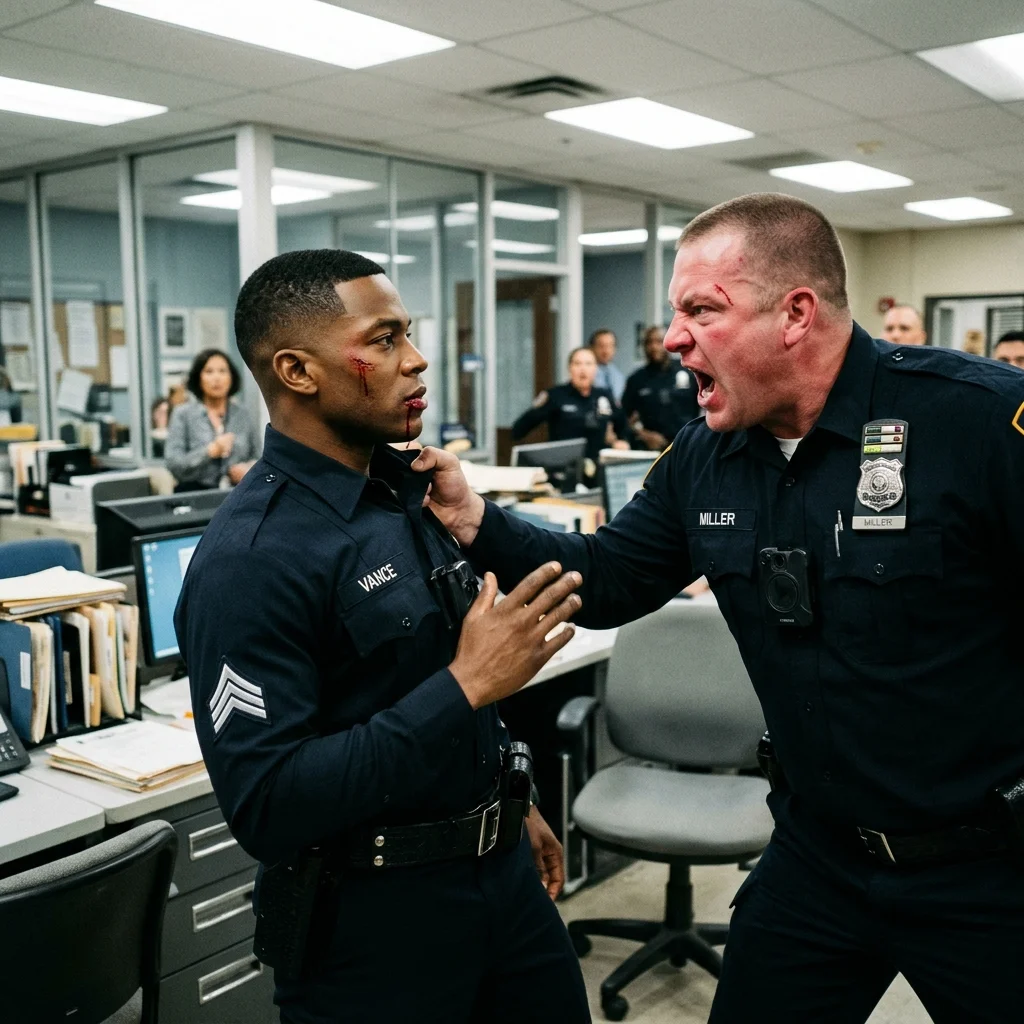
“She said he had attacked an officer and gone to prison because of his own choices.”
Isaiah watched her carefully.
“Do you believe that?”
“I used to.”
“And now?”
Maya looked toward the interview room where her father had been questioned.
“I don’t know anymore.”
She reached into her pocket and pulled out her phone.
“There is something you should see.”
It was a photograph of an old letter.
The handwriting was uneven, and the paper appeared to have been folded many times.
At the bottom was a name.
Darius Bell.
Isaiah read the final lines.
I didn’t leave because I stopped loving you.
I left because every time I tried to come home, someone told me you didn’t want to see me.
If you ever learn the truth, I hope you understand that I never stopped being your brother.
Isaiah looked up.
“Where did you get this?”
“My mother kept it in a box.”
“Did she tell you about it?”
“No.”
Maya’s eyes filled with tears.
“I found it after she died.”
Isaiah handed the phone back.
“Have you spoken to Darius?”
She shook her head.
“I don’t even know where he is.”
Isaiah paused.
Then he told her something she wasn’t prepared to hear.
“He’s alive.”
Maya looked at him sharply.
“What?”
“He’s living outside the county.”
“How do you know?”
“Because he contacted the independent review office three weeks ago.”
Maya covered her mouth.
For fourteen years, she had believed her brother had abandoned her.
Now she was learning that he had been trying to reach her all along.
But there was another question.
Why had her stepfather been so desperate to keep the old case buried?
And why had he attacked the one officer who was trying to uncover it?
Maya looked toward the station entrance.
Her father was standing there.
He was watching them.
Their eyes met.
He slowly shook his head.
It was not an expression of anger.
It was a warning.
And Maya suddenly understood that her family had been built around a lie.
Caleb Voss had never considered himself a villain.
That was the most dangerous thing about him.
He believed that authority gave him the right to decide which rules mattered.
He believed that respect should be automatic.
He believed that anyone who challenged him was disloyal.
And for fourteen years, the department had allowed him to believe that he was untouchable.
He had been twenty-nine when Darius Bell was brought into the station.
At the time, Voss had been ambitious, impatient, and eager to prove himself.
Darius had been frightened and confused.
The teenager had repeatedly asked for his mother.
Voss interpreted every question as defiance.
When Darius refused to accept an accusation he knew was false, the questioning escalated.
Samuel Reed had intervened.
He had told Voss to step away.
But the incident had already become something larger than an ordinary arrest.
The department’s lieutenant, Warren Pike, had arrived and ordered everyone to prepare a report.
By the end of the night, the official version was different from what had actually happened.
Samuel signed the final document.
Voss received no disciplinary action.
Darius was charged.
And the case disappeared into a filing cabinet.
But it had never disappeared from everyone’s memory.
Ruth Ellis, the station’s former dispatcher, had preserved the original recordings.
She had retired years earlier.
Before her death, she contacted Isaiah and explained that she could no longer live with what she had helped conceal.
She gave him a package containing the original dispatch archive.
She also included a letter from Samuel Reed.
It was an apology.
Not an excuse.
An apology.
Samuel had written that he had been threatened with professional destruction if he contradicted the final report.
He had also admitted that he had failed Darius.
The letter ended with a sentence Isaiah had read dozens of times.
If my son ever finds this, I hope he understands that loving me does not require him to protect my mistakes.
That sentence had changed Isaiah’s life.
Now he was sitting at his kitchen table, reading it again.
His daughter, Zoe, placed a glass of water beside him.
“Are you coming to my school event tomorrow?”
Isaiah looked up.
“Of course.”
“You said that last week.”
“And I meant it.”
She glanced at the documents spread across the table.
“Is this about work?”
“Yes.”
“Are you in trouble?”
He smiled faintly.
“Sometimes doing the right thing creates trouble.”
Zoe considered that.
“Then why do it?”
Isaiah looked at his daughter.
“Because sometimes somebody has to make sure the next person doesn’t suffer the same thing.”
She nodded.
Then she pointed toward the photograph of Samuel Reed.
“Would Grandpa have wanted you to do this?”
Isaiah was quiet for a moment.
“I think he would have been afraid.”
“That’s not what I asked.”
Isaiah looked at the photograph again.
“No,” he said.
“I think he would have wanted me to tell the truth.”
The following morning, Maya arrived at the station earlier than usual.
Her father was already in the parking lot.
He stood beside his SUV, drinking coffee.
“Morning, sweetheart.”
She stopped.
“Can we talk?”
“Of course.”
“About Darius.”
The smile disappeared from his face.
“What about him?”
“Why did you tell me he never tried to contact us?”
Voss placed his coffee on the roof of the vehicle.
“Because he was trouble.”
“He wrote to me.”
“Letters don’t mean anything.”
“He said he wanted to come home.”
“Your brother made his choices.”
Maya looked at him.
“Did he deserve what happened to him?”
Voss stared at her.
“Don’t start this.”
“Did he deserve it?”
“You’re a police officer now, Maya.”
“I know.”
“Then you should understand that people who interfere with investigations create problems.”
She felt her stomach tighten.
“That’s not an answer.”
Voss stepped closer.
“Listen to me carefully.”
His voice became lower.
“Isaiah Reed is manipulating you.”
“Why?”
“Because he wants to destroy this department.”
“Or because he knows something?”
Voss’s expression changed.





