I looked at the printed disciplinary notice.
It was lying beside my notebook, its description of unprovoked physical aggression highlighted in yellow.
For the first time, I wondered whether the problem wasn’t that the school lacked evidence.
Maybe the problem was that some people didn’t want to look at it.
The following Monday, Lena’s mother called mine.
They spoke for nearly an hour.
I didn’t hear most of the conversation, but afterward my mother told me that Lena had provided a written account of the confrontation.
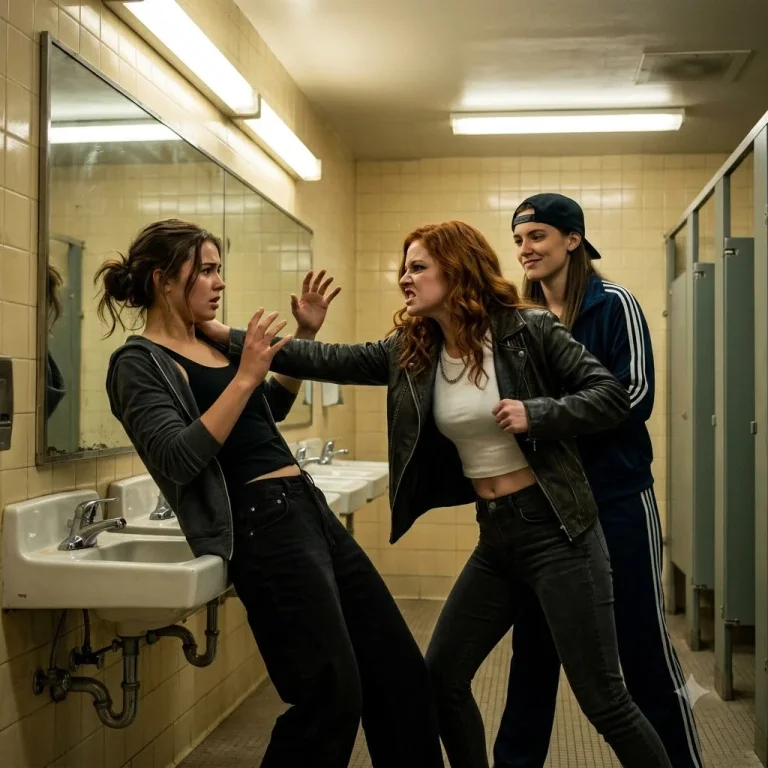
She had seen Trent approach my table, pull my earphones away, strike the back of my head, and shove me before I moved out of my jacket sleeve.
She had also described the final punch.
Her statement matched mine.
I sat down on the edge of the sofa.
“She really did it?”
My mother nodded.
“Her mother sent it to the district review office and copied the investigating officer.”
I stared at my hands.
For the first time since the incident, the truth existed somewhere outside my own account.
I thought of Lena in chemistry class, quietly drawing little shapes beside her notes.
We had barely spoken.
Yet she had chosen to do something that several people who knew Trent far better had refused to do.
“Can I thank her?”
“Yes.”
I typed a message.
Thank you for speaking up.
I read it several times before sending.
Her response came a minute later.
I should’ve done it sooner.
I looked at those words.
Then I answered.
You did it when it mattered.
She sent back a single message.
He shouldn’t have been allowed to do that.
I sat looking at the screen for a long time.
It was the first time anyone from the school had said those words to me.
The complete recording surfaced the next afternoon.
Not online.
Not in a group chat.
It reached Officer Ramirez through a student’s parent, who had contacted him after learning that the investigation remained open.
My mother received a brief telephone call confirming that additional video evidence was being reviewed.
The officer wouldn’t tell us everything it showed, but he said he wanted to speak with me again.
I knew immediately what the recording might contain.
When we arrived at the station, he met us in a small interview room and asked me to describe the confrontation once more without watching the video first.
I did.
This time, the words felt less difficult.
I knew the sequence by heart.
When I finished, he placed a tablet on the table.
“I want you to watch this and tell me whether it accurately shows what you remember.”
My mother took my hand beneath the table.
The screen showed the cafeteria from the angle of Trent’s teammates.
I recognized the aluminum table, the plastic lunch tray, and the edge of my oversized jacket.
Then Trent entered the frame.
His boot struck the bench.
The recording continued.
He leaned over me.
His hand reached for my earphones.
He pulled them free.
I watched myself remain seated.
Then his hand struck the back of my head.
My mother inhaled sharply beside me.
The camera shifted as the student holding it reacted, but it remained focused closely enough to show Trent laughing and gesturing toward his friends.
I stood.
He shoved me.
I moved backward.
And then the camera captured the moment I hadn’t stopped seeing in my dreams.
Trent drew his arm back.
His fist came forward.
The canvas sleeve caught it.
His body rotated over my hip.
The tables collapsed beneath him.
The video shook as the students reacted.
It ended before the security guards reached us.
I sat motionless.
There it was.
Every moment.
Every warning.
Every decision.
My mother pressed her fingers against her lips.
Officer Ramirez stopped the recording.
“Is that consistent with your account?”
“Yes,” I whispered.
He looked at my mother.
“We still need to complete the investigation, including the extent of any injuries and other relevant information.
But this is significant evidence about how the confrontation began.”
I nodded.
He continued.
“Based on what I’ve reviewed so far, I’m not recommending the assault charge the principal requested.”
My mother closed her eyes.
I felt something inside my chest loosen.
It wasn’t complete relief.
The school still controlled my suspension, my records, and whether I could return to class.
But the terrible possibility that a false accusation would become a criminal case no longer seemed inevitable.
As we left, Officer Ramirez walked with us toward the front desk.
“One more thing,” he said.
We turned.
“Keep your original notes and photographs.
Don’t delete anything.”
My mother nodded.
“Of course.”
He looked at me.
“You did the right thing by giving a consistent account and letting the evidence speak.”
I wanted to ask whether doing the right thing would be enough.
Instead, I thanked him.
The next school district conference was supposed to be routine.
It was not.
Two days after the video reached police, my mother received an email stating that the district had obtained additional relevant footage.
A new review meeting was scheduled, this time with a student-services administrator present.
Mr.
Davis would attend.
So would the assistant principal.
My mother printed the email and placed it beside the original disciplinary notice.
I stood at the kitchen counter, looking at the two documents.
“Do you think they’ll finally admit it?”
She considered the question.
“I hope they’ll correct the record.”
“That’s not what I asked.”
She looked at me.
“No.”
I waited.
She folded the pages carefully.
“I don’t know whether they’ll admit they were wrong.”
I appreciated the answer more than reassurance would have helped.
By then, I had learned that being able to prove something and persuading someone to acknowledge it were not always the same task.
That evening, I asked whether I could go for a walk.
My mother agreed, provided I stayed close to home.