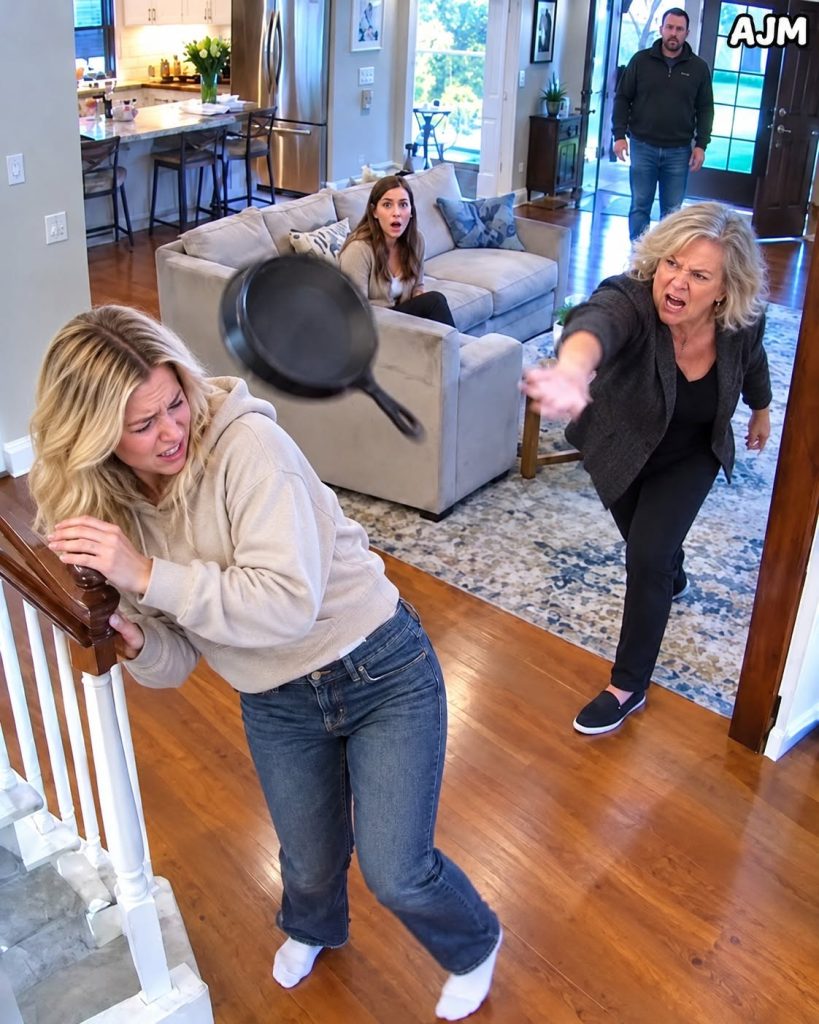
“You didn’t ask about Emily,” Leo noted, his voice flat. “Not once. You’ve been sitting on that stool for two minutes, and you haven’t asked if the woman you tried to decapitate is alive, if her stitches held, or how she is coping with the loss of our child.”
Agnes’s eyes shifted nervously. “Leo… she’s an outsider! She’s just a girl you met in college! Wives come and go, but mother and sister are blood! She provoked me, Leo! She came into my house with that smug look on her face, telling me she was leaving you—”
“It was her house,” Leo interrupted. “Her name is on the deed alongside mine. You were a guest. A guest who paid zero rent, consumed thousands of dollars of our resources every month, and repaid our hospitality by stealing her identity and leaving her to bleed out on the kitchen floor.”
“I didn’t know she was bleeding out!” Agnes shrieked, banging her shackled fists against the metal counter. “She was exaggerating! She’s always whining! If she had just obeyed me and cooked like a proper daughter-in-law, none of this would have happened!”
Leo looked through the glass at the woman who had birthed him. There was no rage left in his eyes—only an immense, hollow pity.
“You truly are incapable of remorse, aren’t you?” he said softly. “You don’t regret throwing the skillet. You only regret that you missed, and that I was standing behind you when you did it.”
“Leo, please—”
“I came here today to tell you what is going to happen next, Mother,” Leo continued, ignoring her plea completely. “The district attorney offered a plea deal this morning: eight years in state prison for you, and three years of mandatory community corrections and restitution for Chloe. I instructed our family attorneys to inform the prosecutor that we will not support any reduction in sentencing.”
Agnes’s face turned an unnatural shade of white. “Eight… eight years?! I’m sixty-three! That’s a death sentence! You’re putting your own mother in a cage?!”
“You put yourself in that cage when you raised that iron pan,” Leo said. “Furthermore, I have initiated a civil lawsuit against Chloe to recover the sixty-two thousand dollars she stole through forged credit cards and unauthorized bank withdrawals. The suburban house is being listed for sale tomorrow. Every piece of furniture, every piece of jewelry I bought you over the past ten years that was purchased with funds from my accounts will be liquidated to pay for Emily’s medical bills, psychological trauma therapy, and our legal fees.”
“You can’t do that!” Agnes screamed, her voice cracking as she pressed her face against the glass, flecks of spit hitting the pane. “That’s my home! You bought that furniture for me! I am your mother!”
“When you enter that courtroom next month,” Leo said, leaning in slightly, his eyes burning with an absolute, irrevocable finality, “do not look at me from the defense table. I will not be sitting behind you. I will be sitting on the victim’s side, holding my wife’s hand. You have no son, Agnes. And Chloe has no brother. From this day forward, you are simply two felons who crossed the wrong family.”
Leo hung up the receiver.
Agnes screamed, slamming the phone against the glass partition, but the sound was completely deadened by the heavy acrylic pane. The guard stepped forward, twisting Agnes’s arm behind her back to force her away from the partition as she wailed, her eyes wide with the realization that the empire of entitlement she had built upon her son’s guilt had crumbled into ashes.
Leo turned his back on her and walked out into the crisp, clean afternoon air without looking back once.
***
When Leo returned to the coastal villa that evening, the sun was sinking beneath the Pacific horizon, painting the sky in breathtaking strokes of violet, amber, and rose gold.
I was sitting on the wooden deck overlooking the ocean, wrapped in a thick cashmere throw, watching the tide roll in. The physical pain in my abdomen had dulled to a faint, manageable ache, but more importantly, the suffocating weight that had rested on my chest for six years had completely vanished.
I heard his footsteps behind me. He didn’t say anything; he simply sat down on the cedar bench beside me and slipped his warm hand into mine, intertwining our fingers.
“It’s done,” he said quietly.
I looked at him. The heavy burden that had hollowed his cheeks for days seemed to have lifted. He looked younger, lighter, as though a curse had finally been broken.
“Are you okay?” I asked softly.
Leo looked out at the vast, endless ocean, then turned to look at me. He brought my hand to his lips, kissing the knuckles with infinite tenderness.
“For the first time in my life, Emily, I am truly okay,” he whispered. “Because I know who I am protecting now. We’re going to sell the old house. We’re going to start over somewhere new—somewhere where no one knows their names. Just you and me.”
A faint smile touched my lips. A sense of genuine hope, fragile yet undeniably real, bloomed within my chest. The justice system was grinding forward; Agnes and Chloe would face the consequences of their cruelty, and the poisonous cycle of our domestic prison had finally been shattered.
Yet, as the twilight deepened into velvet night, Leo’s phone vibrated on the wooden table between us.
It was an alert from his corporate legal department. A certified courier had just delivered an urgent packet to Leo’s office from a prestigious law firm in Chicago—a firm that had represented Leo’s late father twenty years ago.
Attached was a scanned cover letter from a senior partner:





