He nodded slowly.
“Fair enough.”

Then he placed his hand on my shoulder.
“Just remember, son, being peaceful doesn’t mean you have to let people walk over you.”
I looked at him.
“I know.”
He squeezed my shoulder once.
“Good.
That’s all I wanted to say.”
I carried those words with me as I walked back toward the house.
My parents knew I had been having trouble with a few boys at school.
I hadn’t told them everything, mostly because I didn’t want to make them worry over things I believed I could handle myself.
They worked hard enough already, and I hated the thought of adding another burden to their days.
My father spent long hours keeping our ranch running.
My mother worked part-time at a store in town and somehow still found the energy to help with the animals, cook our meals, and keep our home feeling like a place where people could rest.
I knew neither of them would have considered my problems a burden.
Still, knowing that and feeling it were two different things.
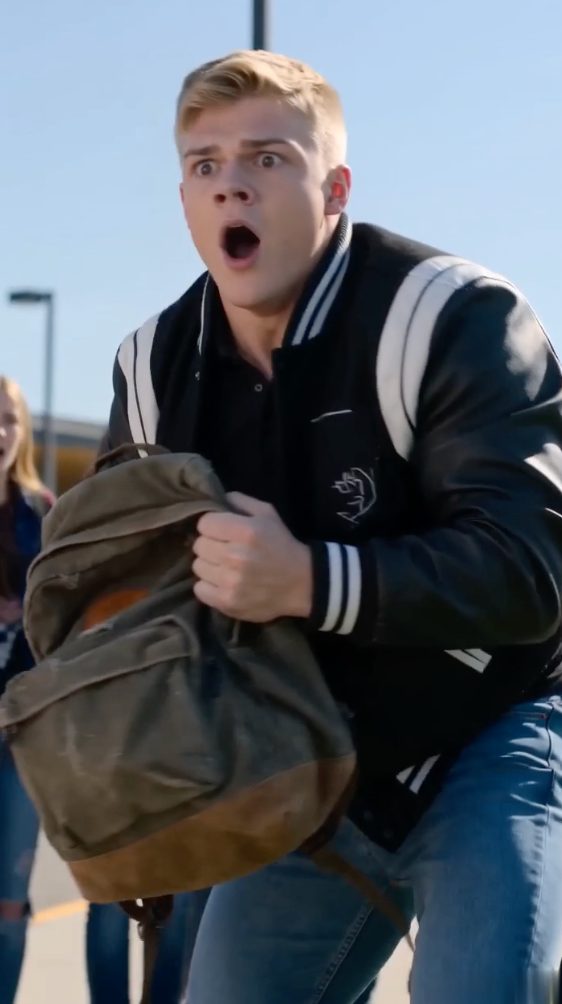
When I returned inside, my mother was standing beside the kitchen table with my backpack in her hands.
She had noticed a loose thread near one of the patches.
“Come here a moment,” she said.
I stepped closer.
She held the bag up and examined the stitching.
“This corner is starting to come loose again.”
“It’s fine.”
“It won’t be fine forever.”
“I can fix it later.”
She smiled.
“That’s what you said the last time.”
I reached for the backpack, but she kept it for another second.
“You know we could get you a new one.”
“I like this one.”
“I know you do.”
Her expression softened, and she brushed a hand across the repaired fabric.
“Some things are worth keeping, even when they’re a little worn.”
There was something in her voice that made me look at her more carefully.
She knew what the bag meant to me, even though we rarely talked about it.
She had been the one who sat beside me late at night before my biggest judo competition, helping me pack my uniform and reminding me to take enough water.
She had been the one who repaired the strap after I returned home, when I was too tired and disappointed to care about anything except sleeping.
And she had been there when I finally understood that coming second in the country didn’t mean I had failed.
I glanced at the hidden flap.
My mother noticed.
“You still keep it in there?”
I nodded.
“Yeah.”
She smiled.
“Good.”
Then she handed the backpack back to me.
“You don’t have to show people what you’ve earned for it to mean something.”
I wanted to tell her how much I needed to hear that.
Instead, I simply said, “Thanks, Mom.”
She reached up and straightened the collar of my sweatshirt.
“Have a good day, sweetheart.”
“I’ll try.”
At the time, those two words seemed ordinary.
By the end of the afternoon, they would feel almost painfully important.

The drive into town took us past open fields, scattered ranch houses, and the narrow creek that curved beside the county road.
My father dropped me near the school before continuing toward a supply store, and I watched his old pickup disappear between a row of cottonwood trees.
Our high school sat near the edge of town, where the last few streets gave way to wide stretches of open land.
It was a modern brick building with long windows, a football field, a gymnasium, and a paved parking lot that filled with trucks and cars every morning.
The school wasn’t large, but it had enough students that people naturally divided themselves into groups.
Some belonged to sports teams.
Others spent their afternoons working on family ranches or helping at local businesses.
A few students seemed to know everybody, while others moved quietly through the halls without attracting much attention.
I had always belonged to the second kind.
I didn’t hate people, and I wasn’t afraid of talking to them.
I simply preferred listening to speaking, and I had never understood why some students treated being loud as proof of being strong.
At home, I had learned that a person could work hard, help others, and earn respect without raising their voice.
At judo practice, I had learned almost the same lesson.
Strength wasn’t about making someone else feel small.
It was about knowing what you could do and choosing carefully when to do it.
That idea had shaped more of my life than most people realized.
I had started judo when I was eight years old.
At first, my parents had taken me to a small training center because I was shy and had trouble speaking up around other children.
They hoped I might make friends, become more confident, and learn something that would help me feel comfortable in my own body.
I still remembered my first class.
The room had smelled of clean mats and old wooden floors.
I had stood near the entrance wearing a white uniform that was slightly too large, afraid that everyone would notice how little I knew.
My instructor, Coach Bennett, had walked over and knelt so we were looking at each other.
“What’s your name, young man?”
I had told him.
He smiled.
“Well, you’ve already done the hardest part.”
I looked at him in confusion.
“What’s that?”
“Walking through the door.”
I never forgot those words.
Over the years, I learned how to fall safely, how to keep my balance, and how to use another person’s movement without meeting force with more force.
I learned that losing a match didn’t make me weak and that winning didn’t give me the right to look down on anybody.
Coach Bennett was strict about those things.
He cared about technique, discipline, and effort, but he cared even more about the kind of people his students became.





