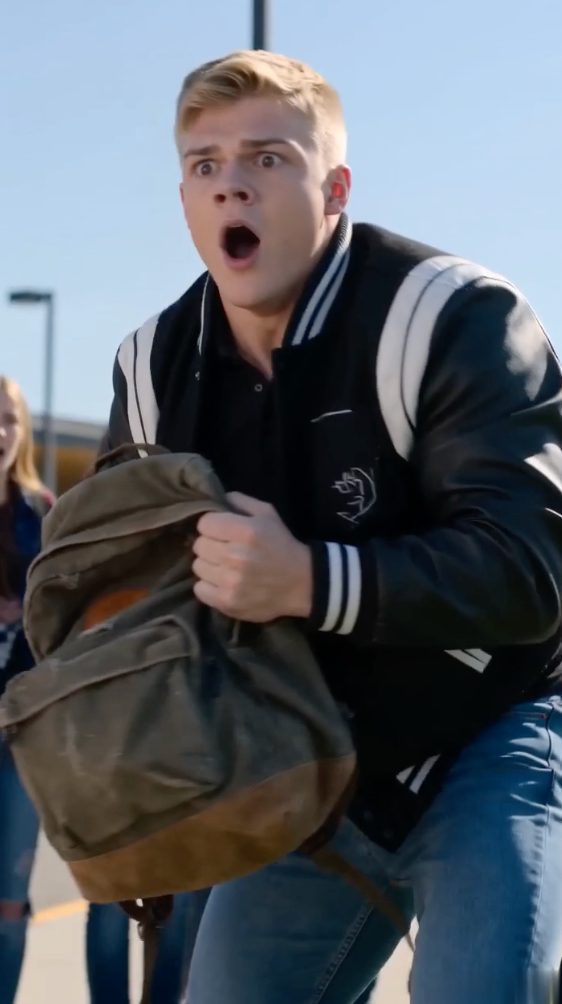
Other times he moved into my path or tried to make me answer questions in front of his friends.
He seemed especially frustrated by the fact that I rarely gave him the reaction he wanted.

I had tried ignoring him.
I had tried being polite.
Once, I had even asked him privately why he kept bothering me.
He had only shrugged.
“You’re too serious.
Learn to take a joke.”
After that, I stopped asking.
I didn’t tell my parents every detail because I kept hoping the situation would pass.
I didn’t want teachers turning an uncomfortable problem into something that followed me through every class.
More than anything, I didn’t want to become known for fighting.
I had spent years learning how to control my strength, and I refused to let Mason decide how I used it.
Still, there were mornings when I wished I could simply walk into school without wondering whether he would be waiting.
That Thursday was one of those mornings.
In my first class, I sat near the window and tried to focus on the lesson.
The teacher was discussing an assignment, but my attention drifted toward the hills beyond the football field.
From that window, I could see the distant line of mountains.
They looked peaceful under the morning sky.
I thought about our ranch, the horses moving slowly near the fence, and my father working outside with the same patient care he brought to everything.
I wondered whether the wind had started to rise.
Then my teacher called my name.
“Would you read the next paragraph for us?”
I straightened in my seat.
“Sure.”
I read the passage aloud, careful not to rush.
My voice was steady, and when I finished, the teacher thanked me before continuing the lesson.
It was such a small moment that nobody else probably remembered it.
But I did.
At school, I was often described as quiet, shy, or serious.
Sometimes I wondered whether people had confused those things with being afraid.
Reading a paragraph in class wasn’t an act of courage, but it reminded me that I could speak when I needed to.
I just didn’t believe every moment required my voice.
During the next class, I caught myself touching the strap of my backpack.
The stitching felt rough beneath my fingers.
I remembered my mother sitting beside the kitchen window on a winter evening, carefully repairing that same strap while I watched.
She had asked how my training was going.
I had shrugged.
“Fine.”
She had smiled without looking up.
“That’s a very short answer for something you spend so much time doing.”
I remembered laughing.
Then I had admitted that I was worried about the upcoming national competition.
“What if I don’t do well?”
She had pulled the needle through the fabric before answering.
“Then you’ll come home, eat dinner with us, and try again.”
“What if I embarrass myself?”
She looked at me.
“You couldn’t embarrass me by trying your best.”
I had carried that sentence into every difficult match since.
It seemed strange that a few simple words could stay with a person longer than hundreds of other conversations.
But some words found a place inside you.
They remained there, waiting for the moment you needed them most.

At lunchtime, the cafeteria was crowded and noisy.
I bought my meal and found a seat near the windows, where I could watch students crossing the courtyard outside.
I wasn’t completely alone at school.
I knew people from classes, greeted other students in the hallway, and sometimes talked with boys who worked on neighboring ranches.
But I didn’t have a large group of close friends who always sat together or waited for each other between lessons.
That didn’t usually bother me.
I had grown up enjoying quiet places.
Still, there was a difference between choosing to be alone and feeling that nobody would notice if you disappeared from a room.
Some afternoons, that difference felt larger than I wanted to admit.
I took a bite of my sandwich and watched two students laughing over something on a phone.
Across the cafeteria, a group from the basketball team crowded around a table, their voices carrying over the other conversations.
Mason was sitting with them.
Dylan was nearby, turning his phone sideways while another student spoke.
I looked away.
It wasn’t fear that made me avoid looking at Mason.
I simply didn’t want to spend my lunch wondering what he might do next.
I wanted twenty ordinary minutes to eat, think about my homework, and enjoy the sunlight coming through the windows.
But when I stood to return my tray, I heard Mason’s voice.
“Hey, backpack boy.”
I kept walking.
“Hey, I’m talking to you.”
I stopped and looked toward him.
“What?”
He leaned back in his chair.
“Where’d you get that thing?
Some old storage shed?”
A few boys laughed.
I glanced at my backpack.
“Had it a while.”
“Yeah, we can tell.”
I said nothing.
Mason pointed toward the strap.
“Looks like somebody stitched it together in the dark.”
For a moment, I felt something tighten in my chest.
He was talking about a bag.
That was all he knew.
He couldn’t know how many hours my mother had spent repairing it, or how carefully she had matched the thread to the worn fabric.
He couldn’t know that she’d fixed it after a long day of work because she understood I wanted to keep it.
To him, the stitches were something funny.
To me, they were a reminder that somebody had cared enough to mend what was damaged.
I looked at him calmly.
“My mom fixed it.”
His smile hesitated for half a second.
Then he shrugged.
“Whatever.”
I turned away.
I didn’t feel victorious or especially proud of myself.
I simply felt tired.
When I reached the hallway, I stopped beside a window and took a slow breath.





