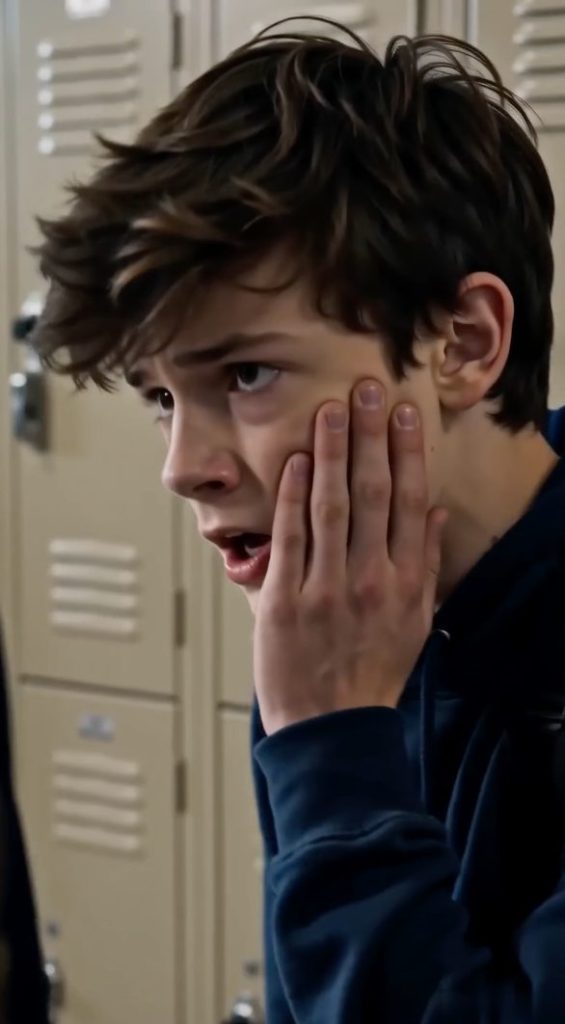
He had gathered information for a newspaper article, and he could explain that work honestly.
When they reached the reception area, the secretary looked up from her computer.
Ethan recognized her from earlier visits when he had requested routine information or delivered copies of the school newspaper.
She usually greeted students with a smile and asked whether they needed directions, a form, or an appointment.
Today, she glanced toward Vance before looking back at her screen.
“The principal?” she asked quietly.
“The meeting will be handled here,” Vance replied.
He led Ethan into the office.
The room was tidy and cool, with a large desk, several chairs, and neatly arranged folders.
Ethan noticed how little personal decoration there was, as though every object had been selected to give the room an appearance of order.
Vance closed the door and walked behind the desk, leaving Ethan standing until he pointed toward the chair opposite him.
“Sit down.”
Ethan sat with the backpack beside his feet.
He kept his hands on his knees and tried to control his breathing.
He reminded himself that he had checked his sources and that his records came from legitimate interviews and public documents.
Still, the room felt different from a conversation between a reporter and someone asked to comment on an article.
Vance had not invited him to ask questions.
He had removed him from class.
The dean opened a folder but did not immediately look inside it.
He studied Ethan across the desk, his expression almost patient.
The silence stretched long enough that Ethan felt an urge to begin explaining himself simply to make it end.
He resisted.
If Vance had questions about his reporting, Ethan wanted to know what they were before offering answers that could be misunderstood.
“I understand you’ve been interviewing students about disciplinary matters,” Vance said.
“Yes, sir.
I’m preparing an article about an incident behind the gym.”
“You’re also looking into administrative records.”
“I’ve been reviewing some publicly available budget reports.”
Vance leaned back.
“And what exactly do you think you’ve discovered?”
Ethan considered the question carefully.
“I haven’t reached a conclusion about the budget.
There are changes I don’t understand, and I asked for clarification.
The article about the student is based on interviews and witness accounts.”
“Do you understand that these matters are complicated?”
“Yes.
That’s why I asked questions.”
Vance’s mouth tightened slightly.
“You have access to fragments of information.
You’re sixteen years old, Ethan.
There’s a considerable difference between reading a document and understanding how an institution works.”
Ethan recognized the familiar argument, delivered now with more force.
He had never claimed to understand every administrative procedure, and he would have welcomed a clear explanation of anything he had misunderstood.
But Vance was not providing one.
He was suggesting that Ethan’s age made the questions themselves inappropriate.
“If something in the article is inaccurate, I want to correct it,” Ethan said.
“You can tell me what the records mean.”
“That isn’t the point.”
“Then what is?”
Vance closed the folder.
“The point is that you’re collecting statements about other students and combining them with administrative documents in a way that could create serious misunderstandings.”
“I’m keeping the issues separate until I can verify more.”
“That may be what you tell yourself.”
Ethan felt heat rise into his face.
He had worked hard to avoid doing exactly what Vance accused him of doing.
The temptation to defend every interview and every note was powerful, but he realized that a long explanation might only give Vance more opportunities to redirect the conversation.
He steadied his voice and returned to the question that had brought him there.
“Can you explain what happened to the reports about Tyler?”
Vance’s expression changed.
The patient look disappeared, replaced by something colder and more controlled.
For a moment, he stared at Ethan as though the boy had violated an unspoken rule.
Then he placed both hands on the desk.
“I’m not discussing another student’s confidential discipline with you.”
“I understand that.
I’m asking why witnesses say their statements weren’t considered.”
“You are not in a position to judge that.”
“Then can you explain the process without giving me anyone’s private information?”
Vance did not answer.
Instead, he looked down at Ethan’s backpack.
The movement was brief, but Ethan followed his gaze and felt a sharp increase in his uneasiness.
The notebook containing his original interviews was inside, together with the printed budget pages he had spent the previous evening checking.
He had brought them because he intended to work on the article after class.
“Give me the original notes,” Vance said.
Ethan stared at him.
“Why?”
“Because I need to see exactly what you’ve collected.”
“I can explain my reporting.
I can show you the public documents.
But those notes contain information people trusted me with.”
“Give them to me.”
“No.”
The answer emerged before Ethan could make it sound more diplomatic.
He had imagined difficult interviews, angry objections, and requests for corrections, but not an administrator demanding possession of the original records.
He knew he was a student subject to school rules, and the thought of defying someone with authority over his education frightened him.
Yet handing over those notebooks would expose people who had spoken to him because he promised to handle their words responsibly.
Vance held his gaze.
“You’re sixteen.”
“I know.”
“You are not an investigator.”
“I’m a student journalist.”
The dean leaned across the desk.
“You are a student who can be suspended.”
Ethan’s fingers tightened around the edge of his chair.
His first thought was of the work he might miss, the questions his teachers would ask, and the fear on his grandfather’s face if he received a call saying Ethan had been removed from school.
He had never wanted trouble.
He wanted to finish his classes, keep working on the newspaper, and eventually study writing or journalism somewhere he could learn from people who took the craft seriously.
“I haven’t published anything inaccurate,” he said.





