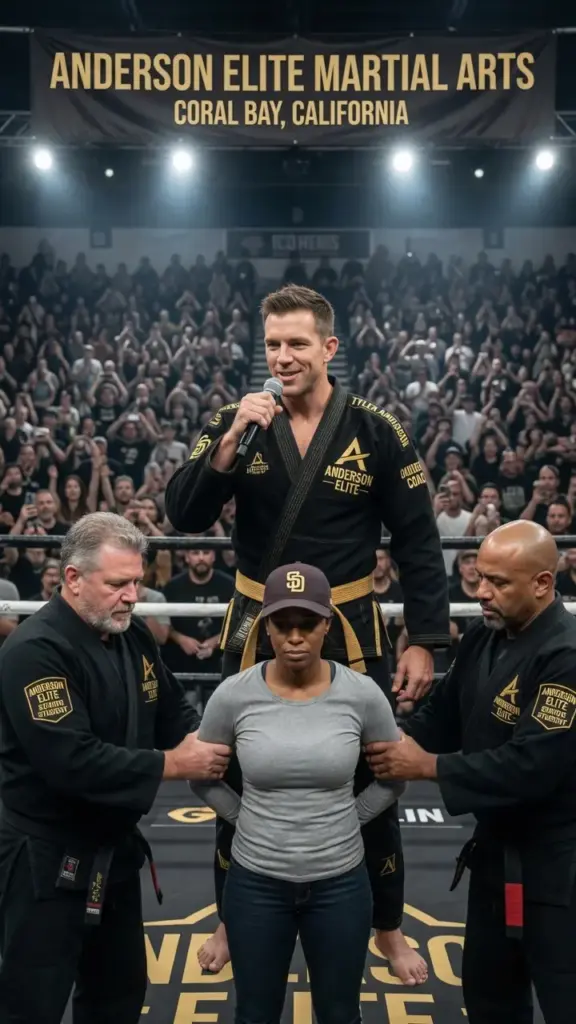
Whitney was offered one final chance to speak. Diana looked at her. Whitney nodded once.
She stood up. She walked to the witness stand. She did not sit down.
She looked directly at Tyler. Her voice was steady.
“I learned to fight so I would never have to. You made me have to.”
Twenty-one words.
She sat back down.
Behind her, Colonel Whitaker stood up, then Brooks, then Lisa Brennan, then every veteran in the room.
Judge Mendes took thirty seconds.
Then she ruled.
“The plaintiff’s case is dismissed with prejudice. All claims denied. I am referring Mr. Anderson’s perjury and his fabricated video evidence to the district attorney’s office for criminal prosecution.”
The fall came fast.
Within forty-eight hours of Judge Mendes’s ruling, Tyler Anderson’s world began to collapse from every direction at once. His insurance carrier dropped Anderson Elite Martial Arts. His landlord terminated the lease for cause. Three sponsors pulled their logos off his dojo walls. The crisis PR firm that had cost him forty thousand dollars stopped returning his calls.
Two weeks later, the district attorney filed criminal charges. Perjury, fabrication of evidence, assault, and false imprisonment from the original incident, civil rights violations under California Penal Code section 422.6.
The case made the front page of every newspaper in the region.
The trial lasted four days. Twelve witnesses testified against him. The jury deliberated for less than two hours.
Tyler Anderson was sentenced to twenty-four months in state prison. He was ordered to pay one hundred thousand dollars in restitution to Whitney Williams. He was permanently barred from owning or operating any martial arts business in the state of California.
His two students, the ones who had dragged Whitney up the aisle, they were charged with assault and unlawful restraint. Each was sentenced to six months in county jail. Both lost their black belts in formal proceedings before the regional Brazilian Jiu-Jitsu Federation.
Anderson Elite Martial Arts closed its doors on a Tuesday in early December. The sign came down on Wednesday. By Friday, the building was empty.
Whitney did not attend the sentencing. She had something more important to do.
She had opened a class. She called it Sleeves Up.
The first session was held in the back room of the Coral Bay Community Center. A converted basketball court, folding chairs, donated mats, hand sanitizer, and plastic pumps. Fifty people signed up in the first week. By the second month, the list had grown to two hundred twelve.
Most of them were women. Many of them carried scars under their own long sleeves. Scars from husbands, scars from strangers, scars from things they had never told anyone about before.
Lisa Brennan came down from Sacramento every Saturday to assist. Gunnery Sergeant Brooks drove in from Bakersfield twice a month. Colonel Whitaker showed up to the very first class in his Marines windbreaker. He carried a folding chair under one arm. He sat in the back. He never said a word. He just watched.
Whitney did not teach punches first. She did not teach kicks first. She taught breath. She taught how to stand. She taught the word no. She taught her students how to say it out loud. Calm, steady, without apology. The way she had said it in the ring six months earlier.
On opening day, when her first student, a seventy-year-old grandmother named Ruth who had survived three decades of abuse from a man now dead, finally said the word no without trembling, Whitney smiled at Ruth. It was the first time anyone had seen her smile in the entire story, two full seconds long. Then it was gone again.
But Ruth saw it and Ruth told everyone.
By spring, the Coral Bay City Council passed an ordinance. They called it the Williams Law. It required written consent from any audience member before commercial martial arts demonstrations could involve them physically. The law passed unanimously. Within a year, five other California cities had adopted similar versions.
The hashtag was the last thing to spread. It started inside the veterans community. Then it moved into the women’s self-defense community. Then it crossed over into everything. #JusticeForWilliams #TooWeakForCombat.
By the six-month mark, the original news footage had been viewed forty million times across every major platform. The phrase that Tyler Anderson had used as a weapon, too weak for combat, now belonged to every woman, every veteran, every survivor who had ever been underestimated, dismissed, dragged onto somebody else’s stage against her will.
Whitney never gave a single interview about any of it. She declined every offer, talk shows, documentaries, book deals.
The only public statement she made was a single line on a small handwritten sign she put up on the wall of the Sleeves Up classroom.
The sign read, “I learned to fight so I would never have to. Now I teach so you never have to either.”
She wore short sleeves to class that day. Standing at the front facing fifty students, the crescent scar caught the morning light, and not a single woman in that room looked away from it.
One year after the events at Anderson Elite Martial Arts, Whitney Williams was back at the Veterans Outreach Center. The board that had suspended her had been replaced. The new director personally drove to her apartment to deliver the apology letter.
Whitney accepted the job back on one condition. She would work four days a week. Friday was for Sleeves Up.
By that summer, Sleeves Up had three locations across Coral Bay County. All of them ran on donated mats and volunteer instructors. None of them charged a single dollar in tuition.
Whitney refused to accept any payment for teaching. She told the press exactly once in a written statement. “You cannot put a price on the word no, so I do not.”
Colonel Frank Whitaker passed away peacefully in his sleep in March of the following year. He was seventy.





